Photos by Alec Burke
She emerged from a city by the sea, not an exhausted old place beleaguered by rot and blight, but a metropolis just realizing its maturity. A place where energy, enthusiasm, and possibilities were abundant. A place where chilly waters reached inland from the North Pacific, washing against gravel shorelines where thousand-year-old giant arbors seemed like living pillars holding up the sky. It was exactly the right place and exactly the right time.
It was 1928 in Seattle. Calvin Coolidge was President of the United States. Charles Lindbergh received the Congressional Medal of Honor for flying solo across the Atlantic. They laid her keel at Lake Union Shipyard, framed with Douglas fir and planked with yellow cedar milled from ancient, close-grained monster logs. Trees so huge that one single section filled the entire cradle of a logging truck.
Although she was newly built, she preserved and exemplified venerable maritime traditions. Her master shipwrights were born in the latter portion of the 1800s, and it was their knowledge, experience, tools, and techniques handed down to them when they were apprentices, that made manifest the traditional lines and loftings of a proper little ship.
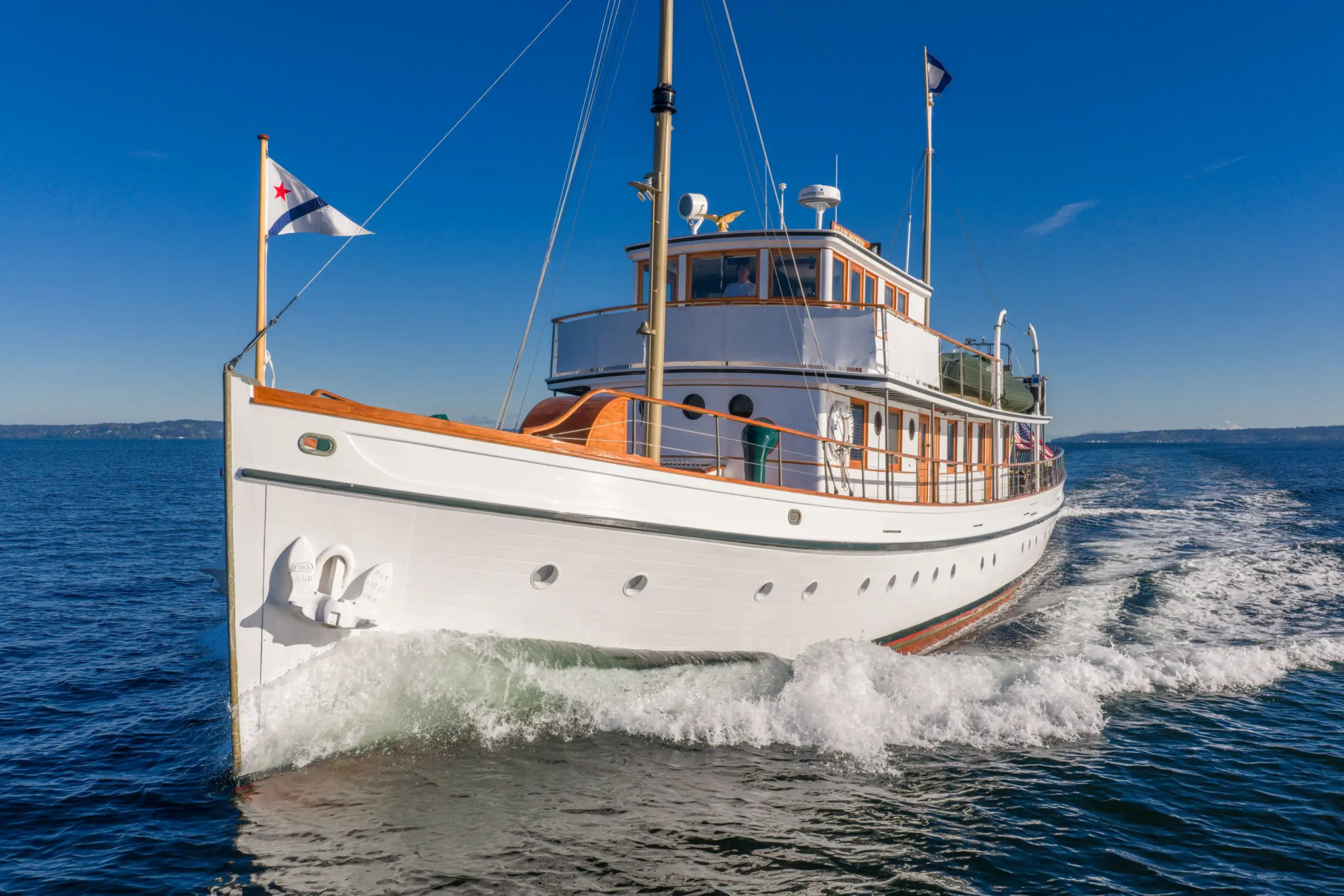
She came down the ways as Blue Peter, named after the semaphore flag for the letter “P.” Vessels on the verge of departure from port would hoist the blue flag to indicate it was time for all passengers to be aboard and everyone else to settle their business with the ship.
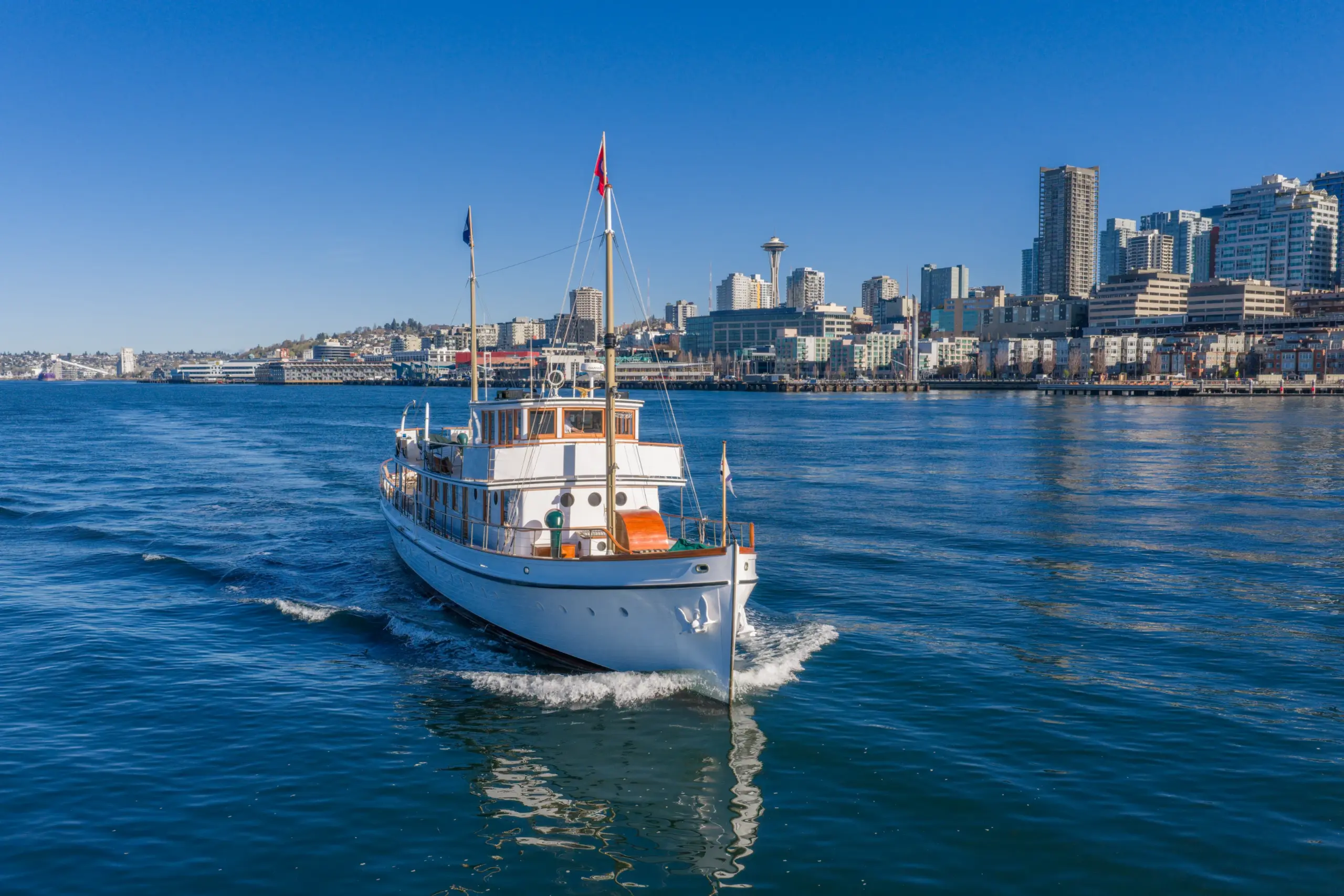
Of fantail design, Blue Peter features a plumb bow, adequate flare, generous freeboard, and a long, graceful sheer. A series of portlights immediately below the strake carries the eye aft, where the fantail stern is ready to mitigate following seas. She is painted gleaming white, with teak accents.
A confidently styled main cabin, long and rectangular, sits in perfect proportion on the deck. Precisely spaced and fitted rectangular windows and teak cabin doors emphasize the sense of disciplined order inherent in her design.
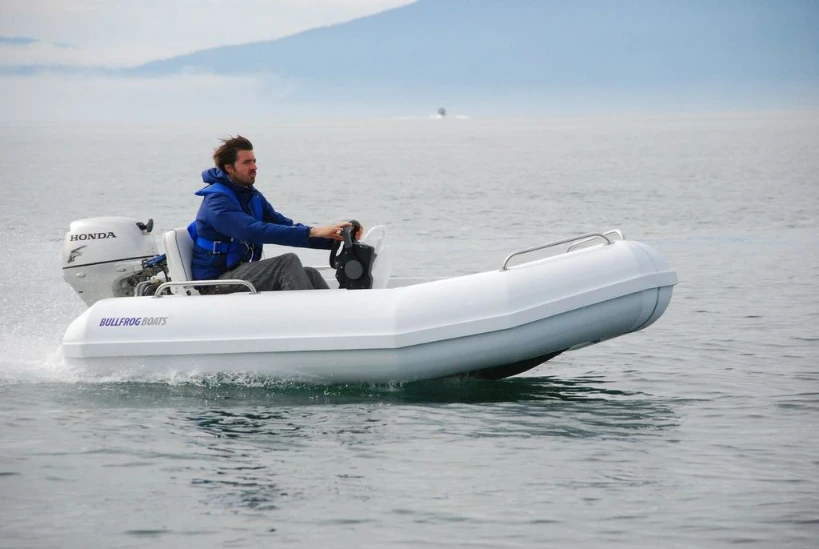
The upper deck overhangs the port and starboard side decks below, providing some shelter from sometimes unpredictable Pacific Northwest weather. She features a dedicated pilothouse, followed immediately by the exhaust stack. There are two shore boats with associated davits nesting gracefully on the second deck, ready to deploy for exploration and adventure. A 12’ Whitehall sailing dinghy or a Rendoza RIB, with 60-horsepower outboard, are ready to launch at a moment’s notice.
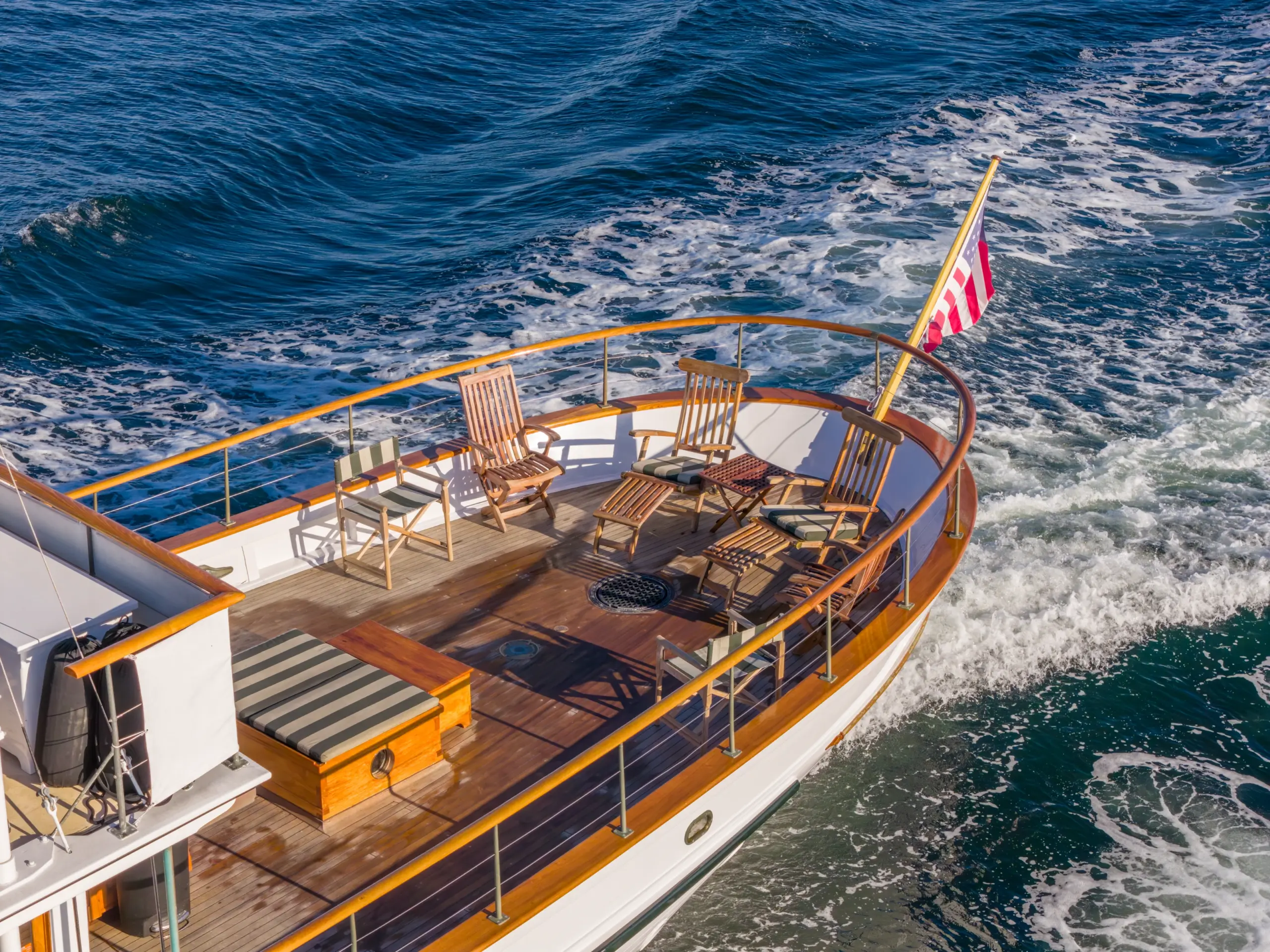
Her lines leave an abundance of room on the aft deck, where generations of owners, passengers, and crew have lounged on lazy afternoons. The aft deck is the domain of deck chairs, umbrellas, refreshing snacks, and often exotic beverages. A traditionally styled teak wet bar with leaded-glass locker doors in a semi-enclosure immediately adjacent to the aft cabin bulkhead, and a gas BBQ grill just aft enough to be on the open deck, help facilitate entertainment on the marvelous aft deck of the fantailed Blue Peter.
Step into the main salon and travel back in time. If everything looks like the day she was launched in 1928, it’s by deliberate intent. Blue Peter benefitted from a multi-year, $4 million upgrade at Haven Boatworks in Port Townsend. Every aspect of the boat was scrutinized, analyzed, and repaired, replaced, or upgraded as needed. Every step of the way, maintaining the original styling and ambience was of paramount concern. Top-tier wooden boat specialists spared no expense and took no shortcuts. Where appropriate, there are modern systems, accessories, and conveniences aboard Blue Peter, but in the cabin areas they are subtly if not invisibly incorporated.
An Asian-style wool carpet, cushions on rattan armchairs, and neatly creased window curtains create a blue theme in Bue Peter’s salon. Most forward in this cabin, impressive and period-authentic joinery frames the original wood-burning fireplace, with a tile apron protecting the teak and holly cabin sole. Cabin ceilings throughout are beam and batten style, typically painted out in gleaming white, with teak fascia on the underside of the beams.
The full-beam master stateroom is most forward on the main deck. There’s an en suite head with shower. The stateroom is light and cheerful, thanks to three bronze portlights in the forward bulkhead and large side windows. While mahogany veneers are used in the salon, the staterooms, heads, and galley are painted in gleaming white, with teak trim.
A VIP and two guest staterooms are on the lower deck. The VIP compartment features a queen-size berth and shares a head with one of the guest staterooms, featuring a bathtub. The other guest stateroom has its own head.
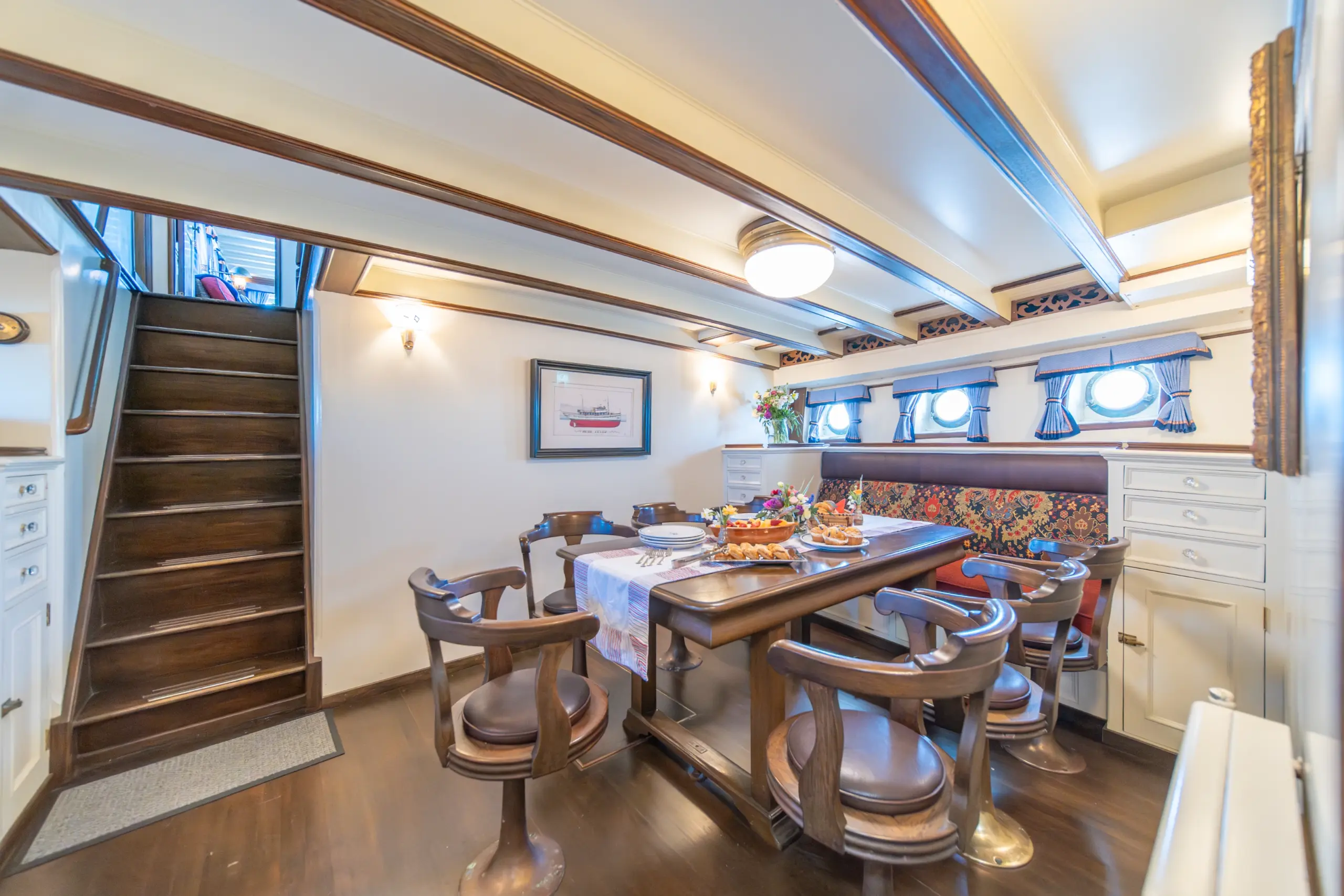
The dining area is on the lower deck as well. Seven period-authentic swiveling stools flank the sides and inboard end of an elegant but sturdily built table. Seating for an eighth diner is available on a settee at the outboard end of the ensemble. Banks of lockers and drawers create serving counters and will stow table linens, silverware, crockery, crystal, or any other accoutrements associated with the dining area.
Forward of the dining area, Blue Peter’s galley would be the envy of many small restaurants. Custom soapstone countertops provide abundant space for food preparation. Lockers, drawers, and a variety of refrigeration units will stow provisions and keep perishables fresh. A professional range by Wolf and a dishwasher by Miele are concessions to modern convenience, but they incorporate into the whole in a manner that doesn’t unduly disrupt The Great Gatsby aura.
The crew quarters, forward of the galley in the bow, are well finished. While crew quarters are often ridiculously cramped with minimal amenities, this area is (not-all-that surprisingly) rather inviting aboard Blue Peter. A pair of single V-berth bunks rest atop painted-out stowage joinery. There’s a dedicated head for the crew, and the ship’s laundry is in this area as well.
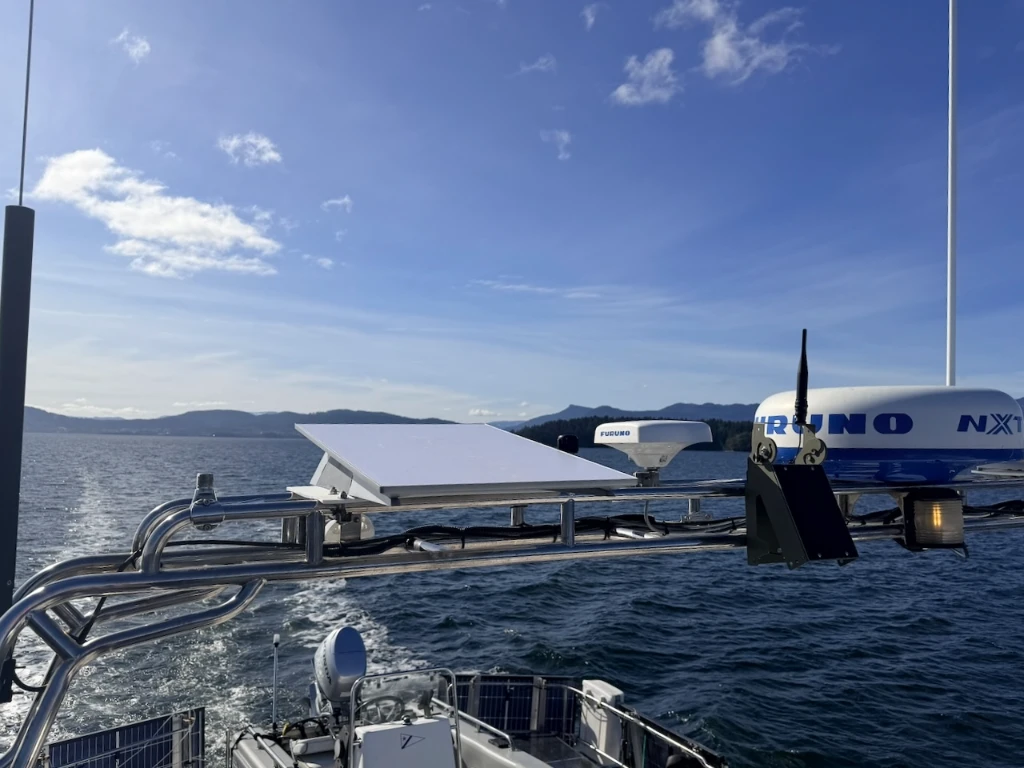
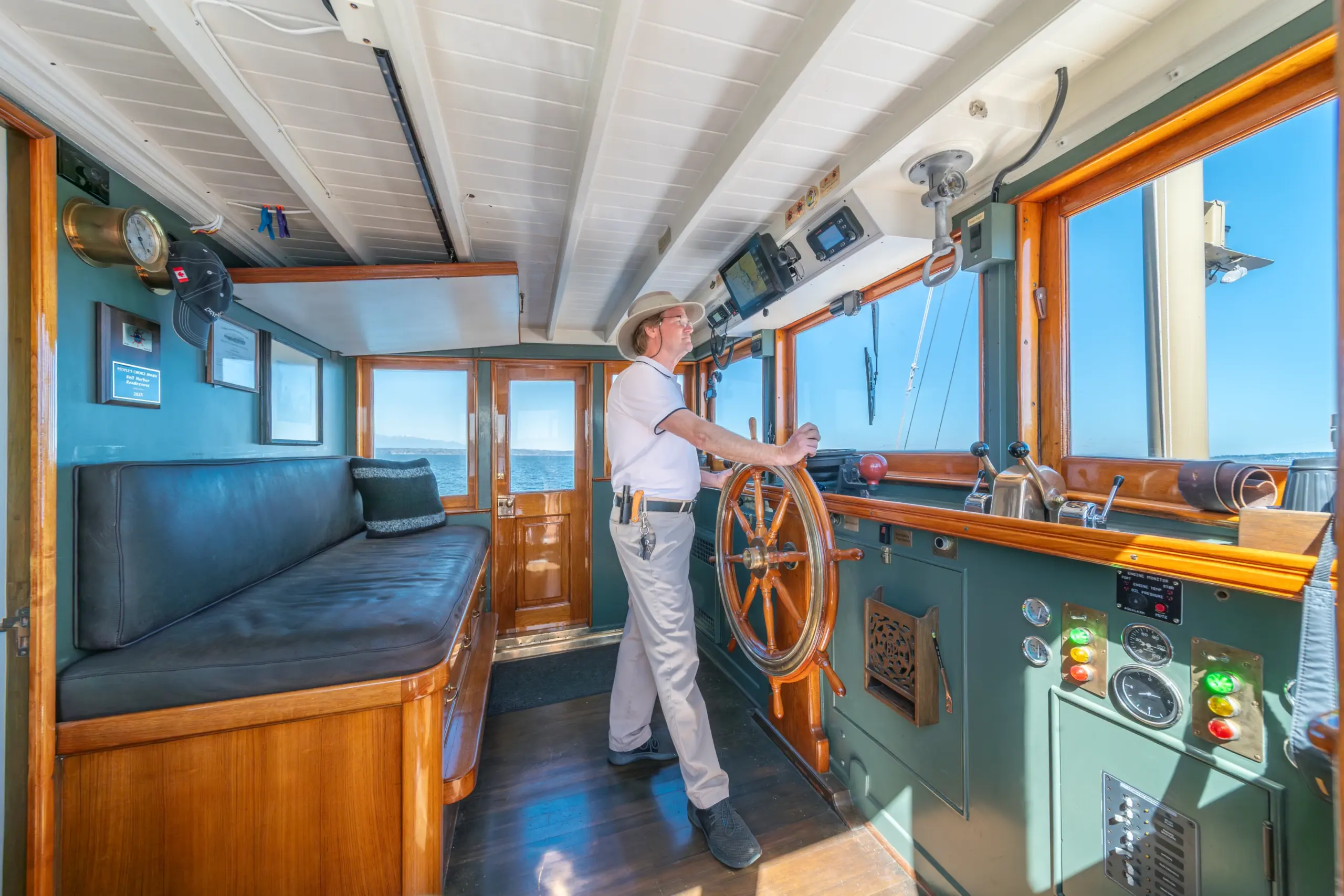
The pilothouse is, of course, Blue Peter’s functional nerve center. Visibility is exceptional through port, starboard, and forward windows. The traditional spoked wheel is authentic to 1928, as is the joinery and décor. But her navigational functions are entirely up to date. Electronics aboard include Garmin Fantom 54 solid-state radar, a 16” Garmin touchscreen chartplotter, Garmin Reactor hydraulic autopilot, and a Garmin Class B AIS transceiver integrated with the chartplotter. She carries two VHF radios—one fixed-mounted, one handheld—as well as cellular and internet connectivity through a Starlink system. An NMEA 2000 “backbone” is installed to facilitate future expansions.
And while her exterior appearance and cabin accommodations are authentic to the 1920s, it’s most definitely the 2020s in her machinery room. Her main engines are a pair of Caterpillar D334, 320-horsepower diesels. They have logged over 6,500 hours but were completely rebuilt in 2020. Larger prop shafts (3¾”) were installed during the refit to permit a potential upgrade to 400-horsepower engines.
A 2021 Northern Lights 20kW generator provides AC current under way or at anchor. Shorepower is a 50/100-amp system. A Kabola B17 diesel boiler provides cabin heat, as well as hot water when at anchor.
Opportunity knocks
A series of meticulous and thoughtful owners, perhaps most accurately described as “stewards,” have shepherded Blue Peter through her first 98 years of existence. She’s now available for acquisition by somebody who will love and respect her and, ideally, who can commit to the additional investments that caring for a vintage vessel will unquestionably require. She’s available for far less than has been spent renewing and upgrading her in recent years —“only” $4 million at the time of this writing. That’s a fact that serves as well as an expression of the economics of owning a functional work of art as much as it expresses the asking price. Buy this boat with eyes wide open; $2.4 million will prove to be merely the first installment. She deserves a steward who can truly afford her.
Blue Peter would be a poor choice for an introvert. She is recognized everywhere throughout the Salish Sea—a regular in Opening Day parades and Classic Yacht Association rendezvous, and a primary draw at wooden boat festivals. A day spent cruising her will be replete with a hundred friendly horn toots and waves from smiling fellow boaters. She’s not just a “Northwest boat,” she’s one of a handful of boats that could be said to define our Northwest boating tradition and experience.
As she is about to begin her second century, recent refits have left her not some tired hull beleaguered with rot and blight, but a grand old lady just now entering maturity. She is filled with fresh energy and will foster enthusiasm and present a full slate of possibilities. May she cruise another century where the chilly waters of the North Pacific reach inland, to wash against gravel beaches. And may the sight of her remind us that, not that long ago, our shores were lined with towering pillars, seemingly holding up the sky.
Specifications and dimensions
LOA: 96’
Beam: 18’ 6”
Draft: 8’ 7”
Fuel: 2,688 gals.
Water: 1,140 gals.
Accommodation for eight in five cabins.
Broker Contact
For additional information on Blue Peter, contact Denison Yachts in Seattle. 206-686-5400. The listing broker is Nick Pillon. Nick commented, “The existing owners would be particularly interested in offers from anybody intending to keep her in the Seattle area and continue a long tradition here.”