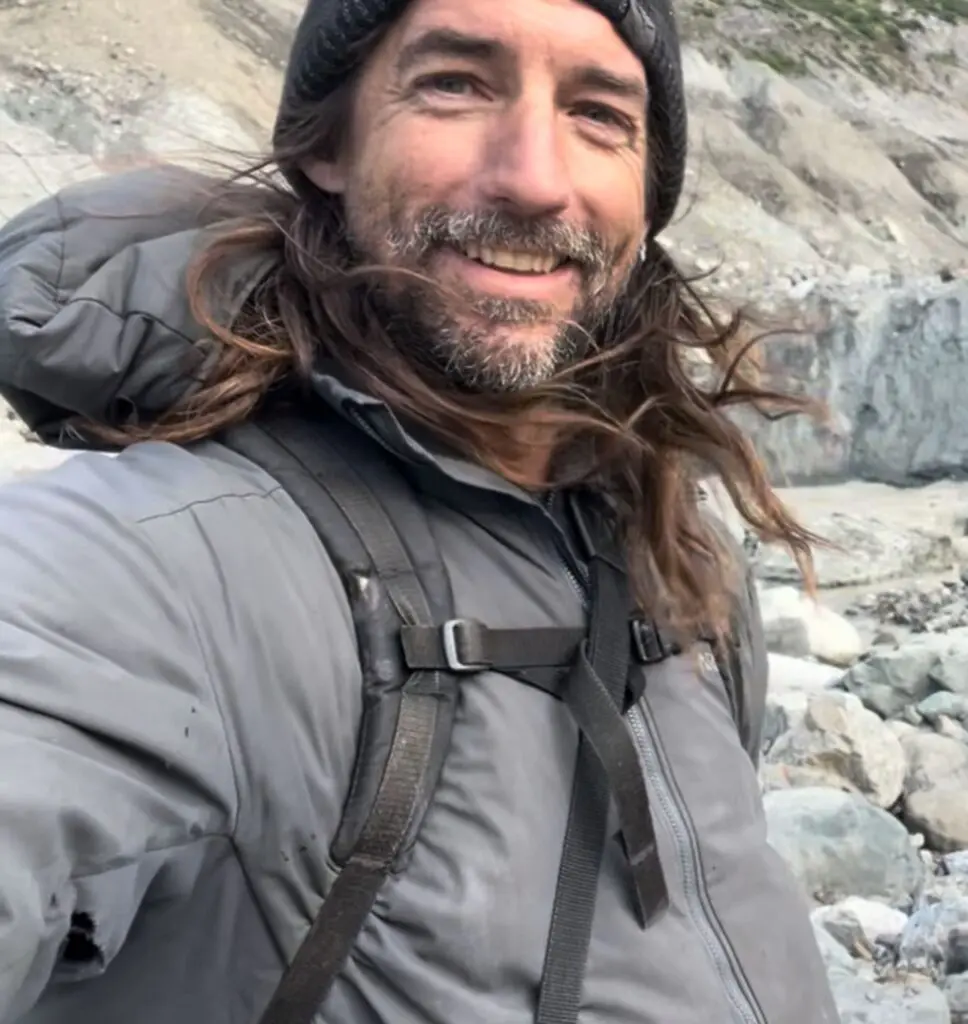
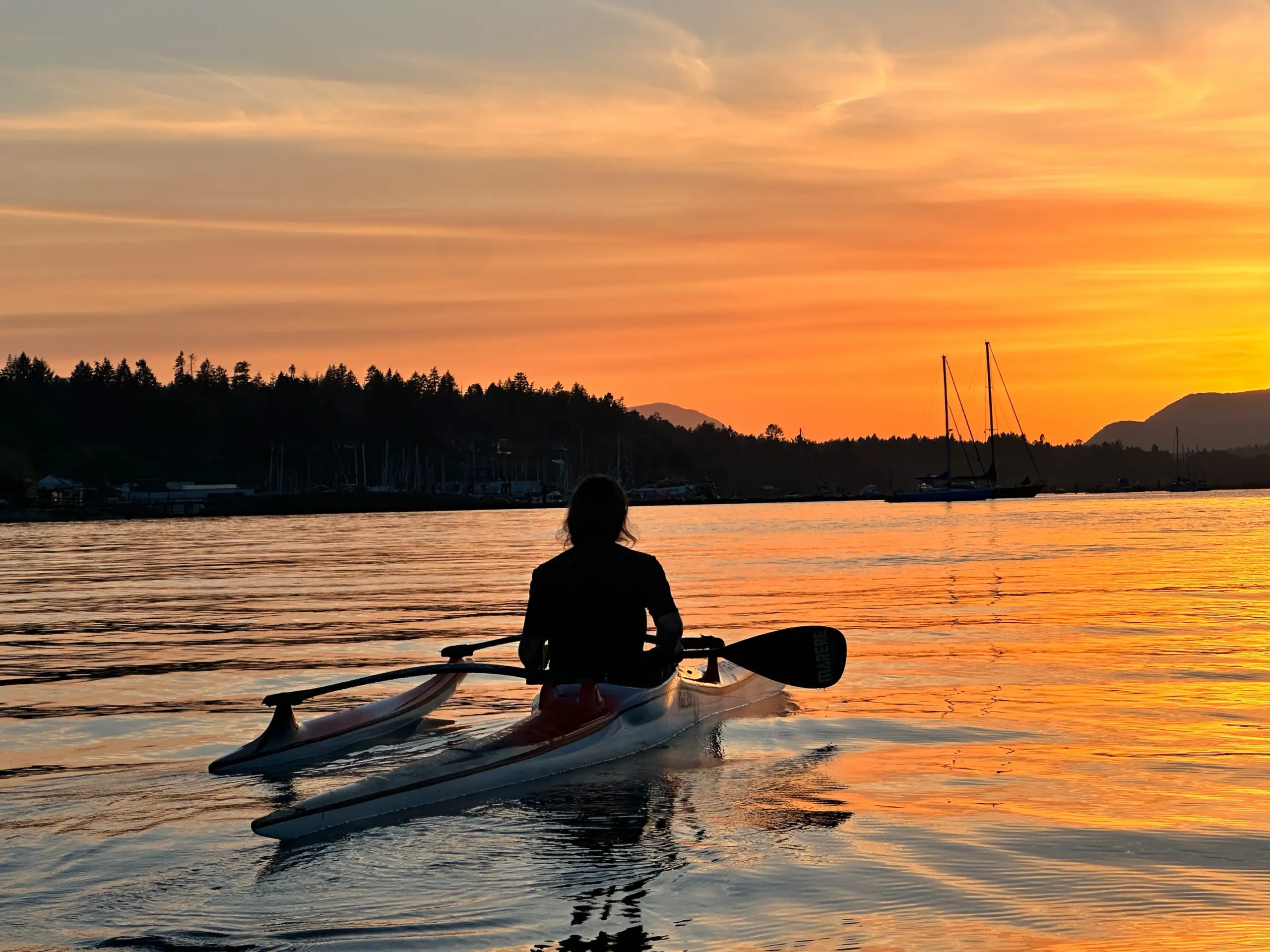
The R2AK and Northwest Passage standup paddler and PNW adventure celeb sail-moved to Hoonah, Alaska last year. What’s the story? Krüger opens up to tell it his way.
I stood on deck before the Niagara Falls in my ill-fitting and leaky yellow rain slicker and mulled over the story I had just been told. The mist billowed up in big puffy boils, drenching everything. I loved the pinprick stings of the cold water on my face. My eight-year-old curiosity lapped up the story of the infamous Annie Taylor, aka “The Maid of the Mist,” who, in 1901, became the first person to survive the express-lane trip over Niagara Falls in an oak barrel. The roar of the famous waterfall in front of me drowned out everything.
The notion of a thrill-seeking school teacher shoving off for a plunge over Niagara Falls in a custom oak barrel ignited something in me. Water dripping from my nose, I imagined what she must have been thinking about as she bobbed along in the current, destined for the edge in just a very few unstoppable minutes. I decided then that Annie Taylor was a badass. I have always admired that special breed of human who has the mental strength and discipline of character to meet intense challenges alone. Conversely, I have always held a deep mistrust of folks who fear being alone. The distinction between these two is worthy of an article all by itself.
Development of an Ethos
Despite her badassery, Annie was flawed. History says her motivations were fame and fortune. I admired her pluck but felt disappointed by her vanity. Despite my young age at the base of Niagara Falls as a tourist, I had experienced enough intense experiences with my father to understand how much I had learned each time. I had already formed opinions about appropriate motivations. My father was the master of the “Who do you suppose we will be tonight?” approach to living hard. I can still hear his gravelly voice, always dangling that esoteric carrot-on-a-stick. I realized early the self-evident fact you cannot take fame or silver candlesticks along when the egg timer of your life goes off. Despite her regrettable vanity, I still admire the discipline and character required to hop in a barrel and push off for the edge, like Annie did.
I often joke about “hearing the waterfall” when mired in preps for the next at-sea adventure mission. There is a sense of inevitability once you’ve taken it upon yourself to huck your meat into something way bigger than you. Drawn forward by the hope of crawling a few more inches toward the light—internally speaking—with the goal of one day making a bold escape from Plato’s Cave, confusing shadows be damned. Therein lies the work of doing. Really doing. Sadly, I’ve learned that most folks aren’t keen to swim in that water. It smells too much like work, or perhaps it is the fear of loneliness. Hard to say. I think this is why most humans tend to run in herds.
After you’ve decided to go and do something that calls to you, what follows is a time of preparation and planning, because when go-time arrives (always too soon) all you can do is cork your barrel, sit there in the moist and musty dark with all the accelerating sounds and smells, and suffer through the glaring crucible of your obviously questionable life choices. Soon you will pop over that roaring edge. There is no avoiding it. Thus, the jokes about hearing the waterfall. There is a gravity to it all. Once you’ve taken steps, the outcome becomes increasingly inevitable as you go along.
Stated a different way, there is an unmistakable moment when the higher functions of the frontal cortex leading up to this day lose their usefulness and the lizard brain must take over. I find that my heart always leads me into the next project, then the frontal cortex functions as a nonstop-scenario-producing, sleep-robbing problem solver. Once I’m in full-send mode, the lizard brain and heart are my best navigational tools. This special transitional moment is what I live for. Once under way, instead of worrying about and planning for all the things that might or could happen, all you need to think about is what is. Not a damned thing you can do about most things by then, anyway. Off you go. Full impulse drive engaged. Basking in that sweet freedom.
Bringing the Ethos into Arctic SUP Action
For the past couple of decades, my heart has led me to projects that lie a bit beyond the realm of modern navigation. I have grown tired of over-reliance upon technology. Humans inherently have a baked-in system of taking in information and making decisions in nature. Too few of us know how to use it anymore. Nothing in life has given me greater satisfaction than deepening these skills and sharing the proceeds.
In July 2022, with the drumbeat of waterfall sounds in my ears, my dear friends Scott Brennan and Elyn (then Oliver and now Krüger (insert natural navigation lesson here)) delivered me to Tuktoyaktuk, Canada, to begin paddling the Northwest Passage. They plopped me in the water and promptly started their own journey back south along the Dempster “highway.” I started pulling my weight east through the Northwest Passage. One paddle stroke at a time. Initially, the goal was to be the first to paddle solo and unsupported through the Northwest Passage by standup paddleboard (SUP). Now, two summer seasons and nearly 900 miles of paddling into the project, the lessons learned are still ripening and maturing, even as I prepare to return for more. Both legs paddling in the Arctic have left me fundamentally altered in ways most welcome and also deeply challenging. Any experience on land and waters so vast will also be vast. Also devilishly hard to describe.
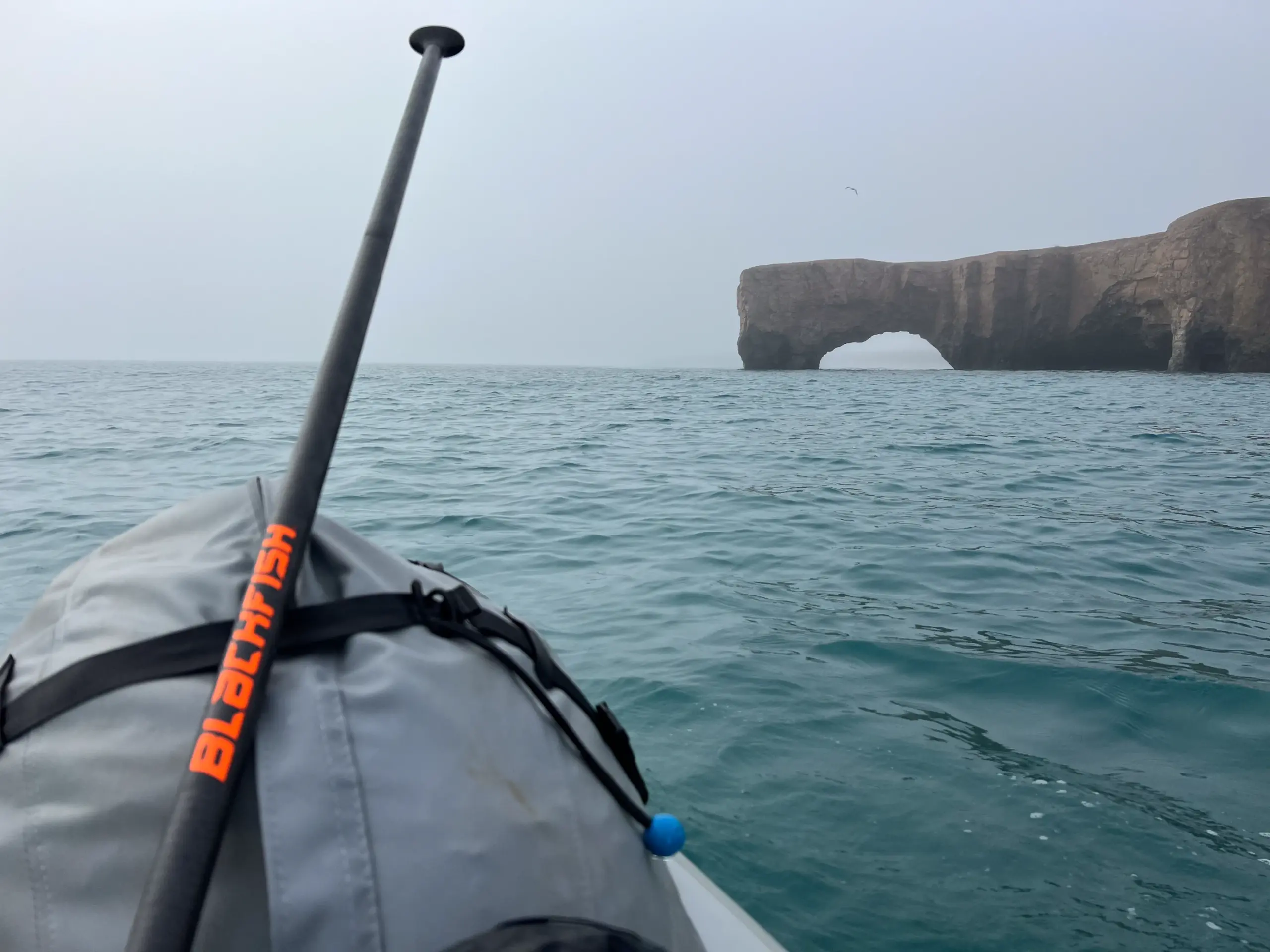
First, I had to confront my own vanity. I’ve learned there is no honor in claiming a “first” while playing in your neighbor’s backyard. How embarrassing. While immersed in the Arctic, I fell utterly in love with the place. I’ve never felt more exposed than when I was there. Heaven. Now, I face two more legs to the end of the Northwest Passage.
Returning to Tuktoyaktuk to begin the project was pregnant with personal meaning. I had been there two years prior, when I decided to pump the brakes, return south, and keep preparing. That experience added weight to my shoulders as we pulled into Tuktoyaktuk the second time. I found I was more terrified of not beginning than of what might happen if I did. That’s how I knew I was ready. I was in Tuk for all of 30 minutes. I was in a rush to get going for fear I’d lose my nerve and pull the plug again. After awkward see-you-laters, I splashed my board, stowed all my gear, and started pulling east. Tuktoyaktuk, Elyn, and Scott disappeared slowly over the horizon. I made it 20 miles that first day before being pinned down by a blow. I started to breathe again and I fell into a rhythm. Despite support and daily check-ins with the Canadian Coast Guard via Elyn, the sense of exposure and being well beyond the pale was intense. Any help would be too late to do anything but collect my bones and ship them…where? Eventually, I decided I’d be happiest if my bones just stayed right where I fell.
Each leg of the paddle is endowed with a theme of whose creation I know not. The first leg was all about exposure. Physically. Emotionally. Spiritually. My task was to become comfortable in that environment. The charts suck. The compass wanders listlessly. The maps of land are misleading. The fog is epic. The constant hubbub of voices robbing my sleep. The thunderstorms were truly terrifying. I very quickly realized how disinterested I was in becoming the first to claim a prize. Paddling in the Arctic is the prize.
The theme of the second leg was deprivation. Security took my spare batteries at the airport and I could not find suitable replacements in time. I was left with only direct charge from solar panel to device. For electronics, I carried only a Garmin InReach, my cell phone, camera, and an iPad for navs. I paddled in thick fog for five days after leaving Paulatuk and was forced to power down my navs and communication through the InReach to save batteries for an emergency. Simply not enough sun to charge.
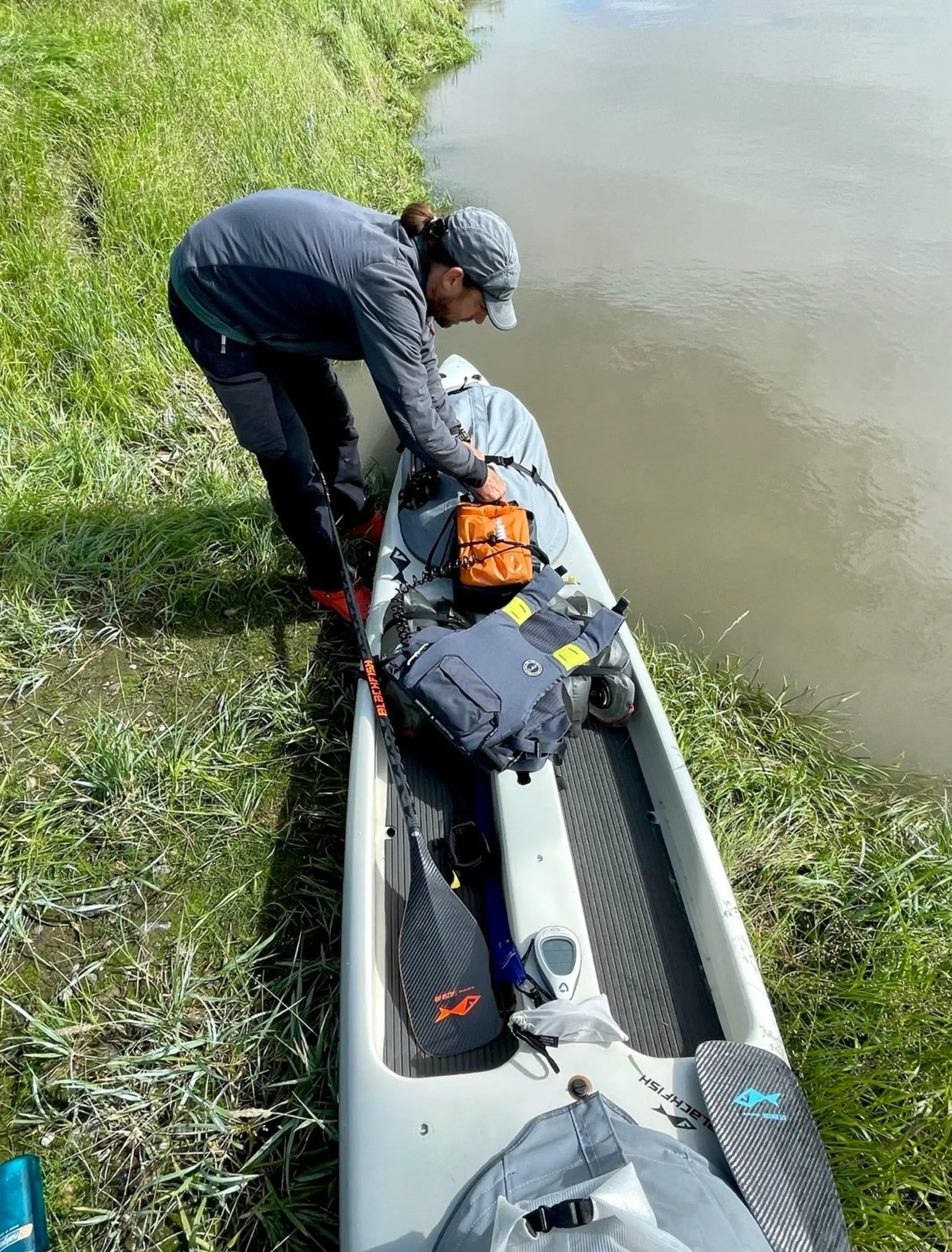
Setting small goals while paddling is a very helpful tool on long days. “When I make that point there, I’ll eat something” or “once I catch sight of land again I will stop and drink a bit of water.” Also, it is simply nice to watch the world go by. Paddling inside the ping-pong ball for five days, I had none of these distractions to help me. It was excruciating work. I navigated by swell angle and wind wave angle on the surface of the swells, and also the sound of waves breaking on shore. A rocky beach sounds very different than a rock wall or the very rare sandy beach. Once I made my daily mileage goal, I would skirt the impact zone and listen carefully to the waves breaking until I could discern a place to land—maybe. Chosen spots often did not work out, and I’d have to keep going. Sometimes I’d paddle another 10 or 15 miles past the daily goal before finding a spot to land.
Once I was in that space of careful mindfulness on one consequential crossing in fog. I looked down between my right arm and the board and found a walrus right there next to my board. He eyed me curiously. No malice. Walrus are really quite large, you know. Shockingly quiet. I nearly fell in. I was paddling with no pants on because the chafe surrounding my nethers was excruciating with my drysuit on and, besides, it was 85 degrees and I’d had a brush with heat stroke earlier that day. I had been pulling too hard. The water was much, much colder than the air. I had no desire to fall in. Instead, I talked (okay, I yelled) to the walrus and asked him to please stand off a bit. He was quite the gentleman and did so. He followed me at a 40’ radius for another 30 minutes. The Inuit hunters have warned me how quickly a walrus can ruin your day. I was ecstatic to see a walrus and also quite relieved to see him go.
Time ashore was spent looking for water to drink, resting, and keeping an eye out for bears. The water-to-bird-shit quotient is the math one constantly grapples with. I once had a barren-ground grizzly come stand in my camp and survey my setup. We had words. He shambled off to the waterhole and then on over the horizon. No desire for a scuffle. My shotgun never left my side while ashore. Arctic foxes would come sit at my piss-perimeter and watch me. I had a bowhead whale come in shockingly close to say hello in the fog another time. Hairy eyeball in the mist. Again I was left with the realization that there is a respectful and deep regard between living things in the Arctic. Even between predator and prey. You have to respect anything that is alive. Being alive is hard to do. Being alive is a gift. We forget that down south.
Rough Re-entry and Northward Bound
The Arctic paddle has proven to be a PhD-level thesis on the topic of natural navigation. The land and waters speak; you just have to know how to listen. The Arctic has also taught me how important it is to have a good relationship with the ancestors. Free from the white noise of life down south, I enjoyed the awareness of ancestral presence in my life.
Another important outcome of the Arctic paddle is the birth of our nonprofit organization, Krüger Creative. Not long after its inception, editor-in-chief of this magazine, Norris Comer, wrote about it in Soundings in January 2025. That article seems like a million years ago.
Long before I began to see the full scope of the Arctic paddle ripple effect—after all, my soul had left my body and I was desperately trying to stuff it back in—and relearn how to function again. Elyn saw a bigger picture. She worked her magic and, in her trademark easy-as-breathing fashion, had the bones of our new krugercreative.org and financial plumbing all roughed in. Meanwhile, I agonized over the mission statement. How could I, in one or two sentences, express the personal history, urgency, and passion I feel for showing the world what’s really important about conservation, indigenous knowledge, and, yes, spirituality? In what visceral way can I describe what happens inside the oak barrel?
On one hand, I feel a responsibility to share the lessons learned on the outer edges of human experience. On the other hand, I also hold strong feelings about how lost humanity seems. This last fact overwhelms me sometimes.
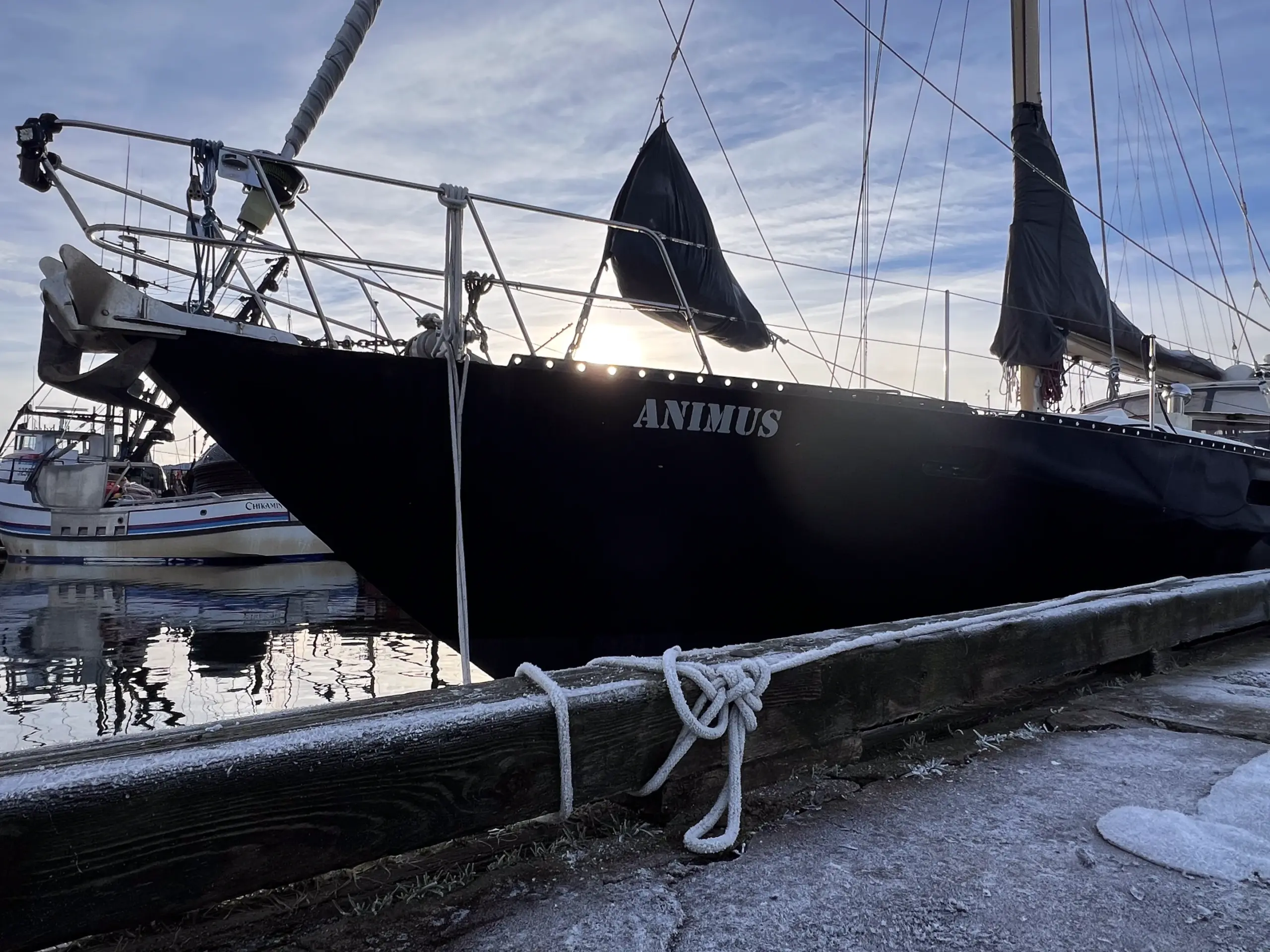
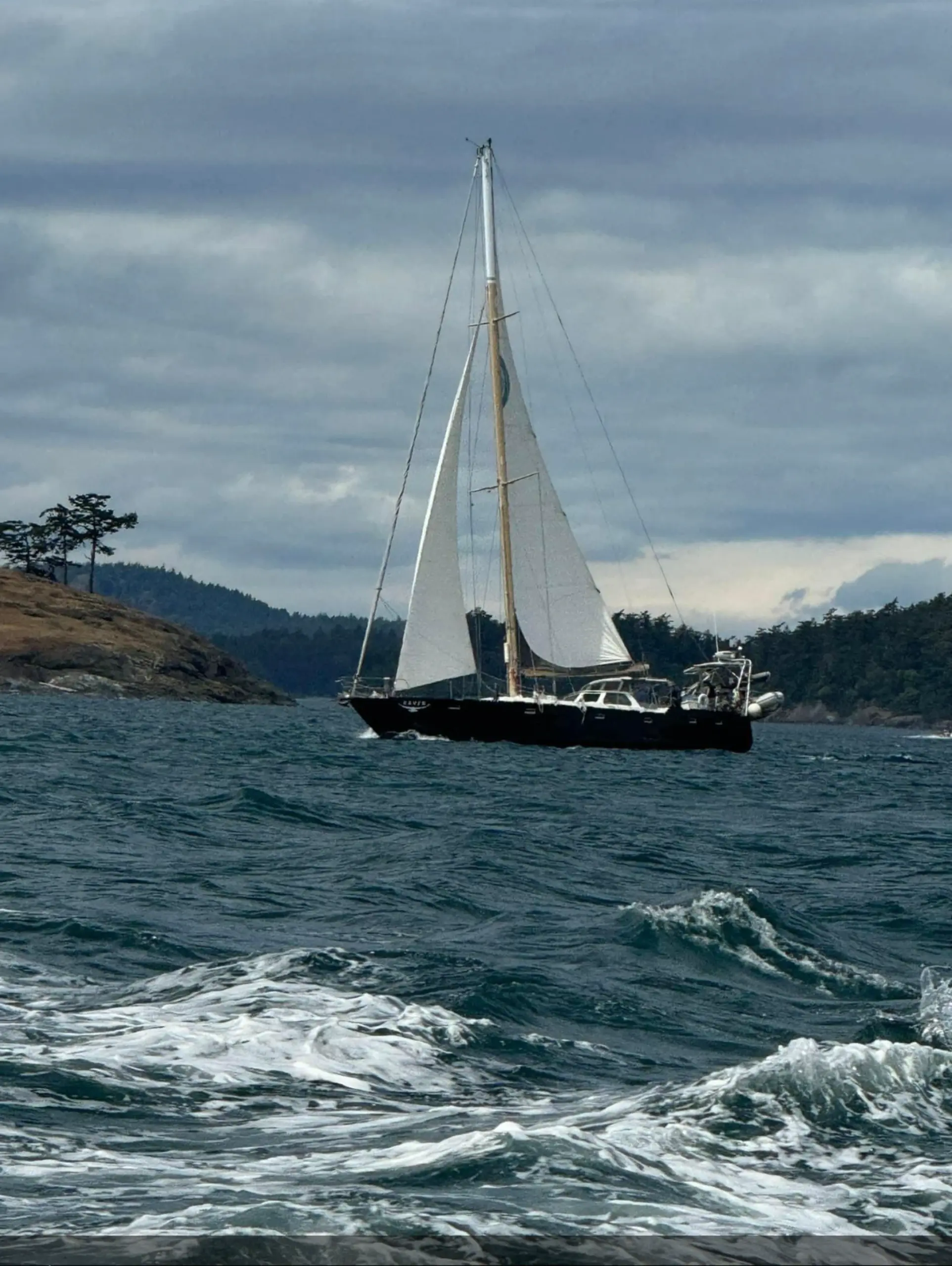
This fact, plus several bumpy post-trip cultural re-entries, caused a massive dose of indecision in my life. My misanthropy got the better of me for a while. I stopped thinking about Krüger Creative and had all but decided to quit trying to save what is likely already lost. Elyn and I purchased Kävik, a Custom 42’ Pouvreau sailboat for the purpose of downsizing, getting lost, and going sailing. The plan was to sell Animus, our Bruce Roberts custom 65’ steel cutter. Quit chartering. Quit trying to save the world.
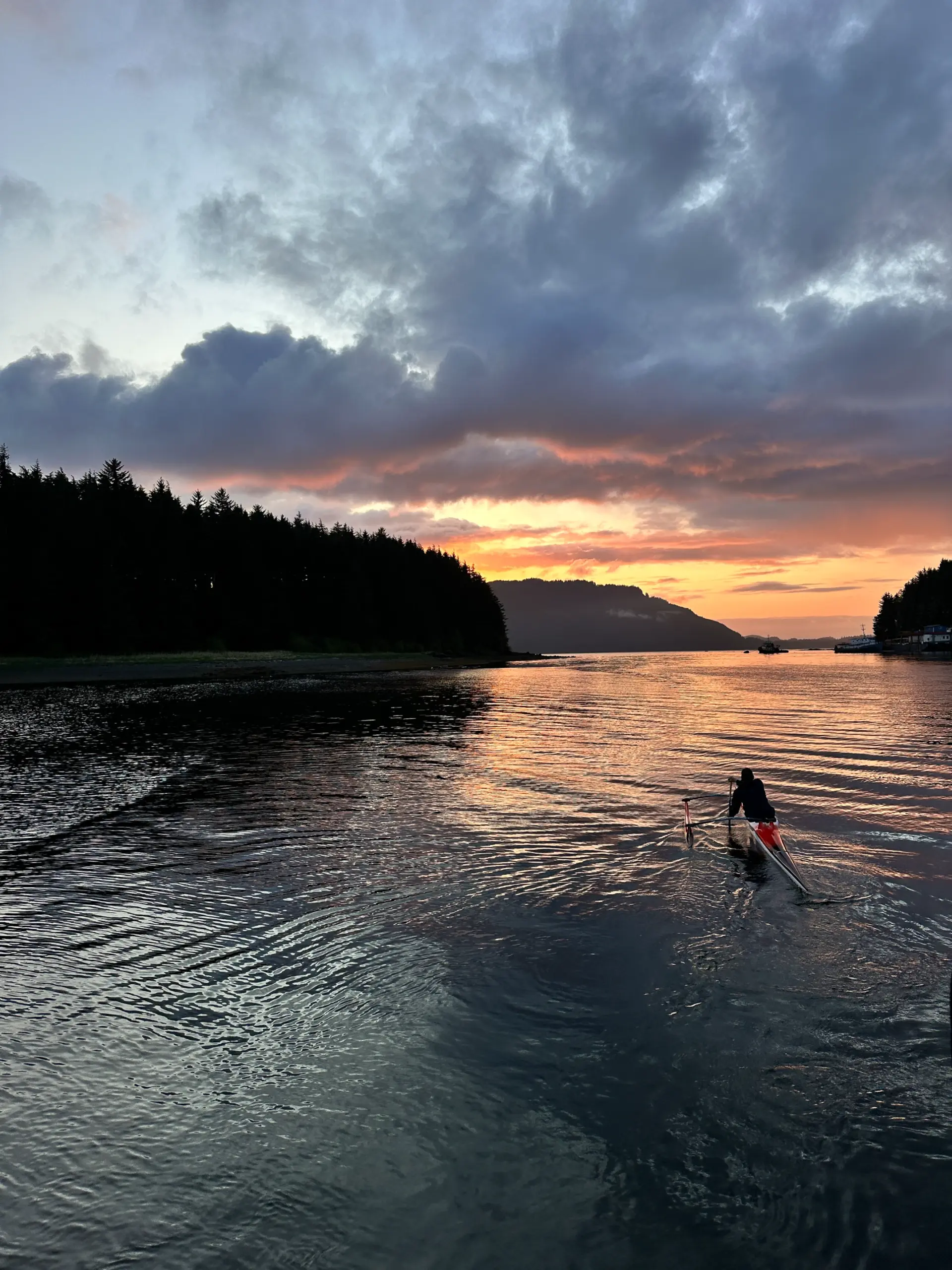
Our first act in heeding the inescapable sounds of that waterfall ahead was to think about all the places we’ve visited in Southeast Alaska and choose one to shift toward. The Salish hasn’t felt like home in a very long time. I needed a place where I feel the need to explain myself to people less frequently, where there are more bears than people. Also, with fertile waters for Karl-style pursuits close at hand. We settled on Hoonah, Alaska, a small Tlingit village west of Juneau on Chichagof Island, accessible only by boat or small plane. Population 800 or so. The bear-to-human ratio is about 4:1, in favor of the coastal brown bears on Chichagof. The Pacific is 30 short miles west and Icy Strait two miles out of Port Frederick. Perfection.
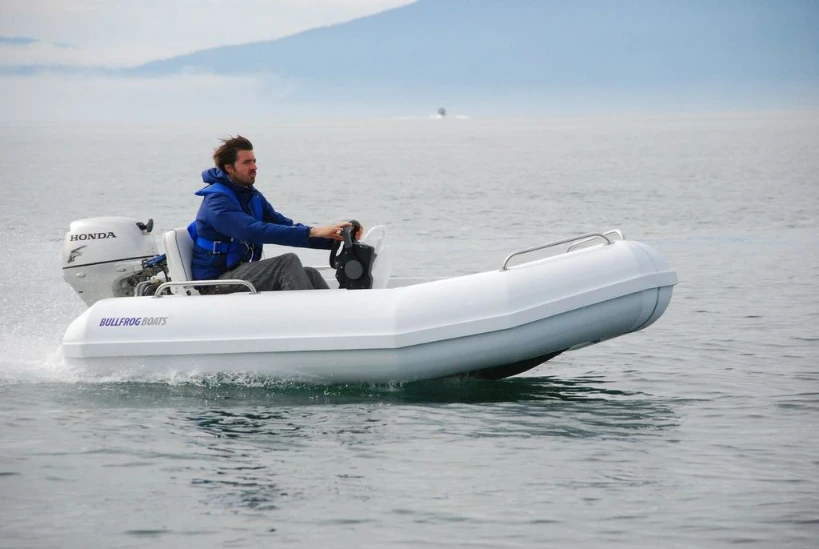
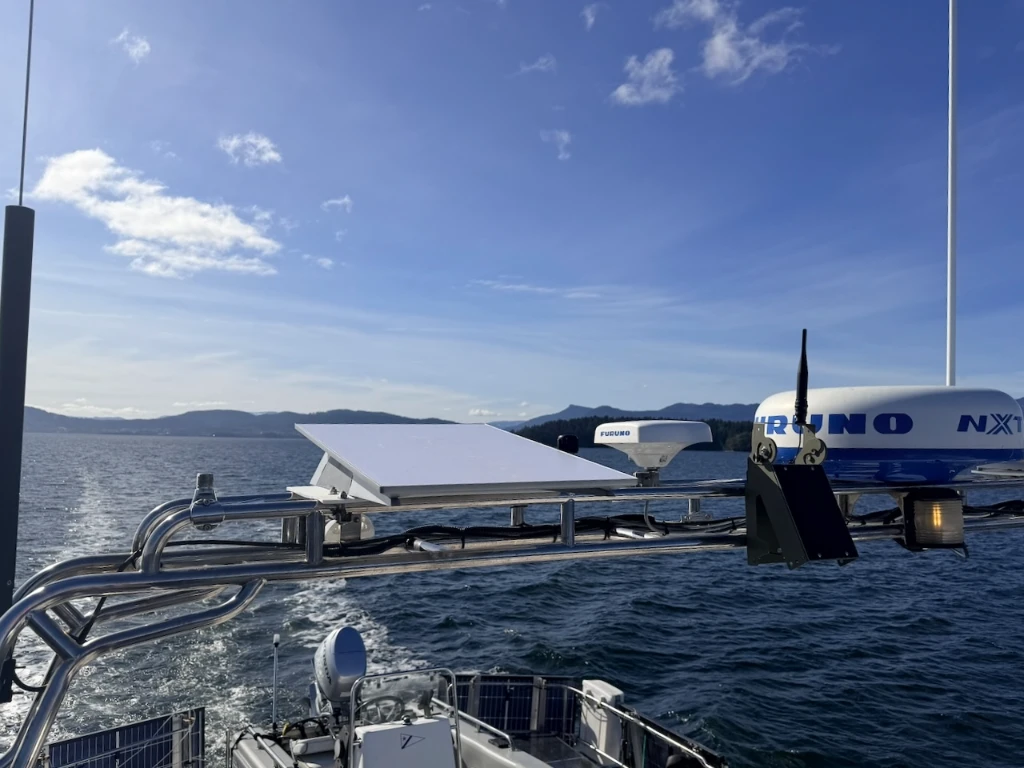
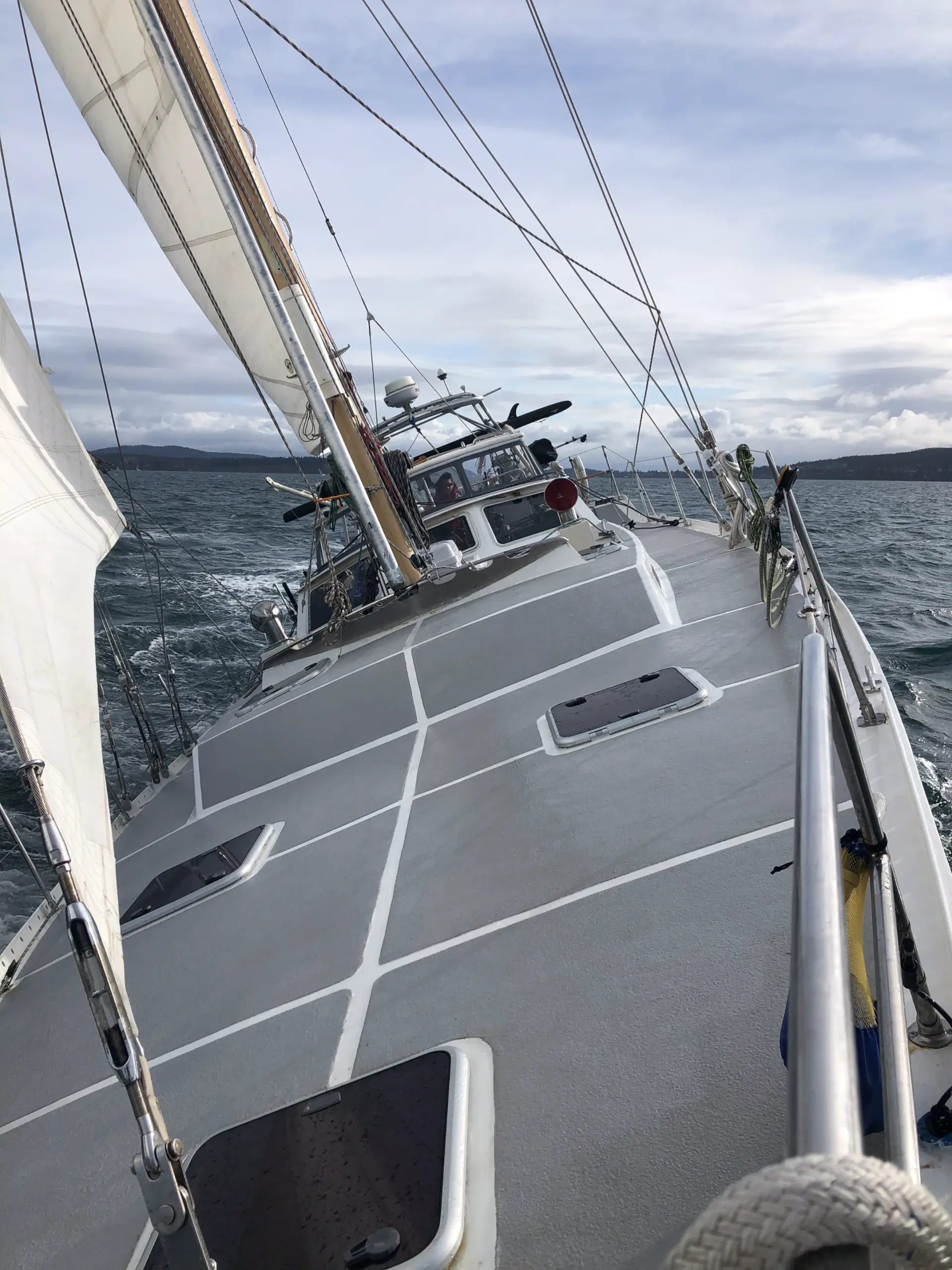
So, with Elyn at the helm of Kävik and me at the helm of Animus, we sail-moved north. We had a lovely two-week, gale-ducking, five-knot-average progression toward our own multidimensional waterfall. We talked on the radio frequently. “Did you see that whale over there?” or “Rainbow!!” We had adventures. It can’t all be whales and rainbows. Our little flotilla responded to a mayday call in area called Whiskey Golf during a small-craft advisory and raced a gale into Revillagigedo Channel into Ketchikan. I wrapped the prop on Animus with a 20’ long piece of four-inch dock line in the middle of Clarence Strait, where Ernest Sound cuts inland. We let both boats sail by-the-hull while I free-dove to clear the prop. Nothing is ever easy. We transited Rocky Pass, one of the most beautiful channels in all of Southeast Alaska, in my opinion. You can feel the deep and long human history there. We soaked in Baranof Warm Springs. We arrived in Hoonah. Nobody knew us, and that felt great. Anonymity, however brief, sure is liberating.
Hoonah Healing
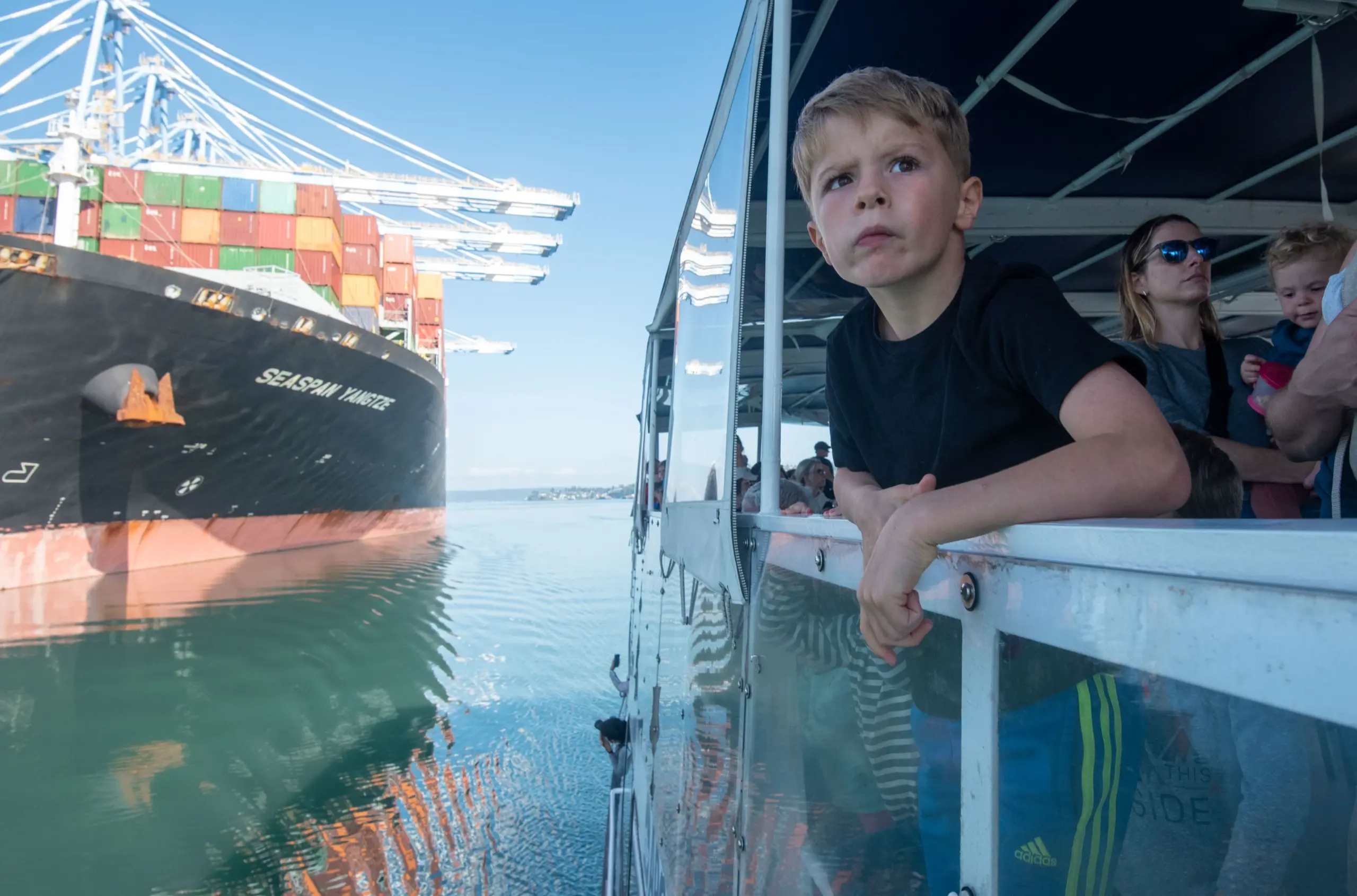
The very next day after arriving in Hoonah, I started work at Icy Strait Point, the only privately owned cruise ship terminal in Southeast Alaska. It is owned and operated by the Huna Totem Corporation, a 100% Tlingit-owned corporation. I captained 26- and 49-passenger wildlife-viewing vessels. I spent the summer on the water showing waves of people the sort of magic that has always animated my life: Bubblenetting humpbacks. Coastal brown bears. Once we saw a famous humpback, named “Wedgie,” and friends intervened to protect the sea lions. We watched resident orca with splishy-splashing pink calves and transient orca tearing apart sea lions. The latter only takes about six minutes. More rainbows. Cold blasts of wind scuffing up the seas at Point Adolphus in Icy Strait.
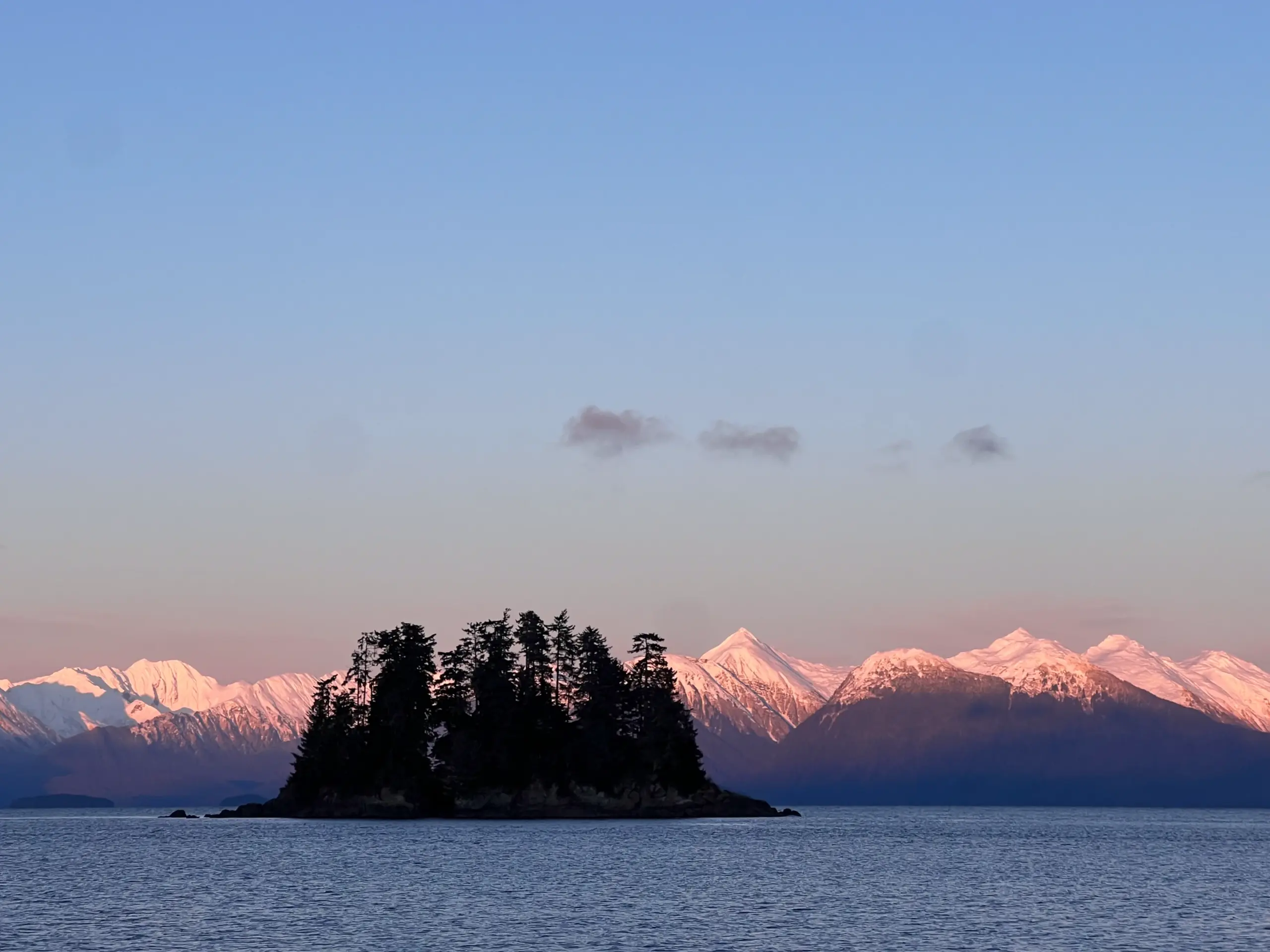
My daughter Dagny came to visit. We had a few Krüger-style adventures. She came along with me to work and watched herds of sea lions working the reefs while always keeping one eye out for orca. Puffins fishing in their merry little splashy way. Eagles nabbing salmon out of the river. Twenty varieties of berries dripping from their branches—plump distillations of the air, land, and forest. Oystercatchers and their silly laughing cries. The smell of mud and life and death at low tides. The bears. One bit my dog Buko on the ass and I had to stitch it up with fishing line and sail-repair needles. No veterinarians in Hoonah. Bonding moments for everyone involved. Learning respect hurts sometimes.
During one of the 26 passenger trips this summer, a pod of transient orca approached the vessel and gave everyone a close-in, minutes-long, hairy eyeball. I turned and found that several of my passengers were deeply moved and crying. Silence laced with reverence blanketed the boat on the way back to the dock. Hugs all-around when I unloaded everyone. All of these experiences made it painfully obvious that quitting on humanity is not an option.
I decided there are too many good people who need to experience the healing vignettes this work offers, even if through art alone. In the act of sharing the beauty this summer, I found myself rejuvenated, and my commitment to our mission was redoubled.
Here is how the Krüger Creative statement now reads: “Our mission is to deepen human connection with wild places through immersive experiences that inspire their protection.” Simple.
Having made an even deeper commitment to that mission, we won’t be disappearing aboard Kävik. In fact, we will sell her in favor of committing resources to Krüger Creative and Animus. Full send. I can hear the waterfall getting louder. Back in the correct current.
While Annie’s initial goal was fame and fortune, along the way I wager she learned to value her experience tumbling over the falls in a way she hadn’t planned. She died penniless, but with one hell of a story to tell. There’s a lesson in that. Her contribution to humanity is intact after all this time while her safe deposit box would be empty regardless.
Our move to Hoonah and a summer of adventure made it clear: my driving wheel remains. Namely, a strong sense of a moral imperative to keep fighting for conservation of wilderness and human connection with it before all is lost. Our success as humans depends fully on saving what is left of both.
I have always loved the words of Wallace Stegner, who said, “Without any wilderness left in the world, we can never have that chance to know ourselves.”
With two more legs in the Arctic to plan, train for, and complete, there is ample opportunity to learn a few things. As such, I am looking forward to more exploring, surfing, paddling, sailing, hunting, fishing, skiing, writing, and, of course, chasing waterfalls.