A Vibrant Waterside Time Capsule on a Sheltered ‘Inside’ Route
The compass rose on a paper chart indicates “magnetic north.” Boaters residing in the southern reaches of the Salish Sea seem to find north magnetic indeed. It’s where most of us tend to head when we depart our marinas or clear the Ballard Locks to begin a summer vacation cruise. Just north of Edmonds, the traffic splits somewhat. There are boaters who set a course up Admiralty Inlet and then across the Strait of Juan de Fuca to reach one of the most popular cruising destinations, the San Juan Islands. If the weather is iffy and the VHF is squawking about 15- to 20-knot westerlies in the eastern reaches of the Strait, most boaters will continue up the east side of Whidbey Island (commonly referred to as “running the inside route”) to avoid rough seas.
Just beyond the north end of Camano Island in Skagit Bay, we vacationing boaters face another decision. Should we continue north to Deception Pass, prudently timing an arrival within a narrow span of time surrounding “slack” current? Or should we turn to the east and enter the Swinomish Channel? The Swinomish Channel is a less-direct route to the San Juans but facilitates access to the ports of La Conner and Anacortes.
While my wife Jan and I have transited Deception Pass several times and enjoyed glorious fair-weather crossings of the Strait of Juan de Fuca, we routinely opt for the Swinomish Channel. Even if impassable eight-knot whirlpool currents during a poorly timed arrival at Deception Pass or lumpy seas broad abeam in the Strait of Juan de Fuca weren’t considerations, we’d run up the Swinomish anyway. Rarely do we allow a summer to go by without a visit, or two, to La Conner.
Immersed in History
The indigenous Swinomish are a branch of the Southern Coast Salish people, with the Lushootseed language as well as cultural and familial ties creating common bonds between coastal villages. When settlers of European ancestry first arrived in the Skagit Valley, the Swinomish controlled a territory that included the north end of Whidbey Island, present day La Conner, along with lands as far north as Anacortes, and “about halfway to Mount Vernon” in the east. The Treaty of Point Elliott (1855) created the Swinomish Reservation on the opposite side of the Swinomish Channel from La Conner and officially opened the remainder of the formerly Swinomish territory to homesteaders.
The North Fork of the Skagit River terminated in a group of widespread waterways, two of which were Swinomish Slough and Telegraph Slough. Telegraph Slough was ultimately filled in for farmland. Both sloughs ran from near the present site of La Conner north to Padilla Bay, but during the summer months at low tide, residents routinely waded across. Nevertheless, at high water, steamboats could motor up Swinomish Slough, and, in 1867, Alonzo Low established a post office and trading post at the last point to which steamboats could navigate. He called the trading post “Swinomish” and that was the original post office designation for the surrounding area.
By 1869, Low was ready to move on. He found a buyer for his post office and trading post; one JS Conner. Conner’s wife was named Louisa Ann, and the settlement was renamed using her initials, “La” Conner.
The Skagit River Delta proved a rich farmland. Over the decades, more farm families settled on the flats between La Conner and Mt. Vernon. While one might assume by the modern prevalence of tulip farms that most of the early settlers were Dutch, the Dutch were not at first over-represented among the immigrants, nor were tulips a commercial crop. In the 1800s, peas, beans, and oats were the primary crops grown in Skagit Valley.
Skagit Valley was also famous for providing seeds. A building on the eastern edge of modern-day La Conner houses a gift ship with the name Tillinghast, and that was the original headquarters of the Tillinghast Seed enterprise.
As true for La Conner as for the rest of the Salish Sea, most goods and passengers in the19th century traveled by water rather than over primitive or nonexistent roadways. With water access (at high tide), La Conner’s commercial district grew to meet the needs of a growing number of settlers in the Skagit Valley. By 1890, merchants began demolishing many of the wooden structures lining the Swinomish Channel and erecting more substantial buildings of brick, concrete, and stone. By 1900, the population of La Conner exceeded 1,000 people.
It might be of interest to note that the population of La Conner in 1900 is roughly the same 125 years later. Few things changed the common culture as dramatically as the introduction of private automobiles and the development of highways in the 20th century, yet La Conner was largely unaffected. While the town in now obviously paved with modern roadways and serviced by every possible utility, La Conner is just far enough from most of the highway traffic to remain relatively unmolested by the hands of time.
Northwest Navigator Recommendations
1. Walk from the Dock: Scones, Antiques, and Ice Cream
From our customary docking space on the more southern of the two guest docks, Jan and I always enjoy a walk through La Conner. Go up the ramp, insert the credit card for moorage payment at the top, walk out to First Street, and turn right. The first couple of blocks en route to town are flanked by late 20th or early 21st century buildings, some of them erected with “retirement living” in mind. A nice and quiet neighborhood for retirement indeed.
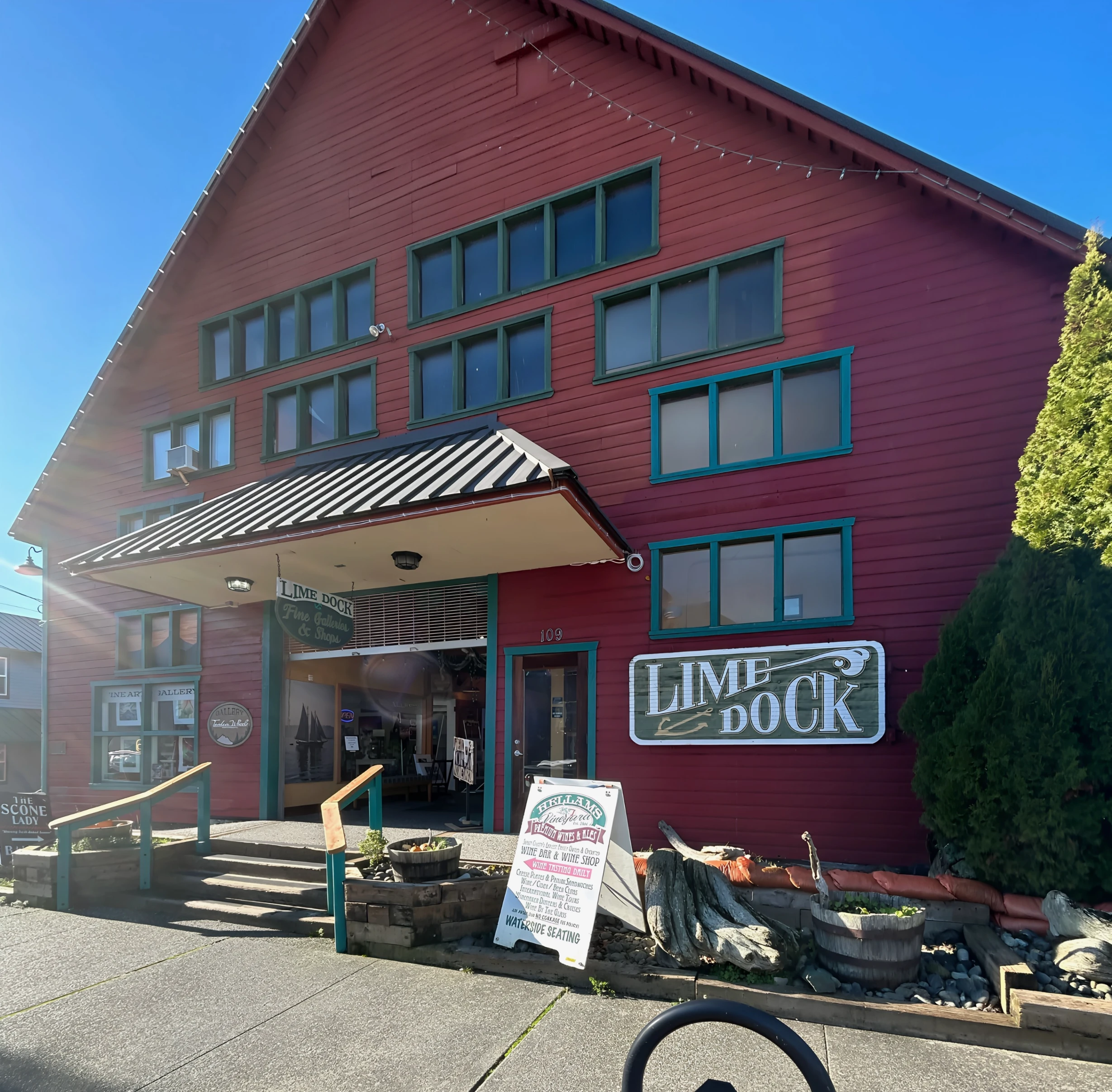
One of our first stops is always a large red barn on the right-hand side of the road. During most of the year, this is a fabulous destination for a morning walk. The Scone Lady bakes several varieties of fresh scones each day, well worth a five-minute walk from the marina. We also very much enjoy patronizing another business at the same location, where we will return later in the day.
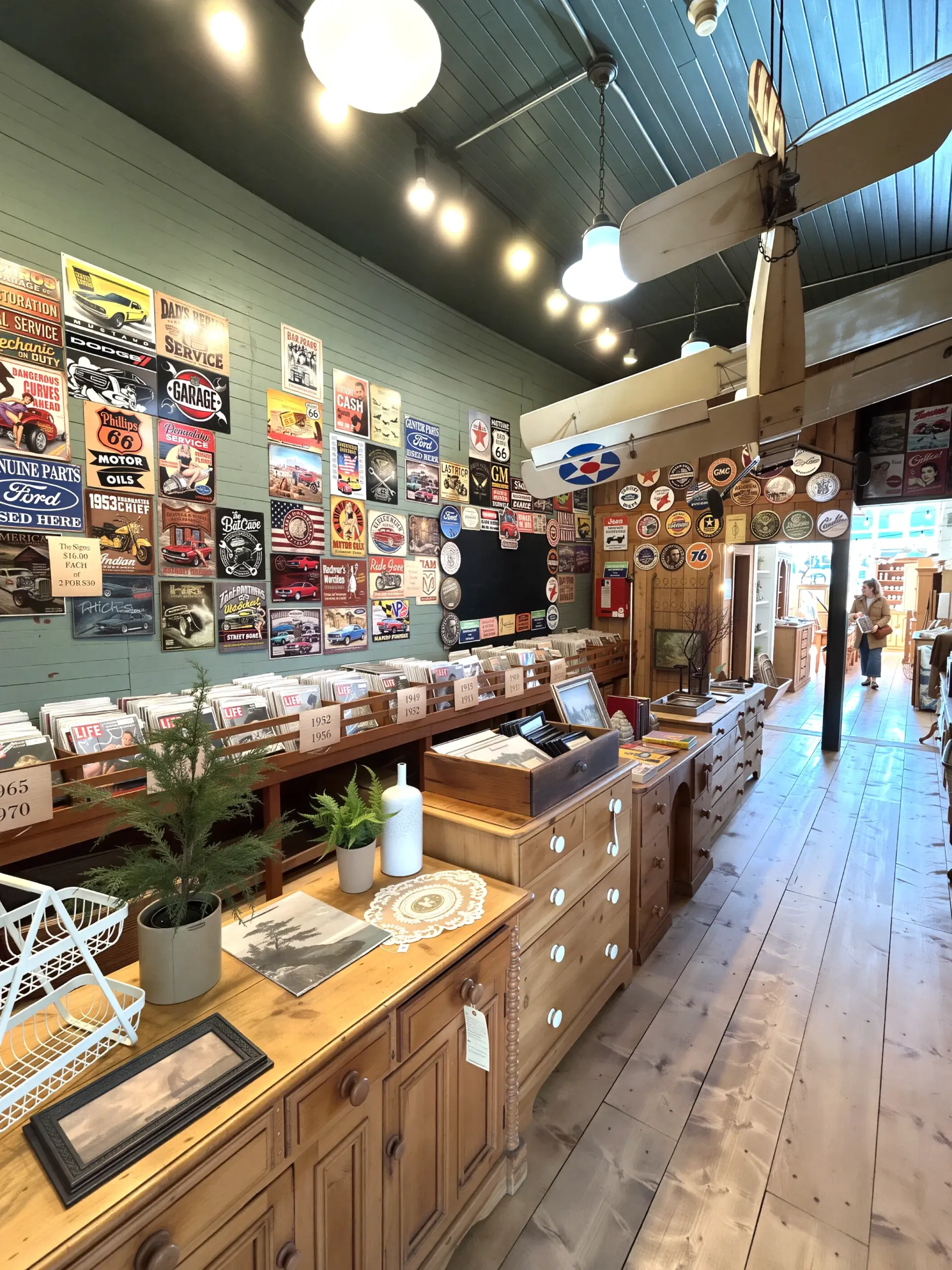
Just ahead and on the opposite side of the road is a business we knew for over 30 years as Nasty Jack’s Antiques. Our Seattle homes have been partially furnished with items we acquired here over the years. Nasty Jack sold out last year, but the new owners, Restless and Refurbished, have more space devoted to a bit classier (but still vintage) furnishings and have maintained some of the eclectic and collectible stocks of old magazines, vinyl records, and novelty metal signs.
Jan is only sometimes successful in forbidding my access to the ice cream shop La Conner Ice Cream Tower, adjacent to Restless and Refurbished, that has a delightful selection of flavors, crisp cones, and friendly service.
2. Historic Heart of Town
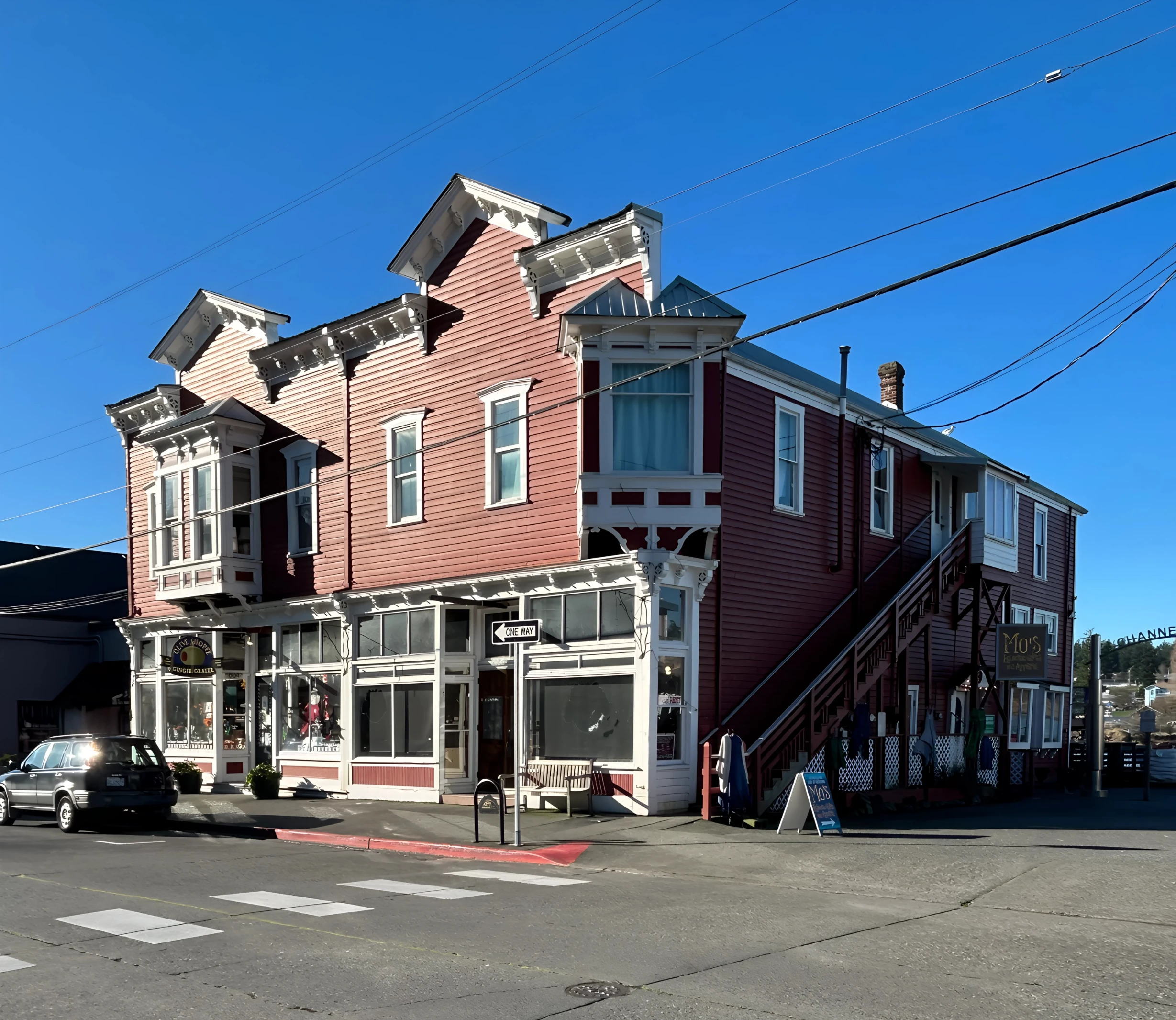
The heart of the National Register of Historic Places-listed business park begins south of Restless and Refurbished. Buildings on both sides of the street sport plaques describing the types of pioneer businesses found here during the 1890s and 1900s. Meat markets, pharmacies, dry goods merchants, and other purveyors of everyday essentials are now all replaced by gift shops and restaurants. Art galleries and craft merchants also abound.
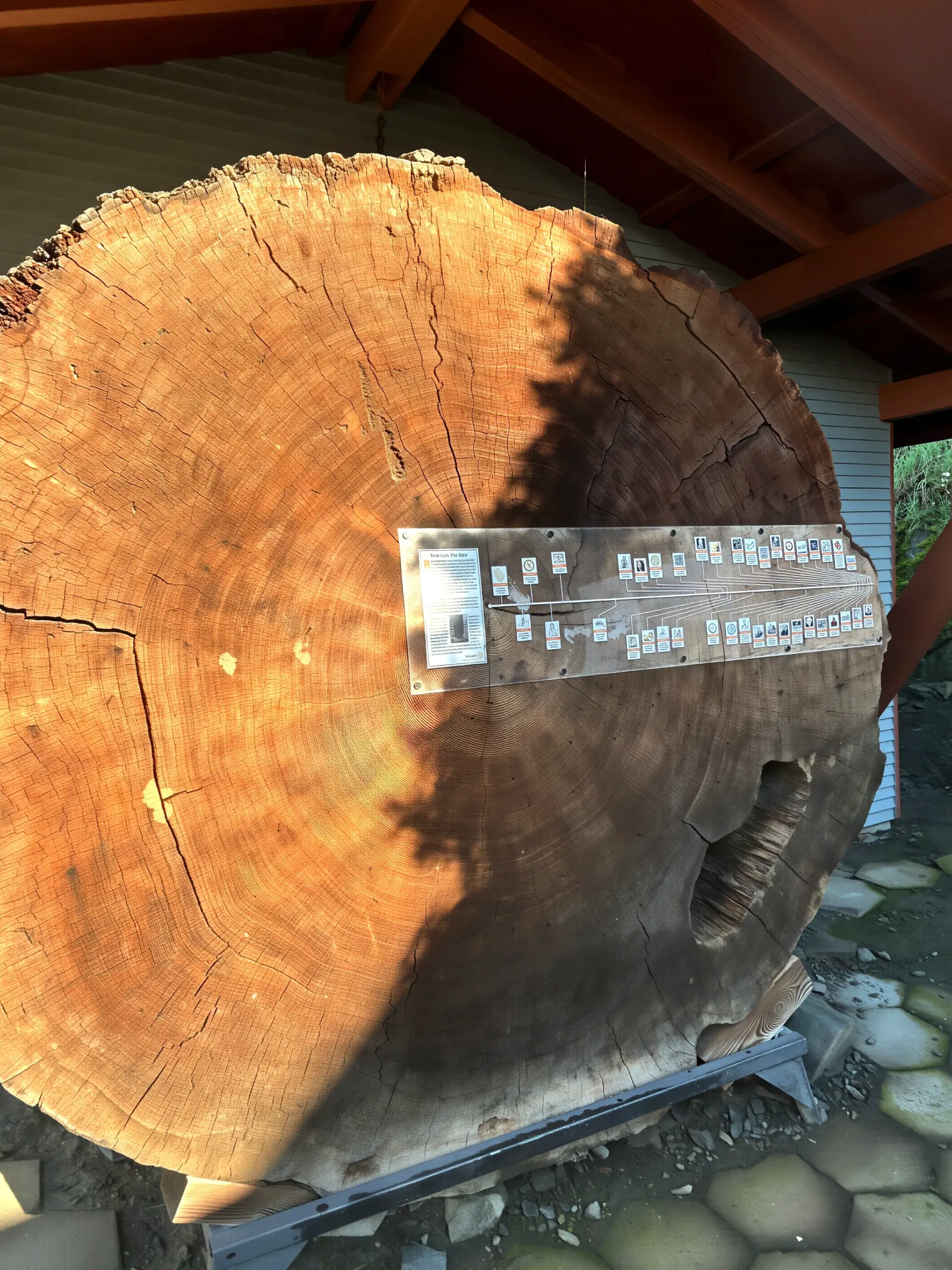
As if the grand old buildings didn’t already convey a sense of history, one of my favorite curiosities in La Conner is a cross-section of a tree displayed near the LaConner Fire Department Museum. Counting the annual growth rings, the tree was a sprout back in the year 1215 AD, a sapling when the Magna Carta was signed, and a substantial tree when Columbus crossed the Atlantic. Dozens of other significant historical events are marked across the sawn face. It’s sobering to consider how many generations of people have been born, died, and were forgotten since the time recorded in the center of that stump. It’s sobering, as well, to contemplate how many generations of people have come and gone since Alonzo Low established his trading post here in 1869.
On our last visit to La Conner, we enjoyed chatting with Mike Bucy, doing business as La Conner Studio 623. Mike restores, repairs, buys, sells, and collects guitars and amplifiers. As a musician, I found him very friendly and informative. But Mike is only a typical example of the reception to expect from La Conner merchants. They’re as happy to have us there as we are to drop by.
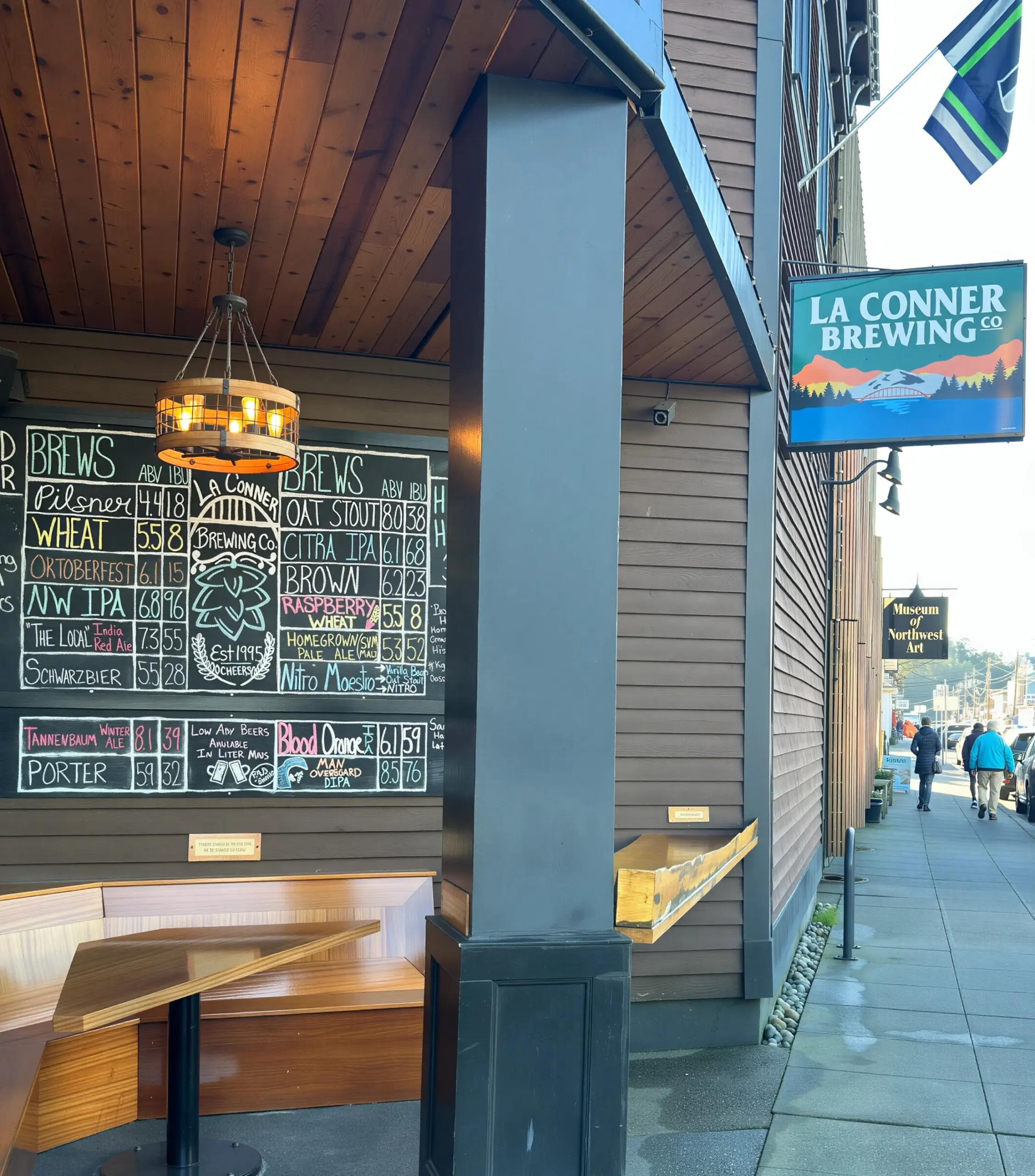
There are far too many places of interest in La Conner to list. Nobody could possibly be bored here. There are several museums, including one of Jan’s favorites—a quilt museum in the old Gaches Mansion. Tasty food is easily available at a variety of restaurants. We’re particular fans of the La Conner Brewing Company, with its excellent pub fare.
If we’re low on provisions, there’s a decent market only a few blocks east of Restless and Refurbished. The Pioneer Market offers a great selection of fresh foods, along with limited hardware items and a few basic boating supplies.
3. Marine Minded
For such a quaint town, La Conner has quite a few marine industry assets worth mentioning. The stout American Tugs recreational cruising boat factory and commercial aluminum boat builder Mavrik Marine are located right there in the La Conner Marina hub, among many other sea-salty businesses and services. Yacht brokers like Fairhaven Yacht Sales and La Conner Yacht Sales call this special waterfront home. There’s some get-it-done marine grit underlying the peaceful, boutique atmosphere.
Seasonal Draws of the Skagit Valley and Surrounding Waters
La Conner and the surrounding Skagit Valley are home to notable seasonal attractions dictated by the cycles of nature. For boaters, they can be a mere bicycle trip, rideshare app, or friend-with-a-car away.
Even if you aren’t a die-hard birder, the avian migration that passes through the area is objectively epic in scale. The months between December and February are generally considered the best to see the migrating birds in great numbers, including tens of thousands of snow geese and swans gathering on Skagit Valley farmland. Hordes of shutterbug birders are often to be found shadowing them from the road with documentarian-level gear.
The aforementioned tulip fields are not far from La Conner and tend to bloom throughout April. Visitors come from far and wide to see the seas of colorful blossoms and enjoy vaguely Dutch-themed bites and ambiance. A visit is ideal romantic date material.
One thing to be on the lookout for, especially when venturing up into the Swinomish Channel from the south, are gray whales. The mighty, barnacle encrusted cetaceans, often referred to as “sounders,” love to sift through the mud for their food on the east side of Whidbey Island and in Saratoga Passage as a stop on their annual migration. Late February through May, with a peak in March and April, are widely considered the time to see gray whales just south of La Conner.
Our special sunsets
Jan and I will either time our walkabout to end just before sunset or venture off the boat a second time once again to the red barn south of the guest dock. Our destination will be Hellam’s Vineyard, located at the extreme end of the barn.
There could be 1,000 bottles of wine for sale at Hellam’s in every conceivable price bracket between “modest” and “oh my gosh.” Fans of beer and ciders will find a wonderful selection here as well. Get some beverages at the bar, order a plate of meats, cheeses, veggies, and crackers, and wander out to the deck overlooking the Swinomish. Bask in the warmth of a late summer afternoon while boats pass to and fro below. Listen to the splash of a decorative fountain adorned with a cement seagull, who might be joined by a few living relatives. Converse with a crowd of mostly fellow boaters, converted to instant friends at Hellam’s.
This is La Conner, the reason why we almost always decide to take the Swinomish Channel when heading north from Skagit Bay.
Navigator Notes
When transiting the Swinomish Channel, it is important to remain aware of the daymarks and buoys. Use a decent chart with an adequate display. Boaters will want more detail than is easily observed on a cell phone format. There’s a definite channel in which one must remain and it shoals almost instantly on either side. Not far north of La Conner, the red and green marks swap sides in the channel at a point where it was determined a vessel is no longer “outbound” from Padilla Bay but suddenly “inbound” to the Port of La Conner. It’s easily detected on a proper chart, but one should be prepared for it.
From one end of the channel to the other, and especially at the south end, do not cut any of the buoys. People committing that mistake often have a rude awakening as they make an unwanted acquaintance with the bottom.
Tide and currents are considerations as well. At full flood or ebb, the current runs about two knots in the Swinomish Channel, which is enough to significantly slow the progress of most sailboats and some trawlers that happen to be running “upstream.” Deep draft vessels will certainly want to consider the tides. Our trawler draws about four feet, and we have been alarmed by some of the readings on our depth sounder when trying to make the passage at a minus tide. We try to time arrival for at least a +1 tide, with a rising tide better than falling.
There are some small “town floats” immediately in front of the historic buildings in La Conner. Moorage there is 75-cents/foot/night. Payment by credit card is collected electronically, immediately ashore. The town floats are normally full in the summertime.
The Port of Skagit County operates two large guest docks at La Conner, with the first immediately north of the business district, and we typically have good luck finding moorage here. Reservations are recommended during the summer months, but only available on one of the two guest docks. The second guest dock is always first-come, first-served. Reservations are available by phone at 360-757-0011 or online at portofskagit.com.
Don’t just automatically make straight for the dock. You may want to turn around, which may require a surprising amount of room, and approach from the opposite direction. If the current is running at any sort of speed, it’s advisable to dock “upstream” or against the current. The practice allows a boater to maintain much more control, with less chance of the current “sweeping” your boat into somebody already secured to the dock (not a recommended way to meet the neighbors).
Some of the oldest salts know that if there’s space on the inside of the guest docks at La Conner, it’s much easier to dock there than on the outside. The flotation for the guest dock descends probably four or five feet or so below the surface, often cutting the current at the surface to about half the speed encountered on the outside of the structure.
Docks at La Conner feature 30-amp shore power and potable water. Each of the guest docks have pump-out systems. There is a privately operated fuel dock as well.
The Swinomish Yacht Club is across the street from the marina. If you belong to a club with reciprocal privileges, and if there’s room, you can tie up to their reciprocal dock for a night or two with no charge, except for shore power. Everyone we have ever met associated with Swinomish Yacht Club have been nice folks.