What goes up, or blows up, eventually comes down. My wife Jan and I vividly recall our last inflatable dinghy. We were secured to a mooring buoy off Jones Island on a gorgeous, warm, sunny, late afternoon in August. Perfect time to go ashore for a walk. We launched the [well-known name redacted] inflatable and began rowing toward the guest dock. At about 30% of the way across the bay, Jan said, “Hey, my feet are getting wet.”
I was so busy rowing that I hadn’t bothered looking at the floor in the dinghy, but yes there was some water there that really shouldn’t have been. “Not sure where that came from, but we’ll bail it out when we get to the…” What at first appeared like a small ripple almost instantly became a major flow of water into the dinghy. I assessed that we were by then slightly closer to the guest dock. It made sense to try to make a landing there.
“Bail whatever you can and I’ll row like hell!” Both tubes appeared to be well inflated. It wasn’t likely that we would sink, but by the time we got to the guest dock we were wet up to our shins. Good Samaritans helped me haul it out. The glue holding the floor to the pontoons had failed down one entire side of the boat.
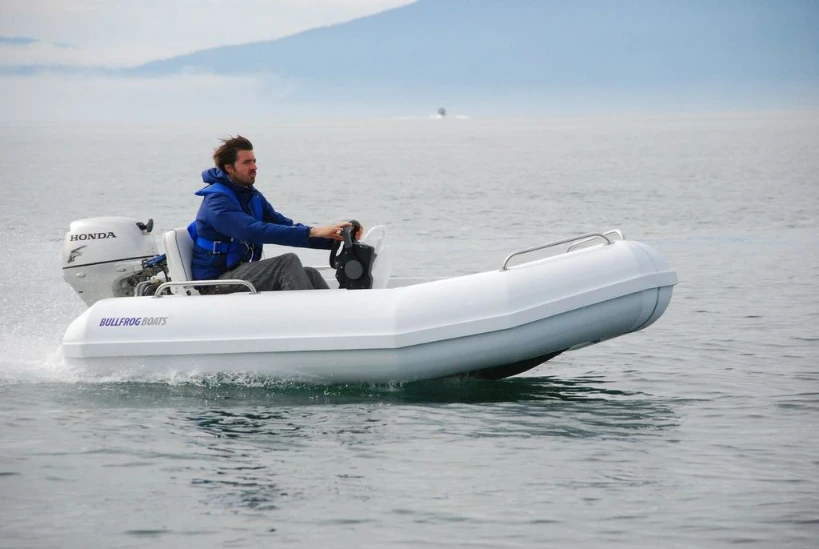
Our immediately next, and still current, dinghy will never suffer the same problem. We upgraded to a Bullfrog Boats 10’ tender. We have been oh-so-pleased with it.
Bullfrog Boats are built with a unique design. The tubes are a high-impact polyethylene said to be several times more impact-resistant than fiberglass. The hollow tubes are filled with foam flotation for an extra measure of safety. There is so much flotation in the polyethylene collar that, when arriving at the dock, an adult male can step onto the side of the Bullfrog and it will remain stable underfoot.
Each Bullfrog has a semi-V aluminum hull (designed to be beached) and an aluminum transom. All the components are bolted together rather than glued. We rigged our Bullfrog with a 15-horsepower Suzuki outboard and it will get up on plane at less than half throttle.
Craig Henderson founded Bullfrog Boats in Bellingham back in 1997. We once asked Craig, “Why did you name these boats Bullfrog?”
Craig smiled and replied, “You can’t sink a bullfrog. Even of one of these boats gets swamped entirely, it isn’t going to sink. It might be riding at or just below the surface, sort of like a bullfrog, but it isn’t going to sink.”
The 10’ utility tender may be upgraded to include a steering console with rotary helm.
Boaters in search of something larger or more elaborate might consider other boats in the Bullfrog fleet. Tenders are available in 10’ and 11’6” lengths, with Sport Utility models at 15’, 17’, and 22’ in length.
********
More Information
Bullfrog Boats are now represented by Seattle Yacht Sales and manufactured in Anacortes, Washington.
Website: https://www.bullfrogboats.com
Phone: 360-531-7685
Email: info@bullfrogboats.com
- LOA: 10’
- Beam: 5’6”
- Weight (with 15-horsepower Tohatsu): 320 lbs.
- Maximum capacity: 3 persons
- Maximum HP: 15