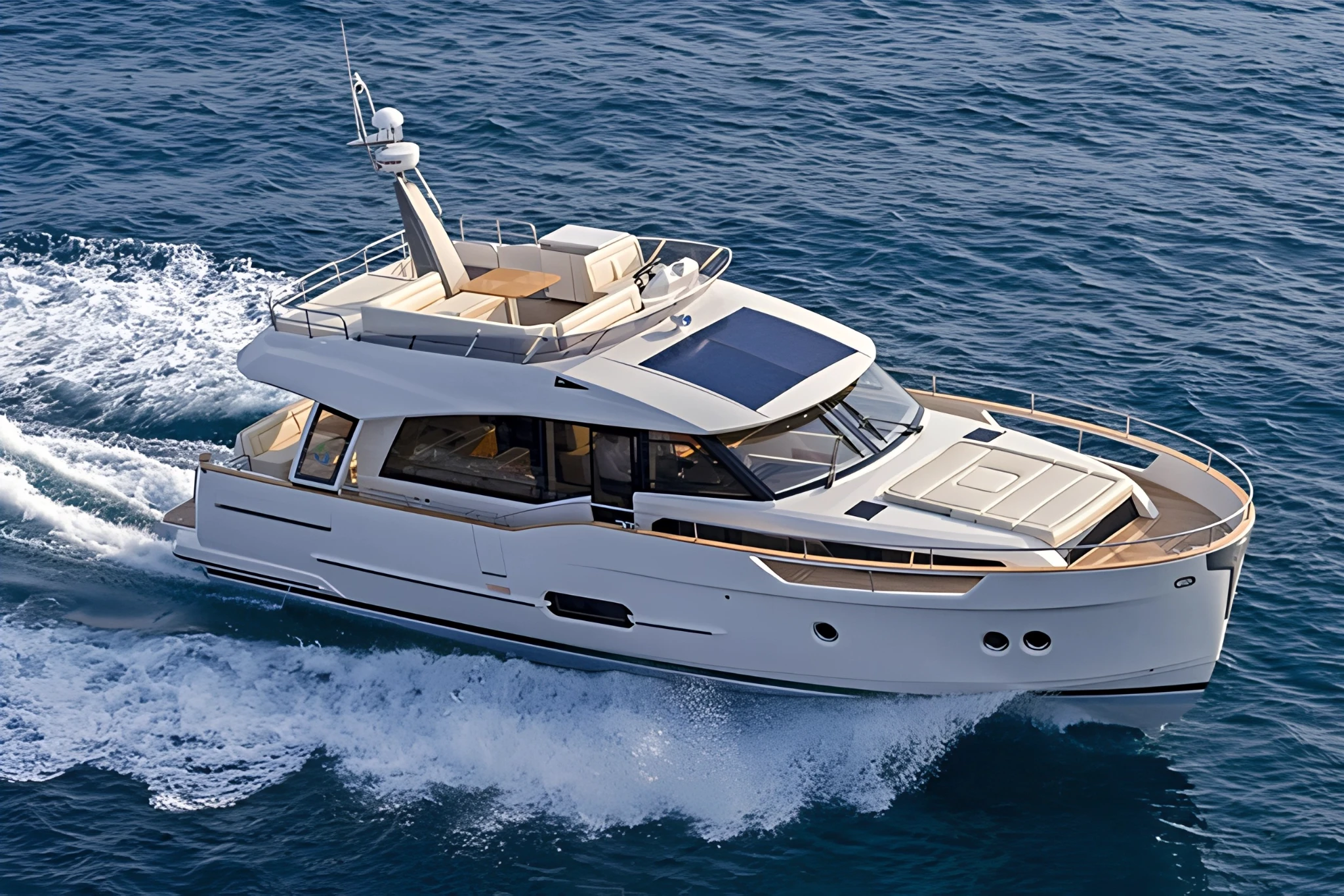
Image: The Greenline 48 flybridge features a clean, low profile design.
We’ve all been there, and some of us have “done that.” Lazy summer afternoon, third week of July, 82 degrees, and not a ripple disturbing an idyllic anchorage. Silence prevails, save the soft splash of oars as somebody in a small inflatable rows a concerned looking dog to the beach. Fellow boaters on nearby vessels sip beverages or turn the pages of a favorite book. But, look at the time! The boat with the all-electric galley needs to begin preheating the oven for dinner and, what’s more, the hungry inverter has all but exhausted the house bank. Crank, crank, crank, VROOM! With a cloud of startup smoke, the dreaded generator begins rattling away and violates the contemplative stillness.
Or it’s “zero-dark-hundred” and if the boat is going to meet slack current at Dodd Narrows, it’s time to get under way. Rumbling main engines roar to life and idle for several minutes to warm up while people anchored nearby are (or more accurately “were”) asleep. To be sure that everyone in the anchorage has an equal opportunity to experience the cacophony, the early morning departure must, of course, wend its way through the entire harbor en route to a plotted course.
These incidents may seem unavoidable and “come with the territory” when at anchor. Understandably, each of us has limited choices based on the design and technology of our boats. But what if there were another way available to those who would prefer an alternative? As it turns out, there is.
Greenline Hybrid Yachts (available locally but manufactured in Slovenia) offer an alternative to noisy diesel generators or the need to fire up a pair of 300-horsepower main engines to motor away at 2 or 3 knots. The acknowledged pioneer in hybrid-electric propulsion, Greenline spent many years perfecting the technology before some of the “Johnny-come-lately” competitors started tracing their first electric-propulsion yachts on an empty drawing board.
By way of simple explanation, a Greenline Hybrid Yacht works on a principle like a hybrid automobile. Electric motors turn the props when the vessel travels at slower speeds, such as around an anchorage, in a marina, when trolling for salmon, or just enjoying the almost “sailboat silence” on a laid-back, low-speed, wine-and-cheese sunset cruise. When more speed is desired, high-efficiency diesel mains start up and take over propulsion. When the diesels are engaged, the electric motors become generators and recharge the batteries.
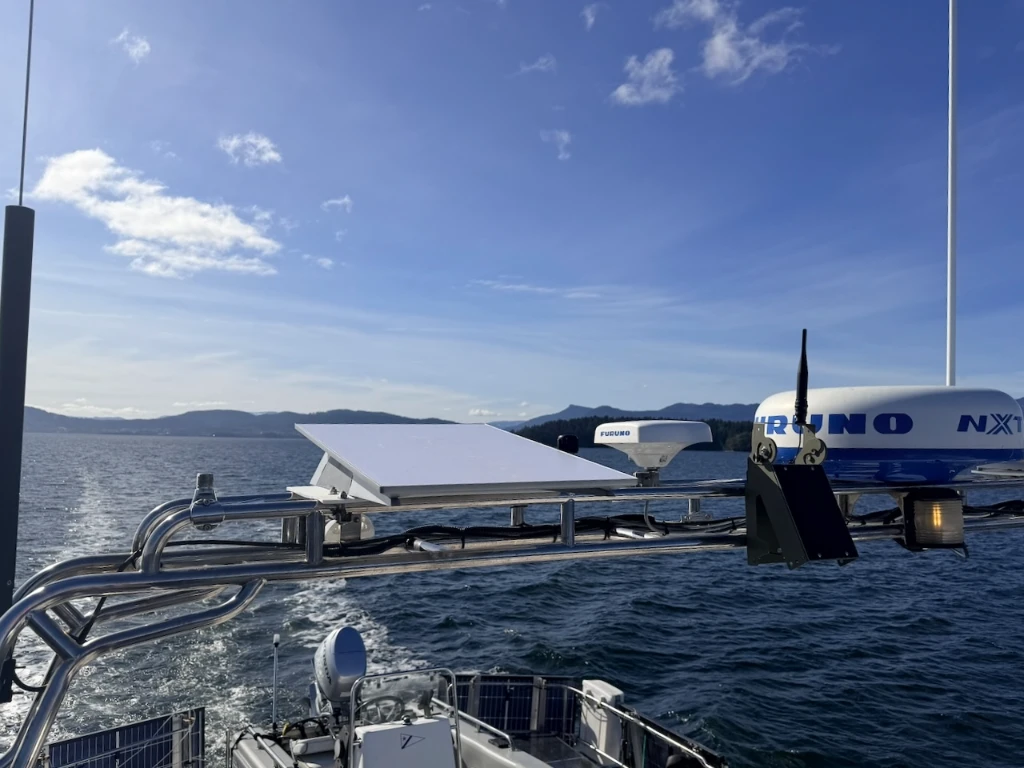
Greenline Hybrid Yachts utilize large photo-electric panels to generate electricity when under way or at anchor. The solar panels, coupled with the large battery capacity of the vessel, provide more than adequate power for any electrical needs aboard. Most Greenline Hybrid Yachts are ordered without an auxiliary generator.
There are several unique yachts built by Greenline. Their hybrid yacht range includes both coupe and flybridge designs from 39’ to 58’. Owners are permitted to make some layout choices during construction of a new Greenline, so, coupled with the differences in basic floorplans between some models of comparable size, acquiring a new Greenline hybrid yacht is not exceptionally different from ordering a custom build.
In this article, we’ll examine a model that proves to be of interest to anyone looking for luxurious style, in a configuration still manageable by a knowledgeable cruising couple: The Greenline Hybrid Yachts 48 (Greenline 48).
Styling
Greenline offers the 48 in either a coupe or flybridge configuration. Styling on either version incorporates the timeless features and proportions of nautical grace and beauty, accentuated with restrained use of flares and flourishes that make a contemporary statement. Greenline avoids the use of over-the-top styling gimmicks that inspire a few “gee whiz!” reactions, but then quickly lose appeal and look dated. A Greenline 48 doesn’t look like your grandfather’s yacht, but at the same time grandfather would almost certainly approve.
Many prospective owners who live in climates where a flybridge isn’t going to be heavily used during much of the year will additionally consider the coupe styling. Greenline Hybrid Yachts coupe styling allows the builder to include several additional solar panels on the expanded cabin top, facilitating faster recharge of the batteries and more effectively eliminating any need for a diesel generator.
Greenline successfully incorporates the flybridge into motoryacht design. Cowlings, radar arches, and other structural components blend seamlessly into the overall look of the boat. Everything is low profile. There’s no towering edifice to exaggerate a rolling motion or additionally complicate docking in a crosswind.
On deck
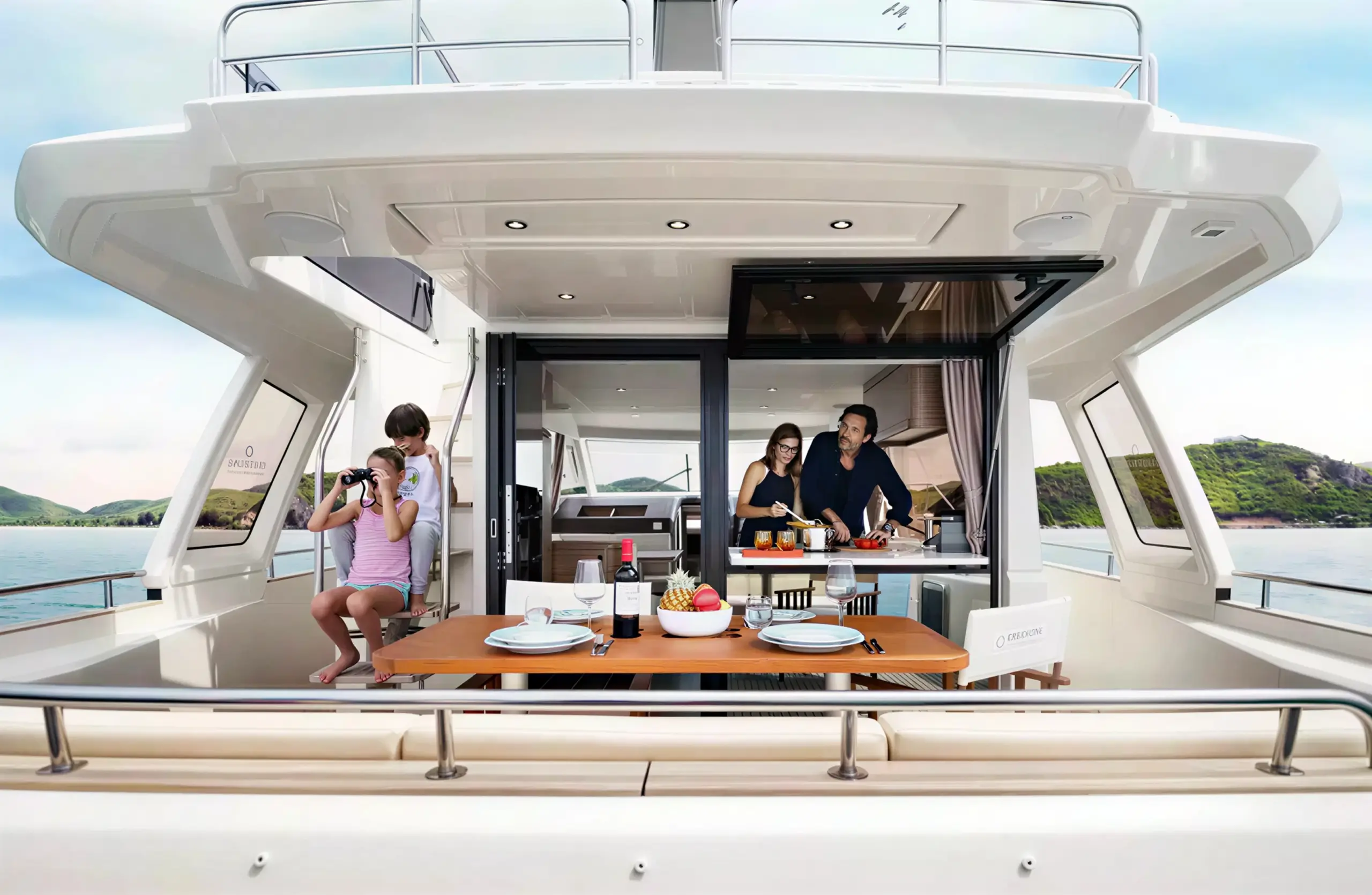
Greenline 48 owners will normally invite guests aboard at the stern. A hydraulic swim platform creates a welcoming “porch” (when not submerged for launching and retrieving dinghies or creating a just-awash bathing platform). The Greenline 48 is boarded with equal ease from port or starboard. Steps on each side are separated by a handy transom stowage locker—an excellent place to tuck away lines, fenders, PFDs, crab pots, or even an inflatable tender.
Easily negotiated steps, rather than a ladder, foster easy passage from the swim platform to the cockpit. The cockpit enjoys some protection from rain or extreme sun provided by an overhanging cabin top.
Greenline perceives the cockpit as one of the main socializing areas within the parameters of each design. While not as (often needlessly) enormous as some cruising cockpits, there is comfortable seating and a generously proportioned table at the transom as well as space on deck to arrange additional chairs. This flexibility permits the seating of guests in a variety of configurations, depending upon the size of the group and the occasion. There are no extended stretches of unused seats taking up space which, again depending upon the occasion, might be better utilized.
Beneath the cockpit, an enormous lazarette increases stowage options substantially. There’s enough room available that the Greenline 48 can be ordered with a “skipper’s cabin” located here, equipped with a single berth, toilet, microwave, and TV.
A Greenline characteristic universally applied among their models is a folding aft bulkhead for the main cabin. Locating the galley most aft in the main cabin permits easy food and beverage service in the cockpit area, without isolating the cook or the barkeeper from the festivities.
Greenline Hybrid Yachts never loses sight of the fact that their vessels need to be functional at sea. Side decks, both port and starboard, are of more-than-adequate width. Passage is secured by high bulwarks topped with substantial handrails. Both side decks offer overhead protection from the elements for a portion of the way forward. Transiting forward, one might notice some cutouts in the gunwales. These openings align with cabin windows on the lower deck, cleverly bathing the interior of the Greenline 48 in an abundance of daylight.
A boarding door on the starboard side is strategically placed to enable the skipper to step out of the pilothouse across the deck and onto the dock—a useful maneuver when docking either solo or shorthanded.
At the foredeck, Greenline includes a sunbathing area atop the trunk, with skylight hatches on either side. Ground tackle is hauled by a vertical winch, with chain stowage in a locker below.
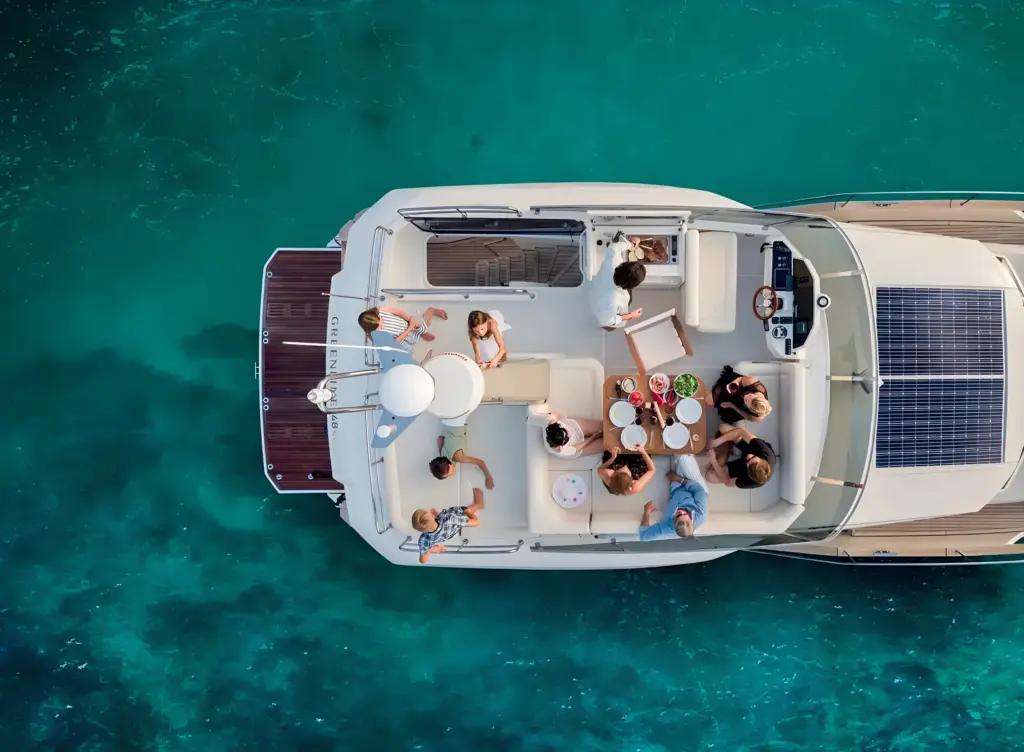
The flybridge version of the Greenline 48 offers some exceptional advantages compared with the 45’ model. There is a an “open D” shaped seating area to starboard, with the helm once again to port. A mini galley with a wet bar and a grill is also on the port side, aft of the upper helm. A plethora of seating options create an area fully prepared for entertainment.
Interior features
The 48 Greenline Hybrid Yacht is always configured with a three-stateroom layout.
The grand entrance to the main cabin of the Greenline 48 leads from the cockpit and continues through the aft bulkhead. Greenline puts exceptional emphasis on making the livability “flow” back and forth between the main cabin and cockpit, especially by use of the folding portions of the aft bulkhead that eliminate any separation from the most forward portions of the cockpit and the aft portions of the galley.
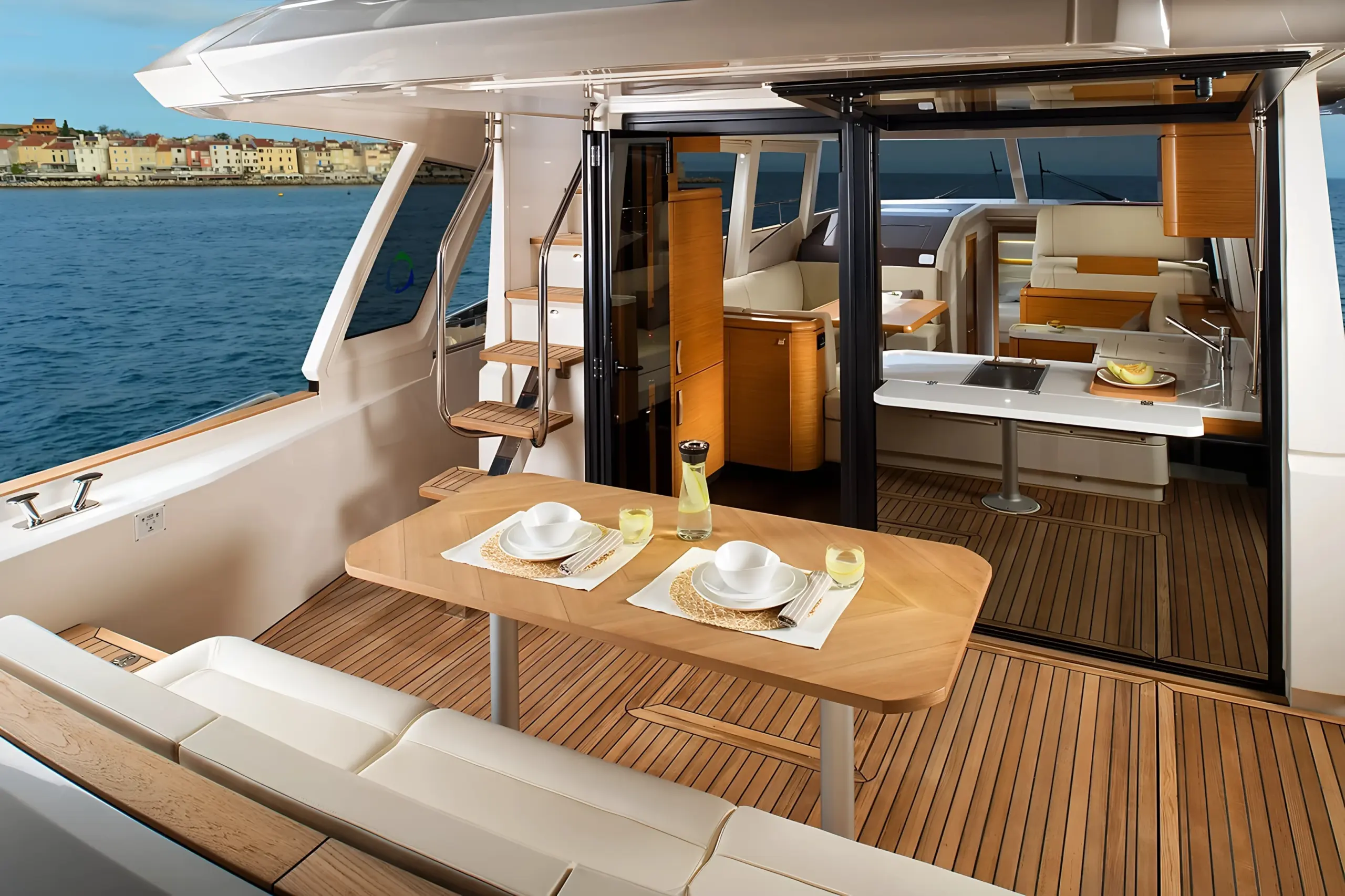
The generous use of large windows in the main cabin additionally helps contribute to a smooth transition between indoor and on-deck spaces. One steps from the cockpit into a similar light level in the main cabin.
The Greenline 45 Hybrid Yacht situates that galley in the aft starboard quarter of the main cabin. Joinery throughout the entire vessel is finished to a world-class standard. A two-burner induction cooktop and an electric oven are positioned athwartship, with a galley sink facing the starboard cabin wall. There are covers for the galley sink and an adjacent garbage bin, allowing the creation of additional counter space when the sink is not required. Across the companionway, in the aft port quarter, the Greenline 48 Hybrid Yacht includes a full “household-size” two-door refrigerator/freezer and a microwave/convection oven. There’s a dedicated laundry area, accessible through a hatch in the galley floor.
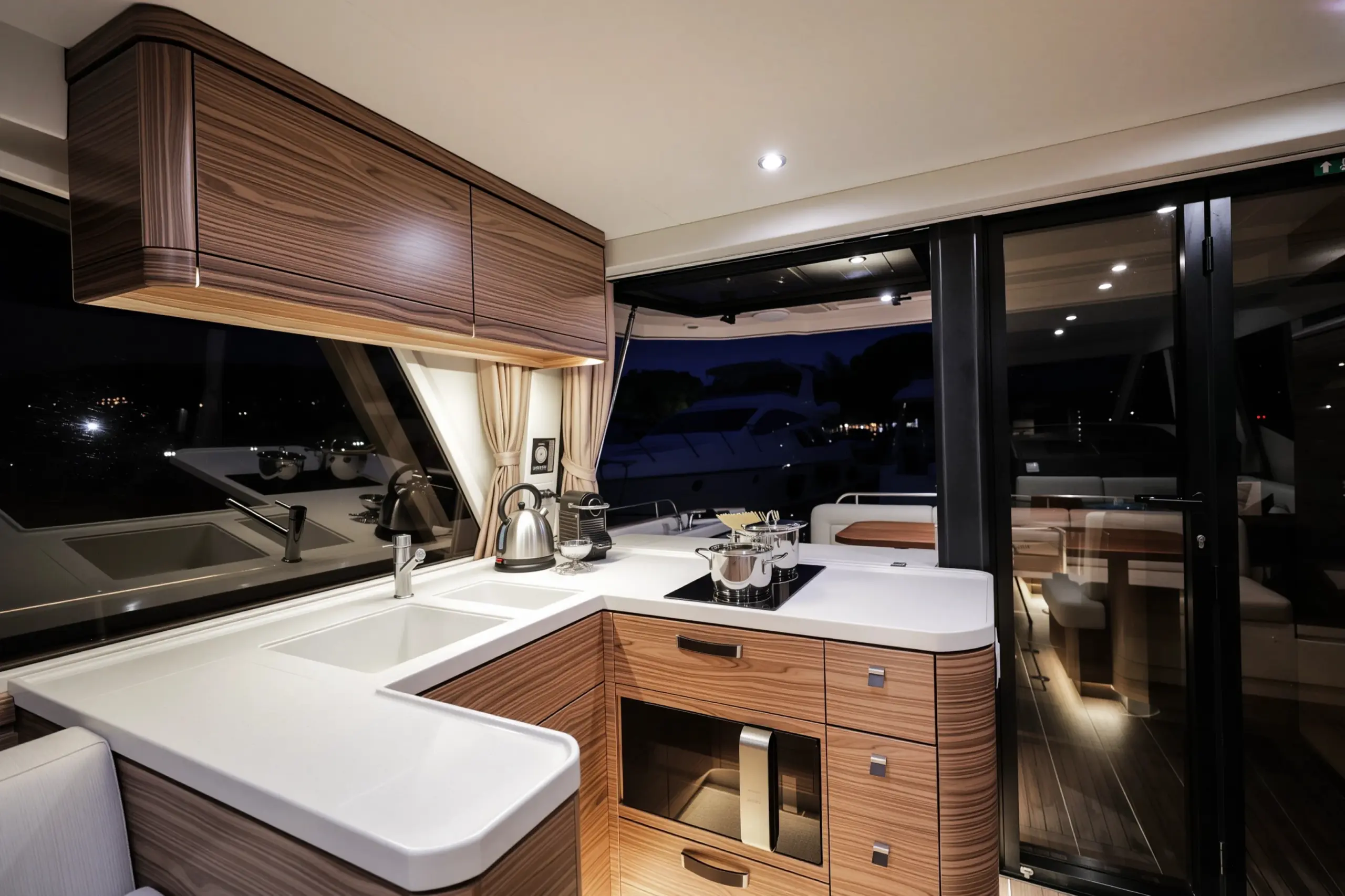
With the high battery capacity of a Greenline 48, in conjunction with solar panels, it’s feasible to operate the all-electric galley and all other functions at anchor, without requiring an auxiliary diesel generator. The coupe versions, with their additional solar panels, are particularly well adapted to this principle.
Moving forward from the galley area, a hi-lo dining table is wrapped on three sides by a well-executed settee. As expected, when the table is in the “lo” position, this area becomes an additional bunk to accommodate that “extra” guest staying overnight.
Opposite the dining area on the starboard side, owners of a Greenline 48 can select either an entertainment center with built-in video screen and stowage or an additional settee.
The lower helm station is in the starboard forequarter of the main cabin. Greenline puts great emphasis on ergonomics, allowing easy access and visibility of all major controls. Everything a modern navigator needs or desires either comes standard or can be seamlessly installed at the lower helm. The helm, of course, includes the simple and intuitive controls for the diesel/electric hybrid drive system.
Companionway steps provide easy transit between the main cabin and the lower deck.
The master stateroom is most forward on the Greenline 48. A large, custom-sized mattress creates a centerline berth. An optional “split single” berth is also available on the Greenline 48—an arrangement that “scissors” together at the heads of each bunk and can be positioned so that the two singles form a centerline double.
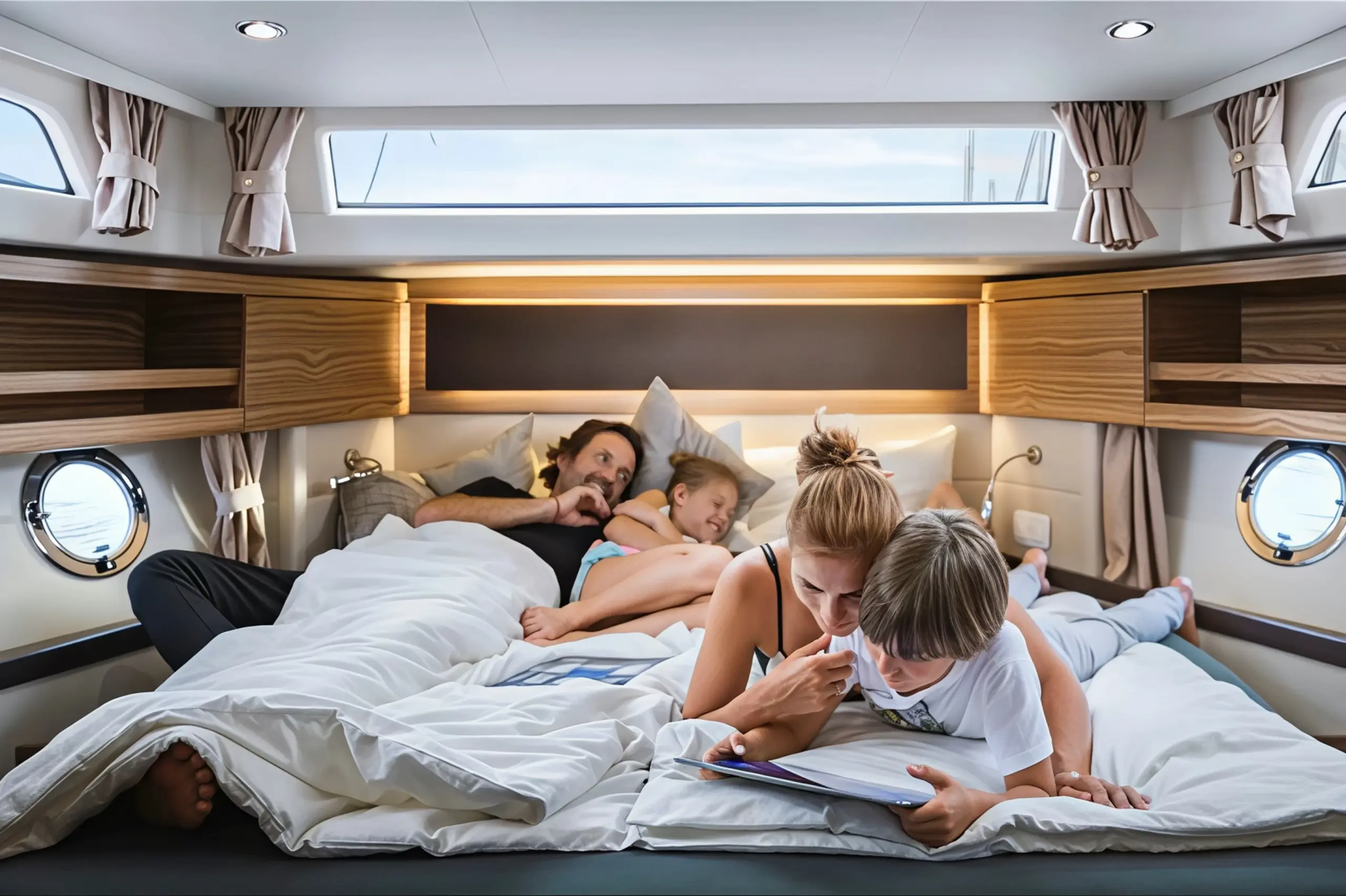
There are fixtures on either side of the berth ideally suited for storing and charging cell phones. Windows in the master stateroom line up with the cutaway portions of the gunwale, permitting “over the water” viewing from the lower deck.
The Greenline 48 features a “split head” concept for the master stateroom, with the toilet and sink in a compartment on the starboard side and the walk-in shower in a similar compartment to port. This is an ideal arrangement when somebody is showering and somebody else would like to use the head.
There are two guest staterooms on the Greenline 48. Each stateroom is equipped with a pair of single beds, a variety of stowage options, reading lamps, charging stations, and almost everything essential for a comfortable night afloat. Each of the guest staterooms has its own en suite, single compartment head.
Propulsion and performance
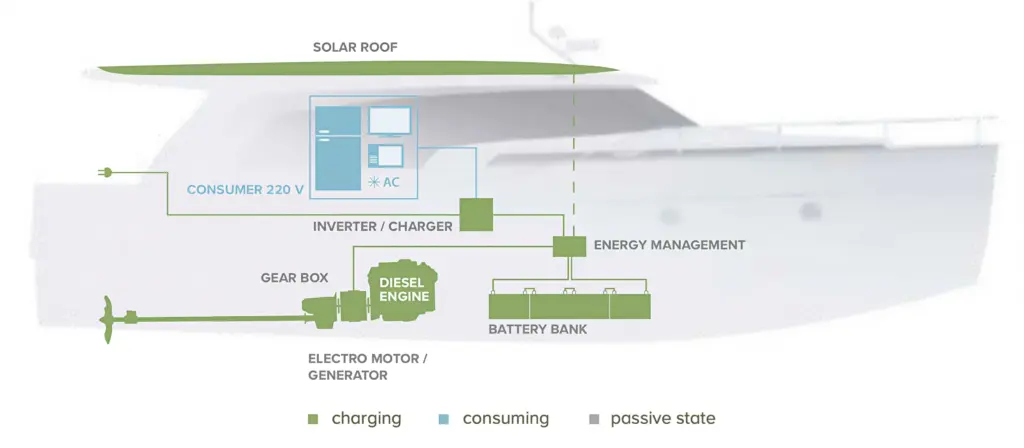
Boaters who aren’t in a hurry or planning to travel a significant distance on a particular day might not even start the diesel engines on a Greenline 48. The electric drive system is rated for a 30-nautical-mile range at 7 knots. Certainly, in our Pacific Northwest waters, currents will either increase such speeds and range but, for short distances at “sailboat speeds,” the Greenline 48 can operate without burning any fuel at all.
The Greenline 48 hybrid employs twin Yanmar diesel engines, connected to electro-generator drive systems. Greenline offers three different diesel configurations on the 48. A pair of Yanmar 4LV 250-horsepower engines will provide a maximum speed of 15 knots. Those in search of a higher top speed can opt for a set of Yanmar 8LV 370s (rated for a top speed of 25 knots) or twin 6LY440s (rated for 28 knots).
At slower speeds, the diesel-electric hybrid drive system relies on energy stored in high-capacity lithium polymer batteries and the prop shafts are turned by electric motors. When a higher speed is required, the vessel shifts into diesel mode and the shafts are turned by the Yanmar engines. While the Yanmars are turning the shafts, electric drive motors become a pair of generators by which the battery system is recharged while under way. The batteries can, of course, be recharged using shore power or by the array of solar panels on the cabin top.
The benefits of a hybrid drive system are numerous. Diesel engines don’t like to run at idle speeds yet, in some cases, as much as 40% of the time a marine diesel is operating at well under 1,000 rpm. This slow speed operation subjects an engine to more wear and stress than running at 80% of wide-open throttle, and the inefficiency often results in increased exhaust emissions. Shifting the low-speed duties to an electric motor system, which is designed for such applications, makes almost too much sense. Hybrid yachts will rack up fewer engine hours, which often improves resale value. Hybrid yachts require fewer “hours based” services, such as oil and filter changes.
What’s more, purchasers who would ordinarily be liable for payment of Washington state sales tax may be able to legally avoid paying that tax under provisions of RCW 82.08.996. The state statute exempts from state sales tax watercraft equipped with a system designed to propel the vessel with electric power. In the case of a new Greenline 48, such savings would be more than $100,000.
Greenline Hybrid Yacht 38 Specifications
Beam: 14’ 8”
LOA: 50’ 8”
Draft (empty): 3’3”
Displacement (empty): 30,423 lbs.
Bridge Clearance: 11’ 6”
Fuel tank: 396 gals.
Water tank: 159 gals.
Waste tank: 2 x 21 gals.
Max range under diesel power: 1, 000 nautical miles
Electric drive system:
Motors: 2 X 100kW
Battery capacity: 160 kWh
Maximum electric drive speed: 11 knots
Electric drive cruise speed: 7 knots
Electric drive range: 30 nautical miles
Solar panel system:
Panel capacity: 2.2 kWh
Standard LiFePO4 batteries: 615 kWh
Standard inverter: 5 kW
Broker Contact
In the Pacific Northwest, Greenline Yachts are represented by Ocean Pacific Yachts in Seattle. Website: www.oceanpacificyachts.com Phone: 206-659-0710