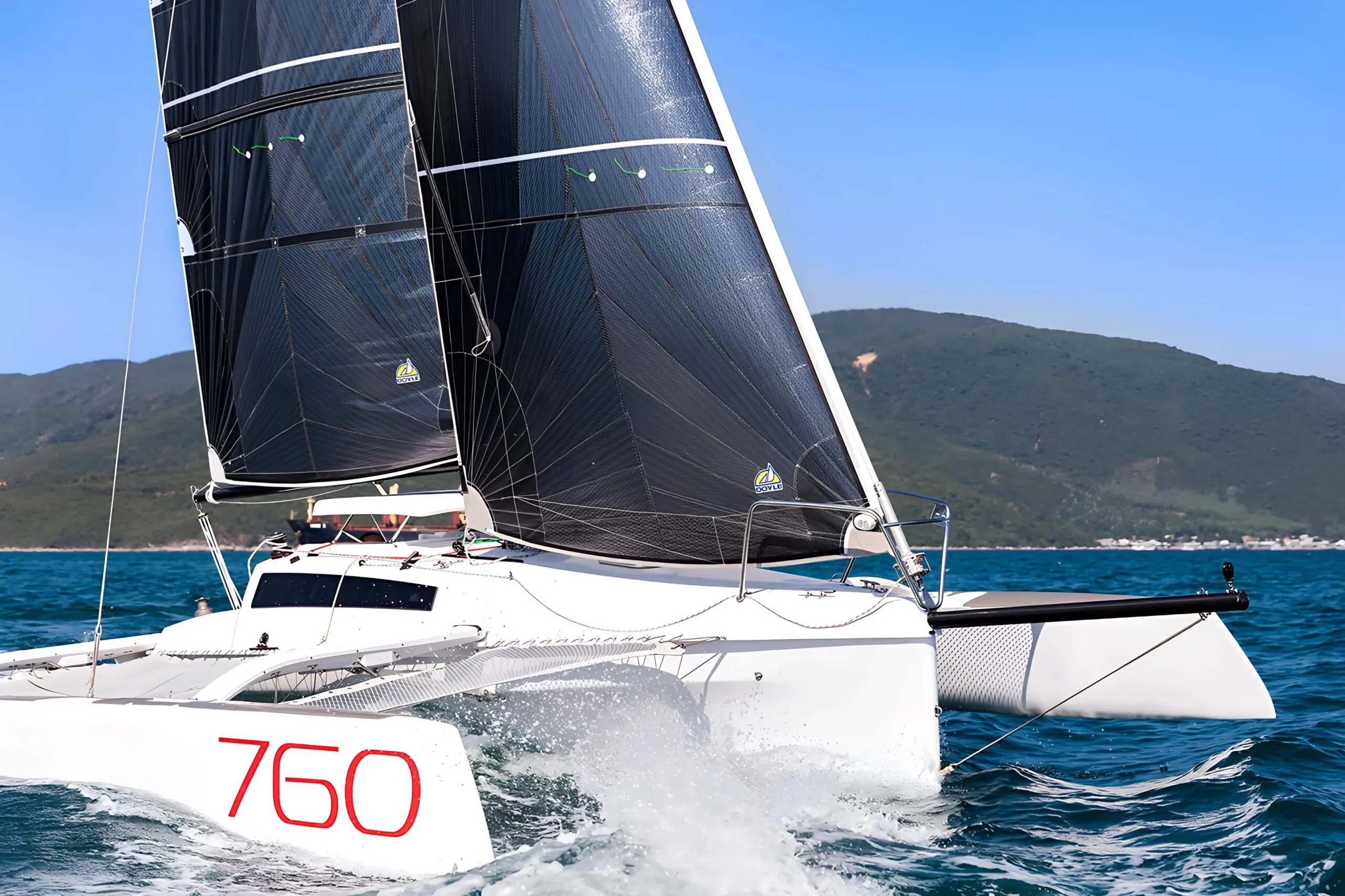
Image: Corsair Marine 760 Trimaran underway. Photo courtesy of Wright Yachts.
Finding, and affording, a slip in most marinas these days isn’t an easy or inexpensive endeavor. For people who own or are considering purchasing a small- to medium-sized boat, trailering can be a realistic option. Certainly, for no more than the monthly rent on a lot of slips, it’s possible to make payments on an adequate and reliable tow vehicle that will meet other nonboating transportation needs as well.
Trailer boating need not be limited to powerboats. A variety of “trailer sailors” with fold-down masts and retractable keels permit sailors to enjoy the advantages of trailering. Boats can be hauled and launched in a variety of locations, drastically expanding the cruising areas available to recreational boaters. Most states limit the width of trailers to 8’6”, without a special permit and/or escort vehicles. Most smaller powerboats and monohull sailboats avoid exceeding 8’6” beams.
At first glance, multihull sailboats wouldn’t seem to be ideal candidates for trailering, but the 24’ Corsair Marine 760 trimaran is built with trailering in mind. Under way, the Corsair 760 makes excellent use of a beam just under 18’, but, in less than 30 minutes, the mast can be lowered for transport and the two outer hulls (“amas”) folded against the center hull. The result is only 8’2” wide—legally trailerable just about everywhere. In cases where the mast doesn’t need to be lowered, such as taking an overnight slip in a commercial marina, folding in the outer hulls only requires loosening a few bolts. The process can be completed in the water and takes just a couple of minutes per side.
Fans of trimarans cite several advantages, but speed and handling are going to be near the top of any list. The Corsair Marine 760 is reportedly capable of 20 knots under ideal wind conditions, leaving most powerboats and virtually all monohull sailboats in its (minimal) wake. Should seas become unpleasantly “lumpy,” multihull boats behave in a more civilized fashion. As with any boat, owners of trimarans should be hesitant to set sail into the teeth of gale-force winds.
The maximum heel angle of trimarans is typically 12–14 degrees; almost “flat” sailing. The daggerboard keel and the rudder remain well submerged, providing a greater sense of control and stability. A solo sailor or a cruising couple should have no difficulty handling a Corsair Marine 760.
Corsair Marine suggests that the 760 model is appropriate for groups of up to seven people aboard, but conventional overnight accommodations would be ideal for two people and possible for four. There are two V-berth bunks forward, and up to two more people could sleep on convertible elements in the salon/galley. “Unconventional” berthing on a warm summer night would include outdoor sleeping in the nets connecting the port and starboard amas to the center hull.
As perhaps the ultimate endorsement, the editor of this magazine, Norris Comer, raced aboard a Corsair 760 named Toast in the 2022 Race to Alaska (R2AK) on the half-Australian team Vegemite Vigilantes. The year was especially rough, but the sporty wee Corsair 760 performed admirably under conditions that broke masts, overturned vessels, and smashed logs into hulls to secure an impressive fourth place finish. All told, what better testament exists than that?
Corsair Marine 760 Trimaran Specifications
LOA: 24’ 3”
Beam: 17’11”
Beam, folded: 8’2”
Draft, daggerboard up: 1’
Draft, daggerboard down: 5’3”
Mast length: 34’5”
Unladen weight: 2,094 lbs.
Broker Contact
Additional information is available through Wright Yachts on Bainbridge Island, WA. Website: wrightyachtsales.com