I arrived in Seattle with a lot of free time and nowhere to go. Surrounded by water, I started getting in, and getting cold, daily. I warmed up by donning my puffer and blasting the heat in my car. Eventually, I started my sauna journey inside, at the Ladies Room, a silent, partially nude day spa in Greenwood for women, nonbinary, and gender-nonconforming folks. Afterward, my body felt amazing. I was warm. I was happy. I was relaxed and I was hooked. All of a sudden, I started noticing saunas everywhere. Of course, saunas are standard in Nordic life, and Nordics are standard in the Pacific Northwest.
Discovering the Cascadian sauna scene
One day after dipping at Golden Gardens, I noticed the mobile barrel of Bywater Sauna. Bywater offers private and communal sessions at four different locations around Seattle, with a new popup at Alki Beach in West Seattle. Tuli Lodge has you covered for sauna and plunging at Pier 62. Von Sauna floats on the east side of Lake Washington, at Carillon Point in Kirkland. Seattle Sauna offers another dockside sauna experience on Lake Union. The City Sweats franchise offers infrared saunas at three Seattle locations. At the top of my PNW sauna wish list lies HAVN, in Victoria, Canada. HAVN is a floating spa built on a repurposed 1943 Tacoma-built US Navy Barge, meant for repairing ships at sea. The list goes on, and most saunas also include some type of cold-plunge or contrast-therapy option.
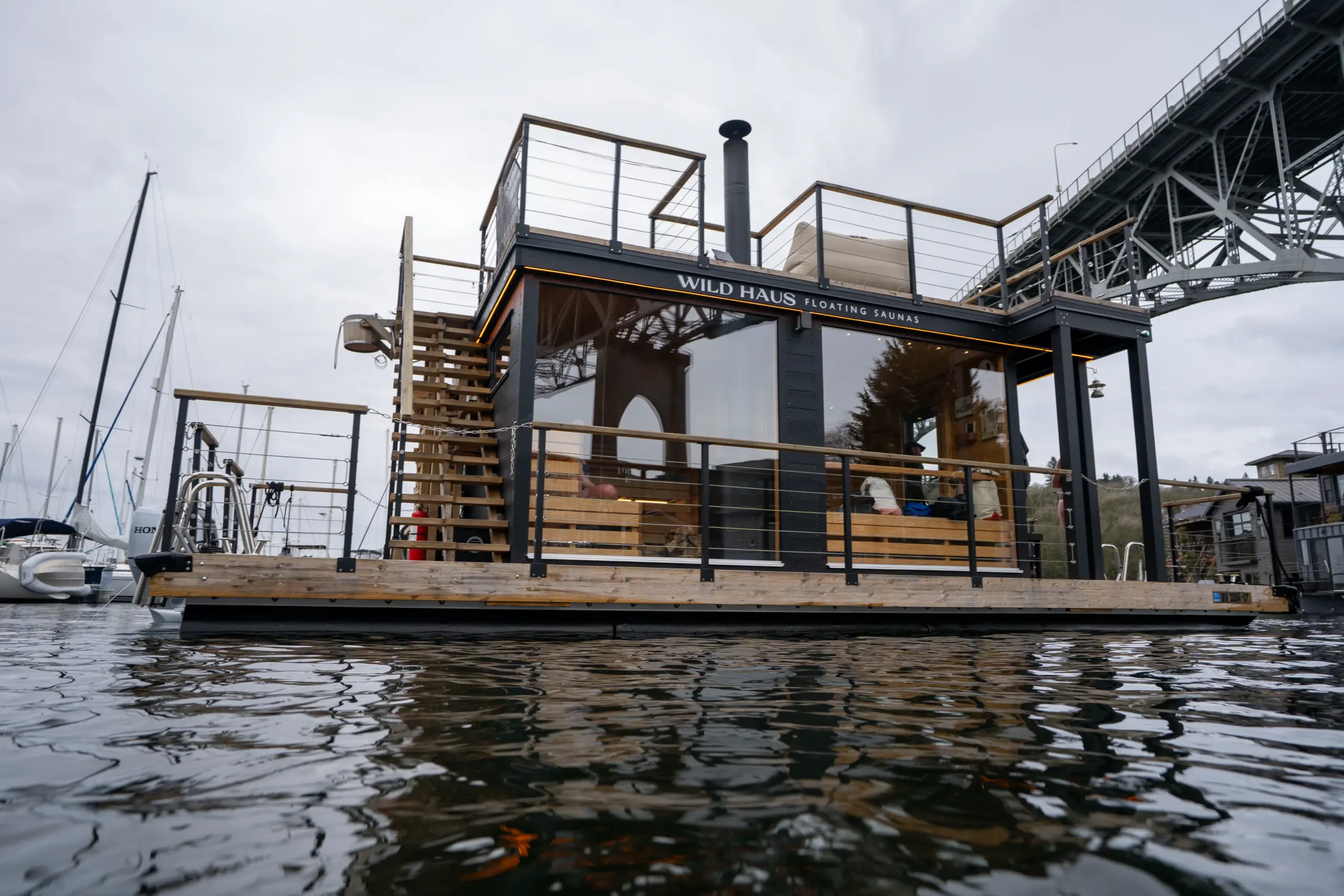
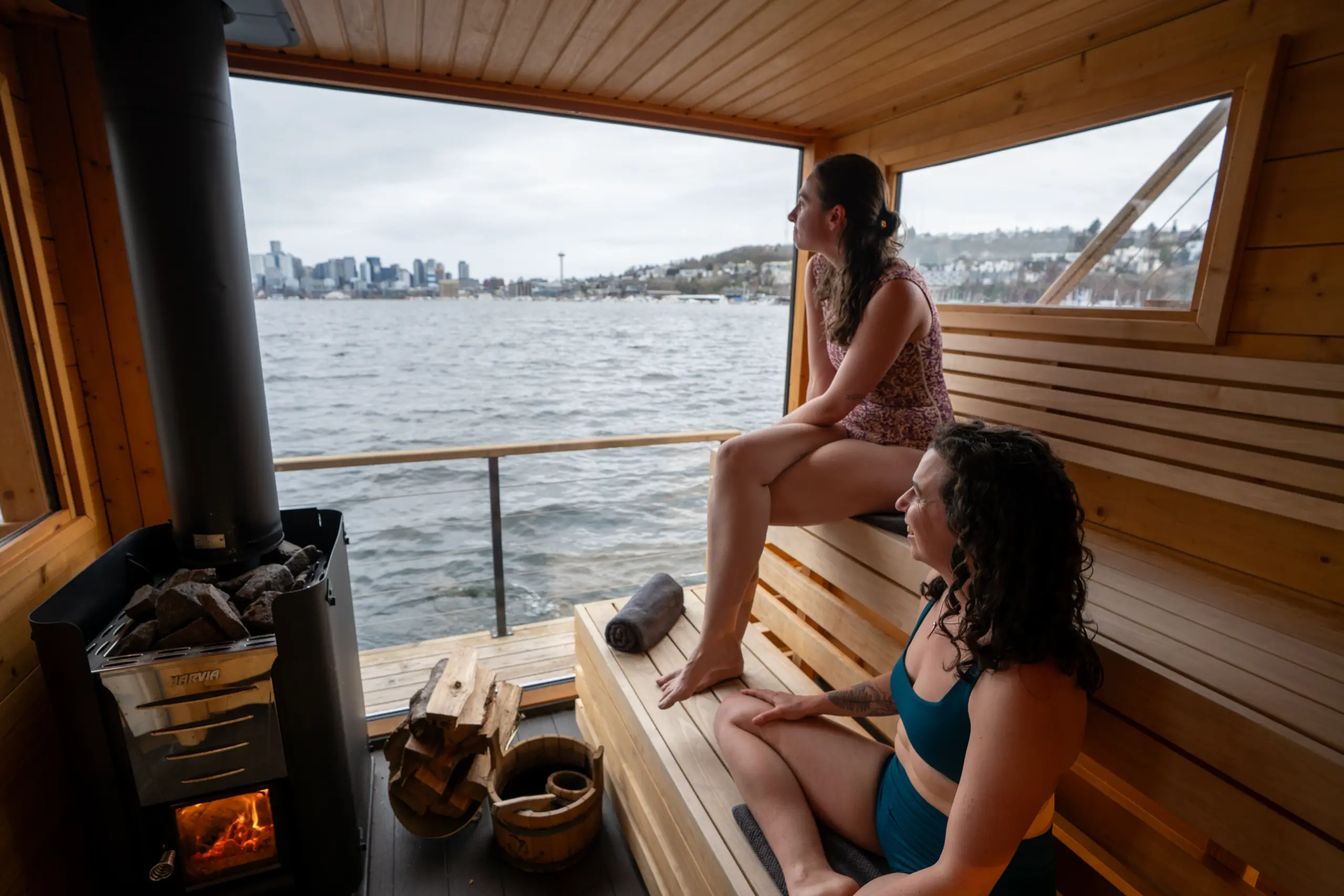
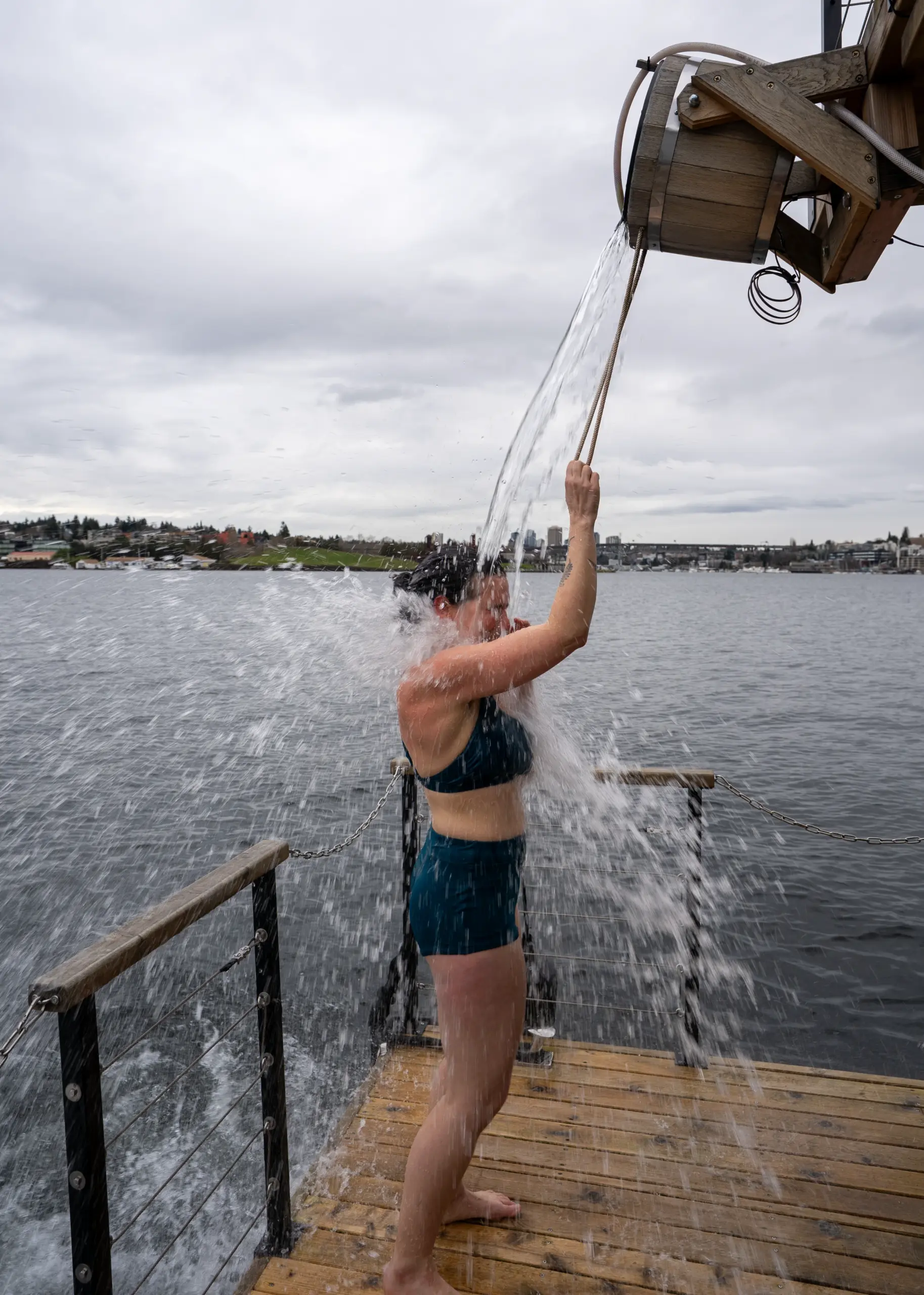
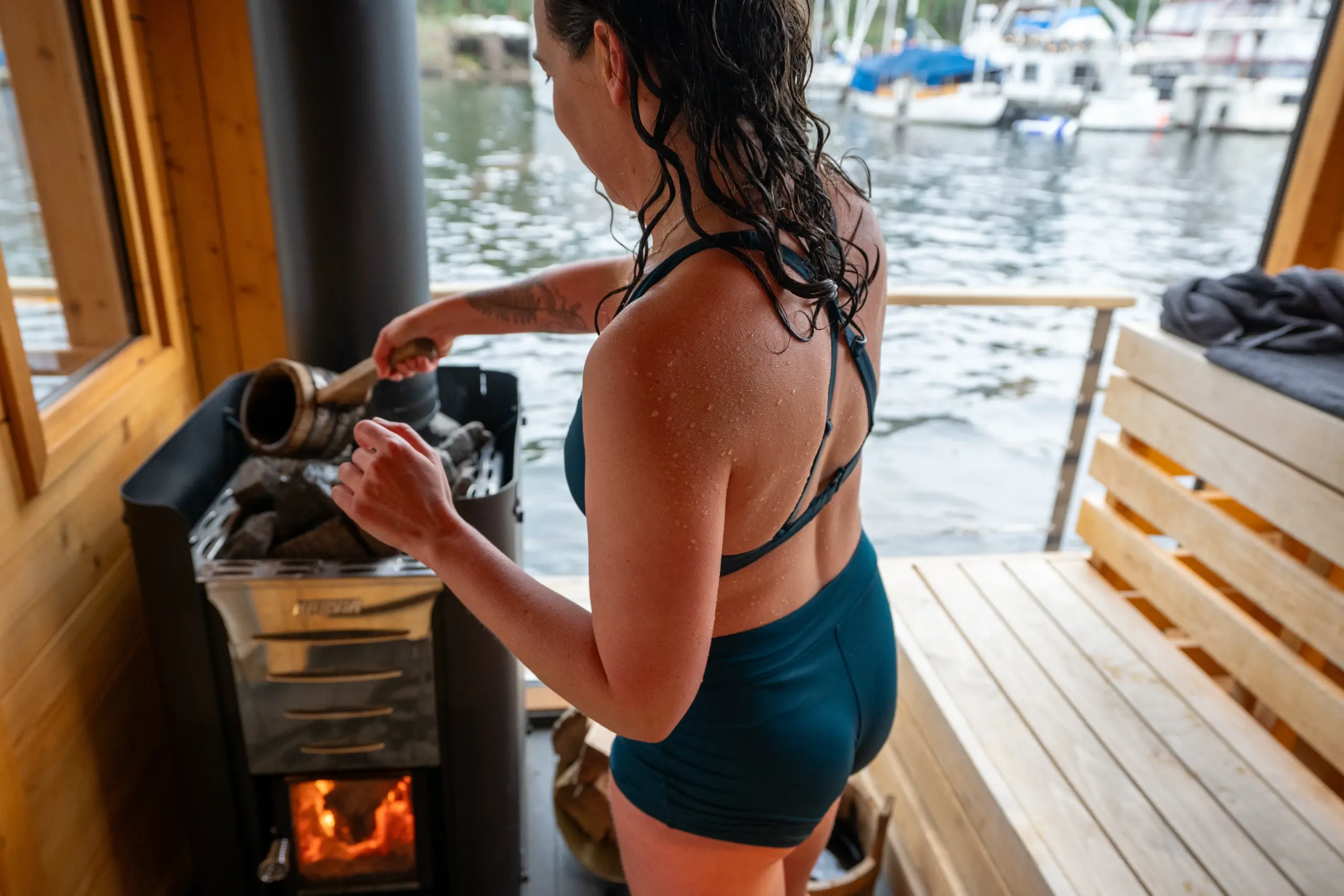
I went to check out two very different saunas for this story. I had heard a lot about Wild Haus floating saunas through the maritime grapevine. Wild Haus offers a captained sauna experience on Lake Union. I was intrigued by the idea of a sauna boat. So I gathered a couple pals on a mild gray Monday in late February and stepped aboard. The experience was amazing. Our captain gave us a tour of the small boat, which has a cozy room to change in, or to just hang out in a neutral-temperature space. A door beyond leads to a spacious sauna, where the wood fire was already heating the room. Steam from ladling water on hot stones is an option and essential oils are provided to add scent. The whole starboard side is one big window, so you can shop for houseboats, people watch at Gasworks Park, and ogle the Seattle skyline. We stopped and took a swim just outside the Fremont Cut as the Holy Names rowing team was launching. We tried out the cold bucket dump. We explored the view from the top deck, built atop the sauna. I left with a huge smile on my face, feeling delighted, relaxed.
Wild Haus was started by seven friends, who had all traveled widely and were inspired by Scandinavian sauna tradition. They worked with a Swedish designer to build a couple boats in Ballard. Five percent of profits go to a fund called The Wild Reserve, which is used to buy wild land in order to stop it from being developed. When I asked about all the different sauna options in the Seattle area, Wild Haus’ General Manager Carly Weiss said, “It’s cool to see there are so many saunas popping up in Seattle, and there’s room for every different experience. You’ll still get the community aspects and the health benefits whether you’re on the water or off.” She told me she grew up in a Finnish family that used the sauna for daily hygiene and health. What exactly does that look like?
Saunas as windows to the world
Finnish people have been sweating in saunas for centuries. Primitive forest saunas have been found as far back as 7,000 BC. More than two thirds of Finns have private saunas in their homes. Saunas were hallowed places. In the past, it was perfectly normal for a baby to be born in a sauna. Or, at the end of life, bodies would be cleansed amidst the wood. Community saunas are a common way that people gather in the nude, to chat, or just to relax with their own thoughts. A wood stove burns, heating a container of stones, which then heat the room. Water can be added to the hot rocks. Steam and temperature rise. Birch twigs gathered into whisks, called vihta or vasta, are used to slap and stimulate skin. Overheated bathers might roll in the snow outside or dip in a nearby body of water.
In Turkey, baths called hammams trade the wooden benches of the Swedish and Finnish saunas for marble. Hammams operate at nearly half the temperature of a sauna, but are extremely high in humidity. A full bath includes a soap and scrub after the hammam and relaxation time with tea in a cold room. In Japan, a practice called totonou involves several cycles of bathing in a dry sauna, bathing in cold water, then quietly resting outdoors. Bathing in natural hot springs, or onsen, is also extremely popular. Russia has its own cleansing banya ritual and Estonians bathe in smokey saunas. In many cultures, bathers don funny little felt hats that help protect the hair from extreme heat or from heat loss while cooling off.
The second sauna I had the chance to visit was more in line with the traditional rituals of a Scandinavian sauna. SeaTsu is located somewhere in the forest near the Jamestown S’klallam Tribal Center on the Olympic Peninsula. Warm light poured through the windows of the geodesic dome that guided us onto Lusa Maria’s lovely off-grid property. Smoke drifted from chimneys in the dome as well as in the sauna. Rain dripped patiently from hemlock, Douglas fir, and western red cedar into a large, cold saltwater pool. Simple wooden furniture was scattered near an outdoor firepit, shower, and kitchen. Lusa and her dog greeted us warmly. This time, a few friends joined me in the sauna with strangers. One bather was nude, keeping with tradition.
Another bather said, “I’m in my sauna era. I really struggled with depression the first winter that I moved up here. This year I’ve been trying to sauna at least once a week, and it has made a huge difference.” SeaTsu also offers private sauna, mobile sauna, overnight stays, and hot baths, all of which I plan to take advantage of in the future. I bathed in the sauna and the cold plunge. I chatted with my new friends about the state of the world. One bather theorized that sauna was the answer to the world’s problems. I showered and rested. Driving through the forest in the dark, I felt more relaxed than I have in a long time.
How much cold is too much?
It seems impossible to talk about sauna culture without mentioning contrast therapy. Mixing cold with hot is indeed part of sauna tradition, but, in the US, it has become more intense. Humans can train for anything, but it seems Americans can’t help but train for everything. At Wild Haus, our captain admitted that he was a bit tired of “woo girls,” screaming and taking selfies as they plunged. A piece by Kristy Alpert for The New York Times delves into this, suggesting that, as far as saunas go, Europeans think we’re doing it wrong. Sauna bathing does have great health benefits, but why do Americans feel the need to make it a competition? Do we have to set a timer and stay in the lake for five minutes more? Can we stand to ignore our biometrics and just enjoy staring blankly at a beautiful cedar wall? Can we relax?
There’s a group of cold-plungers that meets at Golden Gardens every Sunday. Water in Puget Sound tends to hover between 40 and 60 degrees Fahrenheit, ideal for a cold-water swim. The goal is to stay in the water for around 30 minutes. Of course, they encourage everyone to do what feels right for their body, not to push it. I will be the first to admit that I occasionally enjoy flirting with hypothermia. But all evidence points to the fact that whatever benefits people are getting from cold-plunging happens between 20 seconds and one minute after immersion.
There’s not a lot of verified science about the benefits of cold-water swimming—not yet. Stress response to cold does trigger hormones and neurotransmitters like dopamine and serotonin, which are present in a happy brain, but it’s difficult to measure these live in the brain. Anecdotal evidence does point to mental health benefits like decreased depression and anxiety. Endorphins are triggered by cold shock, which can boost mood. Regular cold-water immersion is thought to help with overall body temperature regulation, improved immunity, and decreased inflammation. Plungers report better sleep.
Two words often come up in cold-plunge conversation: brown fat. White fat, the regular stuff, is a natural insulation that undoubtedly keeps us warm. But tapping into those stores takes time. When we shiver, muscles quickly create heat that keeps us warm. The body needs both muscle and white fat to regulate temperature. Compared to white fat, lipid droplets in brown fat are smaller and more widely distributed throughout the cell. Brown fat cells contain more mitochondria, which allows them to create more heat. Babies are the real keepers of brown fat. They don’t have much muscle, so brown fat keeps them warm instead of shivering. People with high levels of brown fat seem to be better at regulating glucose, which could be huge news for people with diabetes, if we knew how to promote brown fat production. Cold air activates brown fat in bodies of all ages. But claims that cold water helps produce new brown fat in adults can’t yet be proven.
There are also real risks associated with cold water. Cold shock and exposure can cause a person to lose consciousness and fine motor control. Nerves can be damaged at low enough temperatures. Body temperature continues to drop after cold water exposure ends. This “afterdrop” can be dangerous. Once out of the water, blood begins flowing back to the hands, feet, and skin. Warm blood displaces the cold, which then cycles back to the heart and organs. Dr. Susanna Søberg, author of Winter Swimming, insists that letting the body warm itself naturally can help with afterdrop overtime. But unless the goal is long-term training for colder water or longer exposure, is it worth it to deny oneself the pleasure of sitting in a sauna, like humans have been doing for ages?
In 1987, Lynne Cox swam across the Bering Strait from Little Diomede (Alaska) to Big Diomede Island (Russia). Soaking in the 38-degree water for two hours and six minutes, her body temperature fell from 100.7 to 94 degrees. Her stroke rate dropped, her speech was slurred, her teeth were chattering, and she stumbled as she made her way ashore to a rewarming tent. The doctors’ main concern was her heart. In the afterword of her book, Swimming to Antarctica, the story of her cold-water swimming adventures, she says, “I do know that the nerves in my fingers, toes, and skin are regrowing, and I’m gradually getting the sensation back; it will just take time for my body to fully recover.” Cox has accomplished amazing things in cold water but hasn’t escaped completely unscathed.
The health benefits of saunas are easier to confirm. Regular sauna bathing can reduce the risk of dementia and Alzheimer’s disease. Saunas can lower blood pressure and decrease the risk of heart disease. They can lower inflammation and help improve skin conditions, even arthritis. Saunas can reduce risk of lung disease. A dose of heat can help with depression. Saunas have also been said to improve sleep. Increased heart rate produces endorphins that cause well-being and calm. Like cold-plunging, sauna has its risks. Sauna can cause strain for those with pre-existing heart conditions. And sauna bathers should enjoy heat in moderation, to avoid heat exhaustion.
Embracing dip-and-sauna life
I think of Lynne Cox as I stand at the edge of Hood Canal on a 35-degree day. I bare my teeth and squeeze my arms into my torso. I have started wearing booties to avoid the pain of numb feet on gravel and sticks. One dipping buddy is wide-eyed and smiling. The other grimaces. We aren’t the most dedicated cold-plungers, but we all enjoy the euphoria and calm that comes after the torture of a tiny swim with the oysters and harbor seals. And we aren’t big believers in letting the body rewarm itself. Life is short.
Though summer is coming, we are saving up for a sauna. It’s exciting to see saunas that are boating, floating, and towed. I look forward to seeing what the next “new” PNW sauna innovation will be.