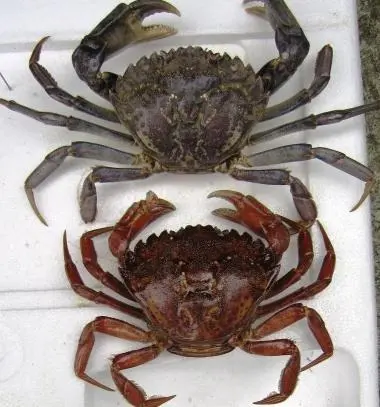
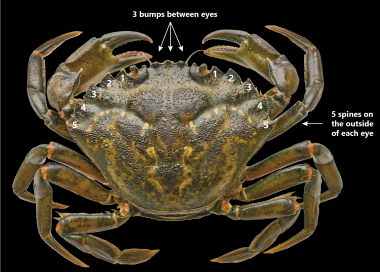
Image: How to identify a European green crab. Credit ODFW.
For boaters in Puget Sound, a small but destructive invader is worth your attention: the European green crab. Also known as the “five spine crab,” this species has spread across coastlines worldwide, and its recent expansion along the Pacific Northwest raises real concerns for navigation, ecosystems, and local economies.
European green crabs tolerate a wide range of salinities and temperatures, which allows them to thrive in estuaries, marinas, and protected bays, which happen to be exactly the kinds of places many boaters frequent. They prey heavily on native shellfish, like clams, oysters, other native species of crab, and mussels, and they tear up eelgrass beds while foraging.
How on earth did a species native to Europe spread so widely? One major pathway is human activity, including boating, though primarily through commercial vessels. Even so, properly clean your vessel and gear when moving between different bays and launch sites. Information on how to report sightings can be found on state fish and wildlife agency websites. Washington Sea Grant and Washington State University have created a volunteer-based monitoring system called Molt Search, by teaching volunteers ways to identify the presence or absence of European green crab molts (the shells that they shed when they grow). To get more information on how to participate, visit their website (wsg.washington.edu/crabteam/moltsearch) or email the WSG crab team at crabteam@uw.edu.
To identify European green crabs, look for five distinct spines on each side of the shell (in front of the eyes) and a somewhat triangular shape. Importantly, they aren’t always green, and sometimes native species (like molting Dungeness crab) can be green, so color alone isn’t a good way to identify these animals.
Agencies and tribes across Washington and Oregon are actively trapping and monitoring green crab populations, but they can’t do it alone. Boaters are often the first to notice changes in local waters, making you an important line of defense.
Protecting Puget Sound isn’t just about conservation; it’s about preserving the places you boat, fish, and explore. Staying vigilant about invasive species like the European green crab helps ensure these waters remain healthy and navigable for years to come.