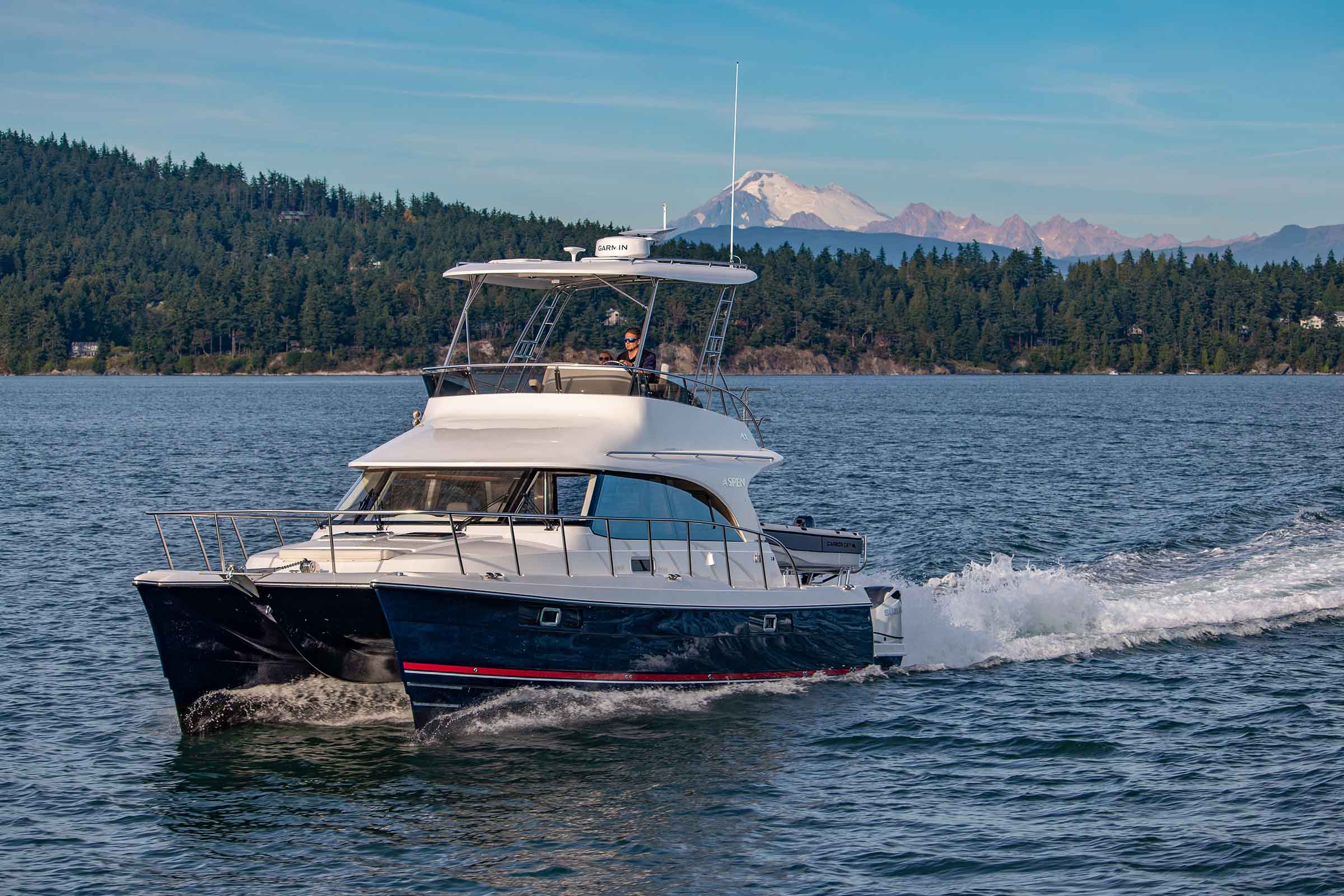
Photo courtesy of Aspen Power Catamarans.
I had the once-in-a-lifetime privilege to cruise the rugged West Coast of Vancouver Island, British Columbia, from Victoria to Nootka Sound last summer. The approximately 10-day trip was undertaken by the intrepid Aspen Power Catamarans owners’ group as their annual cruise. To my knowledge, this is the only owner’s cruise taken along that storied coastline in those often-wild waters. Remote hot springs. Rafts of sea otters. Idyllic, tiny coastal towns. A totem carver and exposed Pacific Ocean runs over 10-foot swells. These are stories for another time, ideally over beers. For now, we zoom in upon Aspen Power Catamarans’ newest flagship build that was splashed literally hours before the trip began to lead the way—the 44’ C128.
Unapologetically an Aspen
In my many talks with Aspen Power Catamarans founder/CEO Larry Graf, he made it clear that the C128 is an evolution, not a complete redesign, of the popular 40’ Aspen C120 model. The C128 is basically a C120 extended by four feet and supped up with Aspen’s newest offerings. The foundational bones of the C128 resembles her sisterships—a high-speed displacement, fiberglass power proa hull where the port hull is about 35% narrower than the starboard hull. Areas of note are re-enforced with layers of carbon fiber and Kevlar, such as the stems. There are bulkheads every 30” or so made of Coosa Composite.
“The boat should last for 100 years,” said Graf. His own Aspen C100 Cat Man Do is a survivor of a high-speed highway accident. While most people would pass on a boat that has careened onto a highway, Graf swooped it up and made it his own. That the boatbuilder would trust his own life and years of boat ownership attention on a car crash survivor like this is a peculiar but strong endorsement of the build quality.
“We start with an amazing fiberglass program with high-quality molds. The surfaces are perfect right there,” said Graf. Aspen uses pure vinylester gel and barrier coats (the expensive stuff) to about an eighth of an inch thick, then switch to an iso MPG laminating resin and e-glass style fibers. From what I know, this is all above average quality and craftsmanship. What’s more, they are built right here in the Pacific Northwest in their Burlington, Washington, factory.
Key Features: Outboards, Easy Davit, Next-Level Luxury
One unique feature to hull #1 of the Aspen C128 Susie Q—owned by the very friendly and ear-to-ear beaming new skippers David and Susie Gatling, who accommodated me for this review during the Vancouver Island adventure—is that the owners were insistent on outboard power. Specifically, they preferred twin outboards of identical horsepower; a normal request for most boats, but for the Aspen’s power proa, asymmetrical hull form, Larry had to roll up his engineer sleeves for some tweaking. But the collaboration came together, and Susie Q’s current setup of twin 300-horsepower Suzukis look and feel like natural fits.
Aspens, and arguably many cruising boats until recently, generally ascribed to the traditional inboard engine philosophy. However, outboards are having an industry-wide renaissance of sorts over the last several years. Benefits often include a quieter boat interior while running, ease of access for maintenance, more space aboard for stowage or a berth, and even fuel efficiency and speed performance. Redundancy is a perk too, as both engines would have to fail to be dead in the water. When running light in favorable conditions, Susie Q was clocking top speeds in the 31-mph (27-knot) range during our trip.
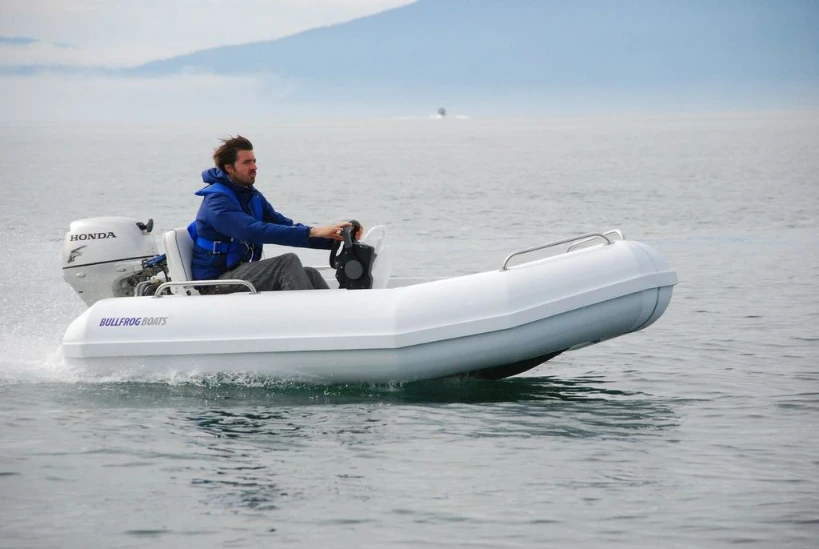
Another change from previous Aspens is the dinghy davit system situated between the twin Suzukis on the transom. This is an in-house built, cradle-style system dubbed “easy davit” that functions almost like a trailer: clip in the tender, push button to winch it in, trim up the dinghy with the davit, and strap down if needed.
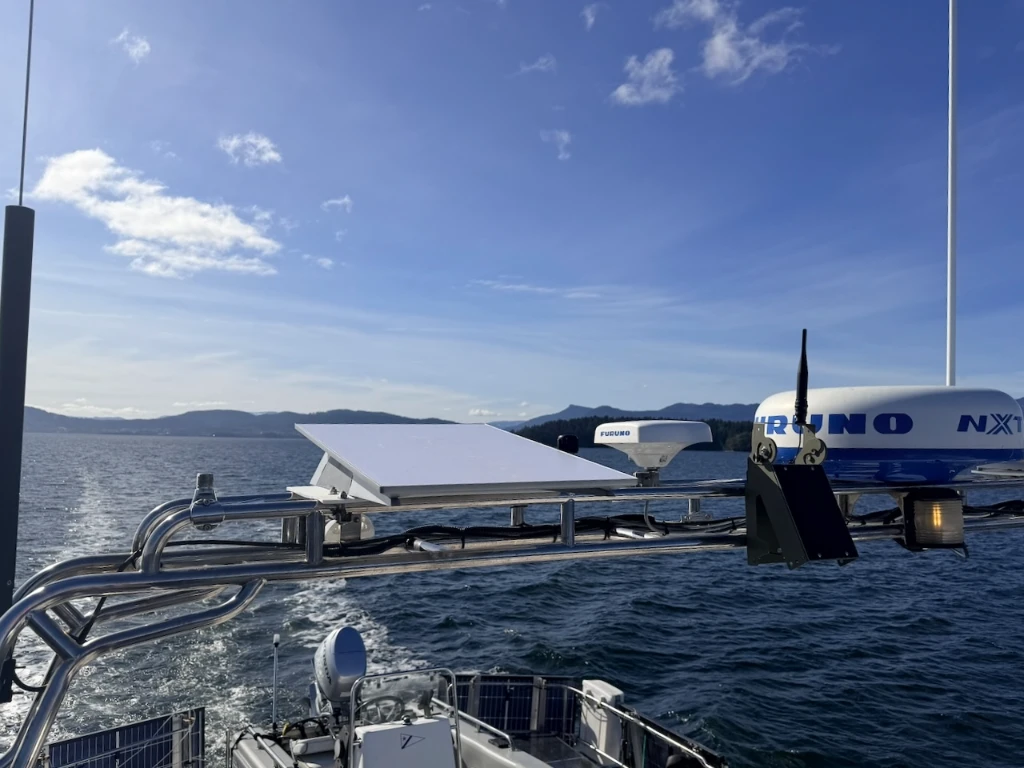
Many of Susie Q’s standout features speak to Aspen’s semi-custom approach with owner options present throughout the yacht. The flybridge is the premium layout with two helm seats and carbon fiber hardtop with solar panels.
Inside, a maxed-out air conditioning system makes its debut with two 17,000-BTU air conditioners powered by a 9,000-Watt generator (standard is 6,000 Watts). The Gatlings plan to do a lot of Virginia Beach, Florida, and Bahamas summer cruising and should sleep very comfortably. The supersized generator also supports a deluxe galley with convection cooktop, microwave-electric oven, and large icemaker. The all-walnut wood interior looked great to me with brand name, quality finishings at every turn. Corian granite galley countertops, Amtico synthetic planking flooring, Ultraleather interior upholstery and Duratek finished tables and surfaces made for a luxurious feel.
Accommodations include three enclosed staterooms: king (with standard king mattress) forward, twin in port hull, queen in starboard. The dinette table drops down in the salon for a fourth berth if needed. All these unapologetically yachty features feel appropriate for Aspen’s new flagship. The builder is mostly known for innovative family cruisers with clean, functional, quality interiors. To go “full fancy” —like with Susie Q— is a new flex for Aspen. They pulled it off well in my opinion.
Performance: Intersection of Fast Cruise and Efficient Burns
Aspen Power Catamarans have a proven track record of providing both impressive cruising speeds and efficient fuel use. It’s pretty normal for other Aspen builds to pull in cruising speeds of 15 to 20 mph (13 to 17 knots) while keeping that fuel efficient mileage below two or even 1.5 miles per gallon (mpg). There are plenty of boats in this world that cruise between 15 – 20 mph, and plenty of others that get sub 1.5 mpg burns—but precious few that do both at the same time. My test aboard Susie Q proved that the new C128 has that Aspen performance and efficiency just like her sisters.
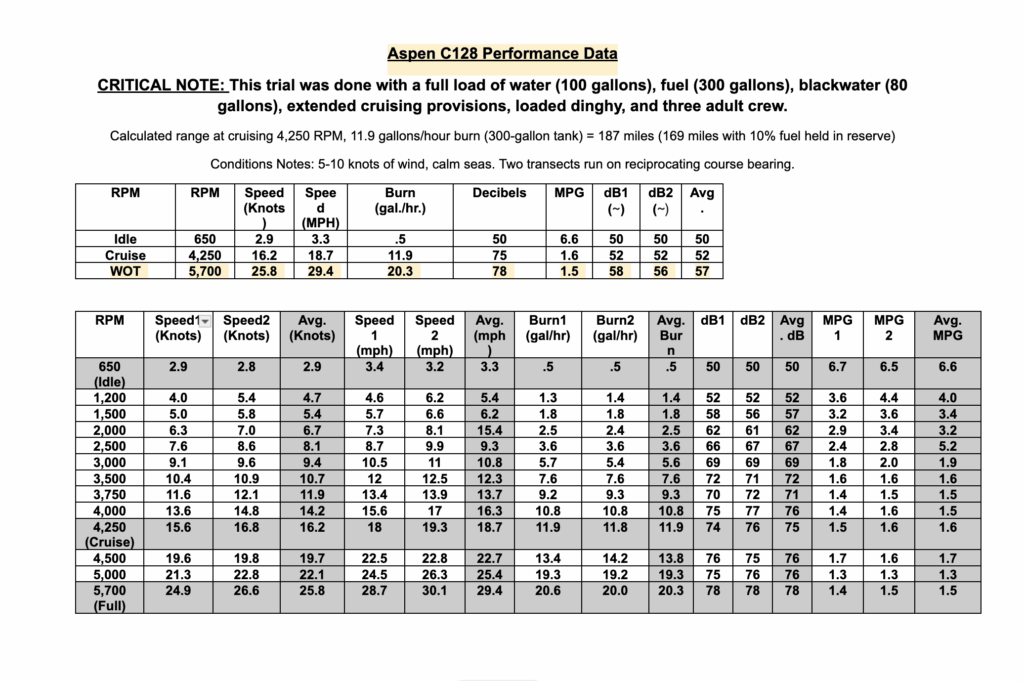
I hopped aboard in Tahsis Inlet with the tide current about a one knot and low 5- to 10-knot winds. One important note in my test is that Susie Q was “flying fat,” aka fully loaded. And I mean fully loaded: freshly topped off water tanks (100 gallons), fuel tanks (300 gallons), blackwater tanks (80 gallons), and freshly stocked groceries. I only mention this because my numbers are, mathematically, the least flattering scenario due to all the extra weight. In fact, I think it speaks highly of Larry that he was more curious than militantly insistent that I publish only the most favorable situation.
You can reference the numbers table within this article, but bottom line, we cruised at 4,250 RPM at 16.2 knots (18.7 mph) at a burn of 11.9 gallons/hour for a calculated 1.6 mpg mileage. Assuming that 11.9 gallons/hour burn and the 300-gallon fuel tank (with 10% held in reserve), that’s an approximate 170-mile range. Bear in mind, the actual range would be more than that because Susie Q would be shedding weight as the fuel burned up and the blackwater tank was inevitably emptied. At a wide open 5,700 RPM, we zipped at 25.8 knots (29.4 mph) at a 20.3 gallons/hour fuel burn for a calculated 1.5 mpg.
The decibel readings ranged from the 50s (moderate rainfall) to 70s (laundry machine) throughout the speed ranges, never cracking 80. This is all on a 24,000-pound yacht, mind you. Her handling was excellent and one hardly notices that this boat is a catamaran which can be less maneuverable with beamier models. In the marina, the bow and stern thrusters make maneuvering even easier. She does have a fair amount of windage, especially from the side, that can be a factor at low speeds and strong winds.
I wasn’t aboard Susie Q during the offshore bashes into and down 10-foot swells and jarring smaller but steeper chops, but she was always at the head of the 15-boat fleet and seemed to be handling it as well as the other Aspens. The transit down the coast with these conditions at our backs was thrilling with eye-popping efficiency and speed perks on Larry’s C100—I can only imagine similar happy boat performance boosts with the C128.
Takeaway: Aspen Raises Its Own High Bar
I don’t want to sound overly like a marketing department on any boat review, but I left Susie Q very much impressed with the Aspen C128. Larry reported at the time that he already had sold two more and I bet, especially post fall boat show circuit, he’s racked up more orders. The pressure to go even bigger with models is there from potential buyers.
“Some of the guys would like to build a 46- or 48-foot boat that will still fit in their 60-foot slip,” said Graf. “It’s hard to get slips that large, almost impossible where your beam gets over 17 feet, 16 feet, or so. That might be our next direction, we’ll see.”
For now, the Aspen C128 is a worthy flagship of the innovative Pacific Northwest boatbuilder. I have no doubt that the Gatlings are having a great time aboard somewhere after their epic Canadian wilderness summer shakedown. What better endorsement exists than that?
Aspen C128 Technical Specifications
From manufacturer
| Length Overall (LOA) | 46′ |
| Length Waterline | 44′ |
| Beam | 13′11″ |
| Max Bridge Clearance | 14′ to 17′6″ (Great Loop Capable) |
| Draft (est.) | 30″ |
| Cabin Headroom | 6′8″ |
| Dry Weight (est.) | 24,000 lbs |
| Top Speed (est.) | 31 mph |
| Standard Power | Twin 300hp Suzuki 4.4 Liter V6 |
| Props | 3 Blade Stainless Steel Counter Rotating Dual-Props |
| Fuel (gasoline) | 300 Gallons |
| Fresh Water | 100 Gallons |
| Black Water | 80 Gallons |