
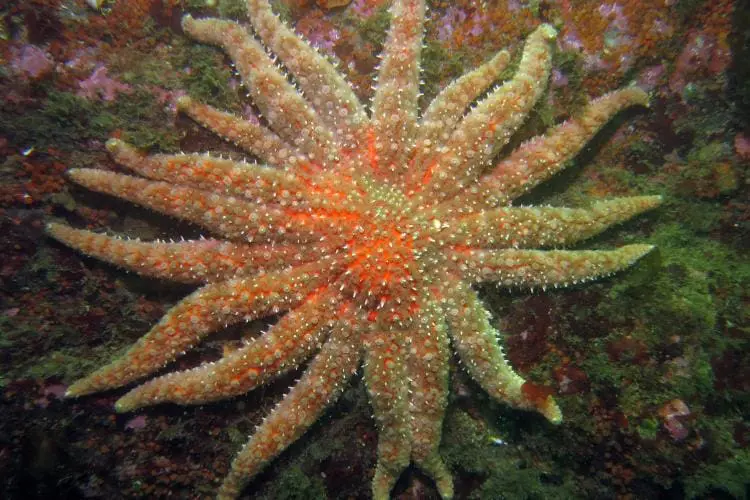
Sunflower sea star. Photo Credit: NOAA
We are all too familiar with pandemics, and we are even familiar with diseases that affect animals, like avian flu, or plants, like blight and root rot. It may come as a surprise that even marine invertebrates, like sea stars, experience their own public health crises. The cause of a recent sea star die-off remained a mystery for over a decade until August of 2025.
Beginning in 2013, scientists noticed a disturbing sight happening in tidepools up and down the West Coast; sea stars appeared to be dissolving and literally pulling themselves apart. This eerie phenomenon straight out of a science-fiction thriller was named Sea Star Wasting Disease (SSWD), and it was responsible for a catastrophic die-off of 50% to 90% of sea stars along the West Coast from Mexico to Alaska.
Although it was called a disease, the pathogen responsible was never confirmed until last year. In August, a team of marine scientists led by the Hakai Institute and the University of British Columbia, including researchers at the USGS Western Fisheries Research Center’s Marrowstone Marine Field Station, published a breakthrough study titled Vibrio pectenicida strain FHCF-3 is a causative agent of sea star wasting disease. First author Dr. Melanie B. Prentice and the team of scientists were able to demonstrate that the bacteria Vibrio was indeed the culprit, confirming what had long been speculation.
Knowing the cause has major implications for the recovery of sea star populations, especially the sunflower star (Pychnopodia helianthoides). An apex predator in kelp forest ecosystems, the sunflower star strikes terror into little clam hearts (they do indeed have a circulatory system) as Pynocopodia silently hunts across the seafloor. Sunflower stars are the grizzly bears of kelp forests, moving with their thousands of suction-ended tube feet at a relative gallop of one meter per minute. SSWD particularly affected sunflower stars, killing roughly 5.75 billion (with a B!) and reduced their population by 90.6%.
And when the sunflower stars went away, the sea urchins they preyed upon played. With the sea urchin population left unchecked, their population exploded, devastating kelp forest ecosystems. In most places on the West Coast, another predator, sea otters, can help keep urchin populations in check. But on the Oregon Coast, where sea otters have been absent for over 100 years, the sunflower star is the main predator, and with their disappearance, the sea urchin population has taken a huge toll on Oregon Coast kelp forests.
In knowing the cause of sea star wasting disease, marine scientists and managers can better understand the factors that drive the bacteria Vibrio. For now, while the sunflower stars have not made a major comeback in their West Coast populations, there are promising signs of positive changes. Baby sunflower stars were found in Yaquina Bay on the Oregon Coast by citizen science volunteers with the Oregon Coast Aquarium in June 2023. Hopefully these are the first hints of a population rebound in the years ahead.