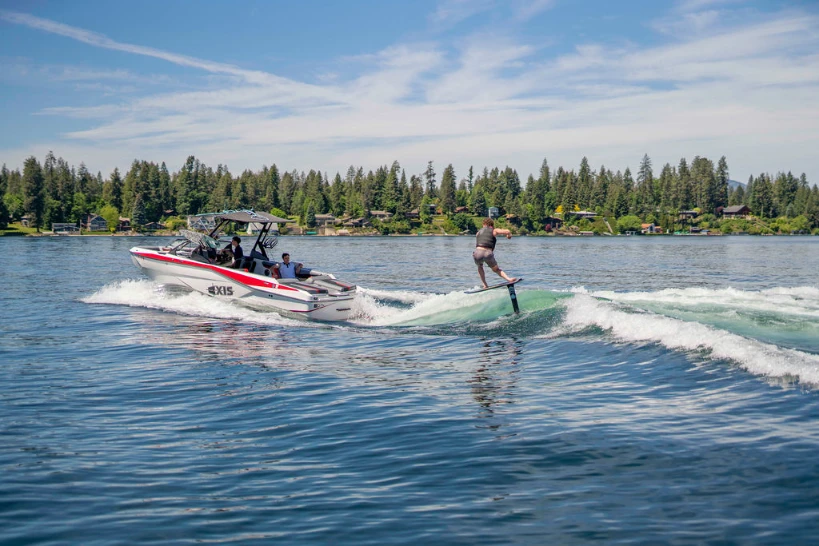
Image: A foiler on Hayden Lake performs behind the massive surge from an Axis wakeboat. Photo credit: Hayden Lake Marina
Hawaii has ocean surfing, Florida has waterskiing, Oregon has windsurfing, but Idaho is home to one of the fastest-growing watersports. Rising in the land-locked state’s deep lakes—Coeur d’Alene Lake, Hayden Lake, Lake Pend Oreille, and Priest Lake—is the phenomenon of wake surfing, along with its close cousin, wake foiling.
“Wake surfing became popular mostly for how much safer it is than wakeboarding,” said Gunnar Nickerson, the harbormaster at Hayden Lake Marina. While wakeboarding requires speeds of 18 to 25 mph, surfboats only need to reach 10 to 12 mph, he said, until the surfer can stand up and improvise their own moves, like shuvs, flips, and 360° spins. “It only takes 30 to 60 minutes to get the basics,” he said.
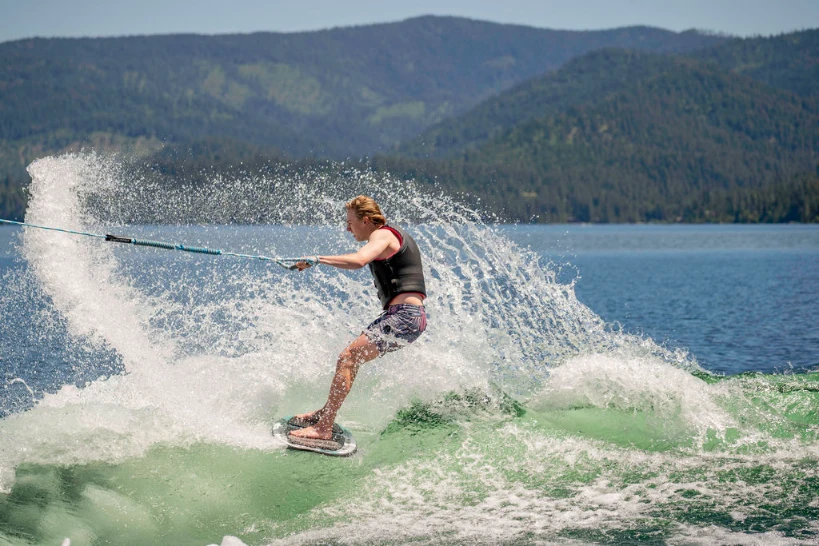
“Surfing is slower, but it still has a ‘wow’ factor,” said Thomas Follett, manager of Tobler Marina and ProShop on Hayden Lake. “It’s taking off like we’ve never seen before with kids in the 15- to 16-year-old age range.”
Some boat brands now make it easier for skippers to shape customizable wakes. For instance, surfboats made by Tigé, Centurion, and MasterCraft offer deep-V hulls and carefully placed ballasts to create large, smooth wakes. On the higher end, surfboats made by Malibu and Nautique use specialized trim tabs that can shift the wake from right to left on the fly.
Many of the best surfers are able to compete professionally, even on a global basis. According to the Competitive Wake Surf Association, more than 400 people compete in wake surfing events held in over 60 countries. Several of them also use newer hydrofoil-assisted boards with rigid “wings” underneath to lift riders above the surface. Idaho-based wake surfer Hayden Scoffield said he has earned some decent money competing in a handful of international wake foiling competitions each year, some as far away as Dubai.
But here in the soggy PNW, the pro-tour events are limited to the summer months. On July 10 and11, the Premier Wake Surfing Championship will take place at Lake Tye Park in Monroe, WA. At the same time (July 11), another competition called “Wake in the Snake,” hosted by Idaho Water Sports, will be held on the Snake River at the River’s Edge Golf Course in Burley, ID.
Since around 2015, however, the introduction of electric motors for propeller- or jet-driven movement has made “eFoiling” a new recreational phenomenon. With no need for a tow boat, eFoils seem to levitate silently over the surface, like a magic trick. “It’s a whole new category by itself,” Nickerson said. “The eFoil market started taking off about five years ago and really surged in the last two years.”
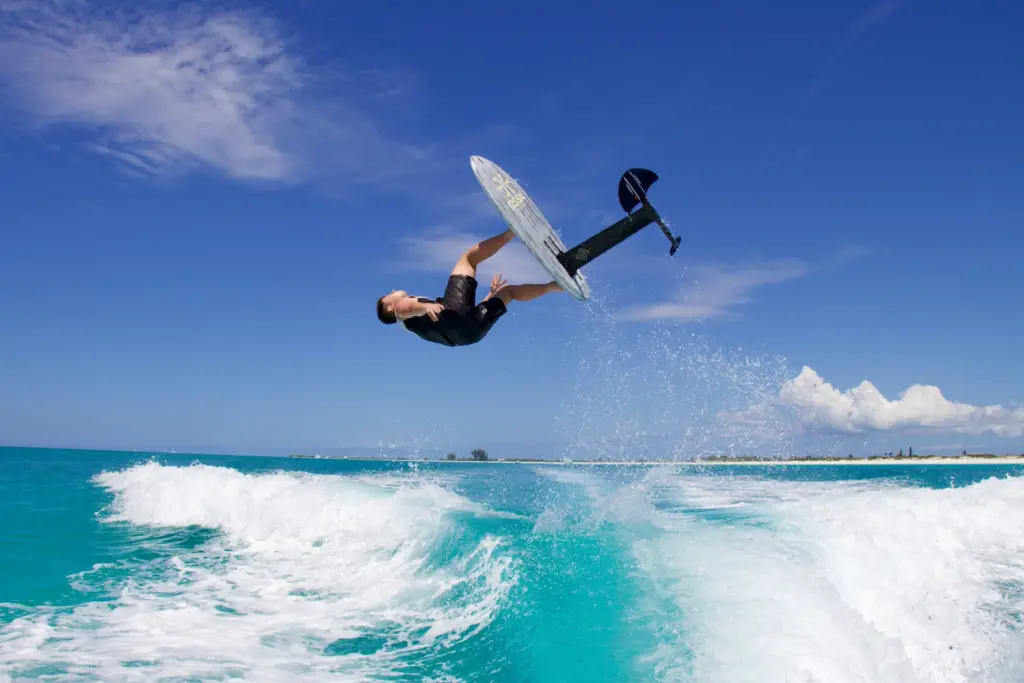
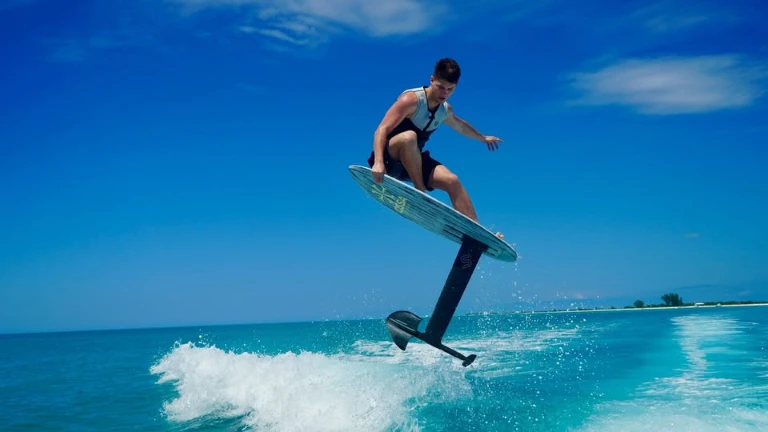
But foils also come at a steep price barrier. While standard foil boards range from $1,500 to $10,000, two of the most popular eFoil boards—Fliteboard and Lift—can cost $11,000 to $18,000, due to their complex electronics and advanced batteries.
“The eFoil sales at our ProShop have been increasing about 25% each year for a while,” Follett said. “The high point in sales for eFoils was 2022, when COVID was at its peak, and you’d see a lot of older dads getting interested in the sport.”
Despite a recent dip in sales caused by inflation and tariffs, expect to see more people of all ages—from teenage show-offs to retiree eFoilers tooling around in their 70s—perfecting their tricks on inland waterways this summer.