According to the Center for Whale Research, there have been a handful of confirmed encounters with J-pod of the Southern Resident Killer Whales (SRKWs) in the past couple of months. There’s no need for concern with L-pod or K-pod, though, they just simply haven’t had a confirmed sighting in a few weeks, but we hope to see them again soon.
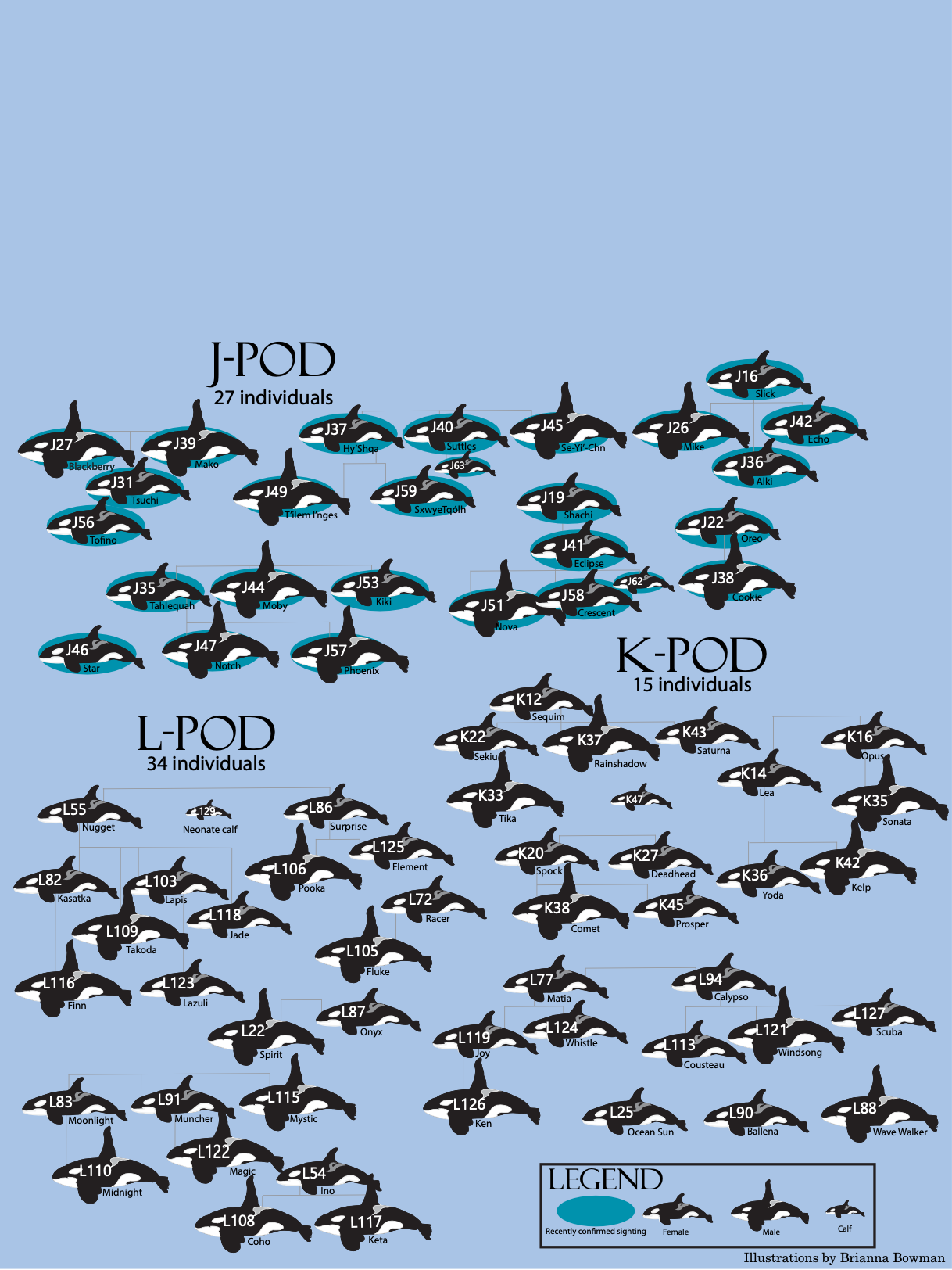
J-pod was encountered on March 1, 13, 19, and on the 29, all in the area between Victoria and San Juan Island in Haro Strait, and in places like Boundary Pass on March 29. All members of J-pod were sighted, including the youngest members J62 and J63. On March 13 and 29, the J-pod members were mostly observed swimming slowly and socializing with one another, with J45 (Se-Yi’-Chn) observed ‘babysitting’ J62 and J63 (J45’s niece) on March 13. On March 19, a socializing group of females including J19 [Shachi], J42 [Echo], J22 [Oreo], and J46 [Star], with J37 [Hy’Shqa], J40 [Suttles], and J59 [SxwyeTqólh]) was seen off Eagle Point, while J38 [Cookie] lingered nearby and leading the group to the J19’s family: J51 [Nova], J58 [Crescent], and J62. Other whales were found foraging nearby. More socializing and foraging behaviors were observed during the other documented encounters.
Three whales that had never been seen before in the Salish Sea made an appearance on March 12, and were later identified as Biggs killer whales T420, T419, and T421. Biggs killer whales, also referred to as transient killer whales, are a genetically and culturally distinct population from the SRKWs, and as of 2024 have been recognized as a separate killer whale species. These three individuals had only been documented for the first time in March 2025 in Cook Inlet near Anchorage, Alaska, and were identified in Puget Sound using their distinct scars from cookie cutter sharks. Solving the identity of the mystery whales was an excellent example of community science in action, with photographers in Alaska, Vancouver, and Seattle submitting their photos to various online groups like the Howe Sound and Sea to Sky wildlife sightings group on Facebook, Happywhale, and Orca Network to then be confirmed and identified by researchers.
Another transient orca, T049C (Nielson) was spotted swimming in the mouth of the Siuslaw River in Florence, Oregon. Transient orcas hunt other marine mammals like sea lions, and so this whale was likely looking for a meal.
Note for graphic: Not all the male orcas shown are fully grown or display typical male features like a tall dorsal fin, large pectoral fins, and big flukes. The male vs. female comparison is just for information. Changes were made to reflect that K14 (Lea) and K16 (Opus) are sisters.