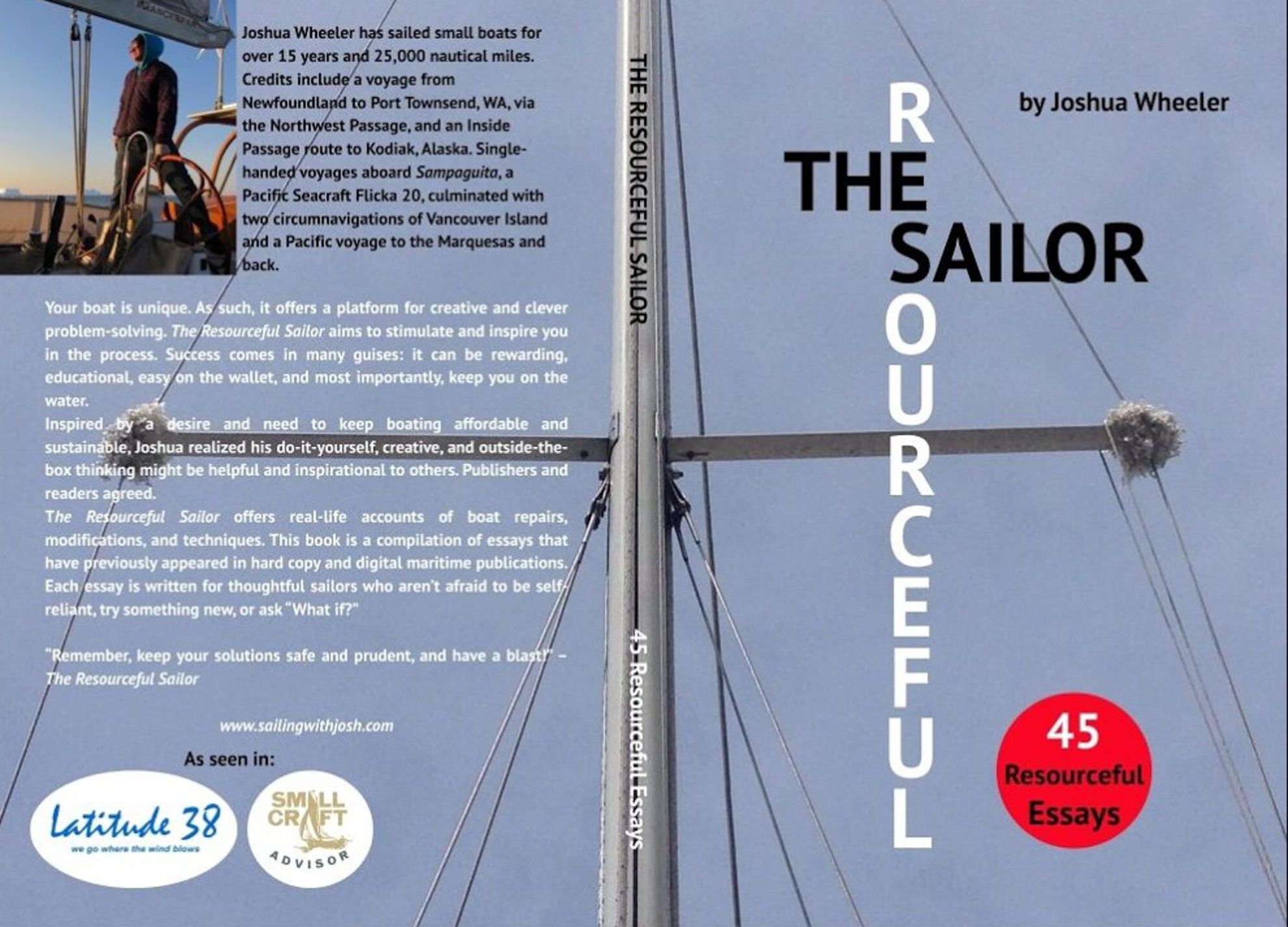
If you’re a sailor, especially if you’re West Coast-based, you’ve probably come across the name Joshua Wheeler, who often appears under “The Resourceful Sailor” magazine contributor moniker. Wheeler is the consummate Pacific Northwest-based small sailboater and is synonymous with his stout, wee Flicka 20 Sampaguita. Together without crew, they’ve sailed twice around Vancouver Island and from Port Townsend, WA, to the Marquesas and back. In total, both on Sampaguita and on other boats, Wheeler reports 25,000 nautical miles sailed, including a voyage from Newfoundland to Port Townsend via the Northwest Passage.
These experiences all have fueled his prolific “The Resourceful Sailor” magazine writing career. His topics of choice are affordable do-it-yourself (DIY) sailing/boating solutions and fixes with an emphasis on smaller sailboats. With his trademark sign off of “remember, keep your solutions safe and prudent, and have a blast,” there’s almost a Bob Ross-like feeling of warmth to Wheeler’s writing. Topics cover the gamut, from making transparent dropboards for the companionway to his Flicka 20 solar solution; replacing and redesigning spreader tips to skyed halyard retrieval made easy.
Enter new the The Resourceful Sailor book (SWJ Books) by Johsua Wheeler, a compendium of 45 of his essays, many of which started in articles within local sailing magazines.
“I’ve only had one article in the big glossy [national] magazines that have recently been consolidated,” wrote Wheeler to me. “I stopped sending them submissions because I was tired of being ghosted. My writing mentor pointed out that I might sail a little too close to the water for their readers and advertisers. I get that. On the other hand, the smaller publications don’t pay very well, but there are no contracts and rights given up. Thus, I have my first book!”
The book is exactly as advertised, with the 45 stories about affordable DIY sailboat solutions presented without an attempt of a narrative arc. There are a few that play with themes beyond strictly useful instruction, say, about “Arctic bricolage” driftwood sculptures Wheeler observed in the far north. The perceptive insight springboards into musings about how bricolage (i.e., something created out of randomly available things) is a part of the Arctic as well as everyday life. One chapter simply posits the question, “what is your favorite tool?” Where the captain of his Northwest Passage sailboat all but grunts “Leatherman,” Wheeler winces. The Leatherman is prone to bend and damage what it touches, he reasons. His own surprising personal answer? The mirror and light by which to see, assess, understand. Mirrors also reflect ourselves back at us. His favorite tool answer struck me as a core insight into Wheeler’s thought process.
It’s Wheeler’s occasional but undeniable flirtations with memoir and grander themes that make his writings more than a “Smart Sailboat Fixes for Dummies” guide. During my reading of The Resourceful Sailor, I found myself hungry for a more classic narrative structure or ambitious literary aspirations to show themselves. I think Wheeler, as a writer, certainly has the chops to swing for a Zen and the Art of Motorcycle Maintenance-style novel. But that’s not the book that The Resourceful Sailor seeks to be, and I respect the author’s choice. At the end of the day, the book elevates Wheeler’s years of contributions as a smattering of magazine articles scattered across multiple regional publications into a proper body of published work between two bound covers. We should all be grateful. Many years of my own published contributions to now-dead regional magazines like Fishermen’s News have been annihilated from the Earth with the click of a website-killing button by people I’ll never know.
While The Resourceful Sailor book is firmly for sailors who possess tinkerer instincts and values of self-sufficiency—and who are fans of Joshua Wheeler—it is well written, interesting, and important in its way. Wheeler’s adventures and his writings embody a timeless, almost John Guzzwell-esque spirit that has its own admirable values system. It’s not the big expensive boats that are impressive, rather it’s the small seaworthy ones. Top-of-the-line gizmos and hiring “a guy” to fix things for you are almost embarrassing; solving a problem with a mirror, light, and bricolage is cool. The highest ambition of all isn’t a yacht party with babes at a popular anchorage—it’s a singlehanded communion, tiller in hand, to the Wild Blue Yonder.
Personally, I think the collective humanity needs the Joshua Wheelers more than we know. I think it says something negative, but not surprising, about “us” that Wheeler’s emphasis on minimalism, affordability, and DIY are not advertiser-friendly enough for mainstream publication. But I see you, Wheeler! If these topics interest you and you want to support him, grab a copy of The Resourceful Sailor. I’ll be keen to check out his next title, too, especially if he decides to swing for a more ambitious literary work.