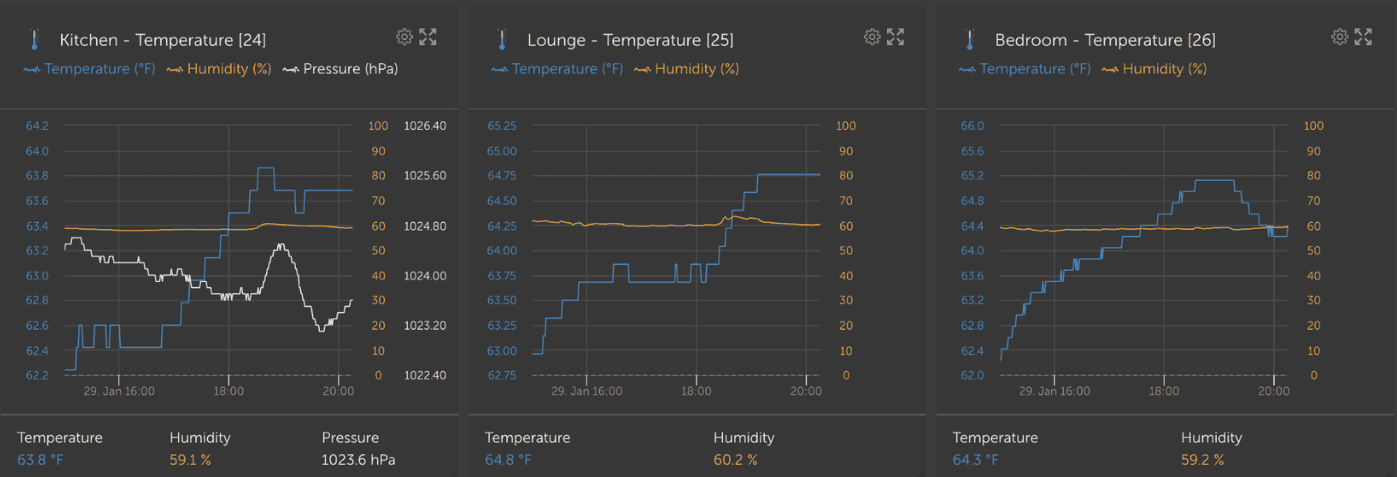
Image: Victron’s VRM Portal, showing temperature and humidity for various Ruuvi sensors.
In my last column, we talked about putting your boat on a power diet for the winter—calculating exactly how long your batteries will last if you lose shore power. But let’s be honest: Even with the best math in the world, sitting at home during a classic Pacific Northwest “Pineapple Express” storm can make any boat owner a bit twitchy. Is the dock power still on? How are the temps inside? Is the bilge pump running more than usual?
The traditional dock walk involves driving down to the marina in the rain, dodging puddles, and checking on the boat. Today, we have the tools to perform a “virtual dock walk” from the comfort of our living rooms.
The Easy Path: Victron VRM and Ruuvi
If you have a modern Victron power system, you likely already have a great monitoring solution waiting to be unlocked. If you have a Cerbo GX or Ekrano GX, you can log data to Victron’s Remote Monitoring (VRM) system.
The real magic here for monitoring is the integration with RuuviTags. These are tiny, inexpensive Bluetooth sensors that you can stick anywhere—the engine room, the salon, or even the refrigerator. The GX picks up their signal via Bluetooth and pipes the data directly to the VRM portal.
This allows you to set up specific alarms for the environment. You can get a push notification if the salon temperature drops below 40°F (meaning your heater has failed) or if the humidity spikes above 60%. It is a very approachable ecosystem that allows a lot of flexibility in monitoring without requiring a degree in computer science.
Temperature alarm on an iPhone.
The Pro Grade: Maretron
Maretron offers a level of professional-grade detail that is hard to beat. However, getting that data off the boat isn’t as straightforward as it is with Victron. Traditionally, you needed a PC running constantly on the boat with Maretron’s N2KView software, combined with a VPN to access it. Even then, it’s not anywhere near as easy as the rest of these solutions.
Maretron has started to bridge this gap with their MConnect hardware, which offers a web-based interface and can use Tailscale (a common tool in the tech world) for remote access. This is a big step forward for remote access, but it still feels a bit rough around the edges.
Maretron MConnect custom status screen, showing general boat status.
The DIY’er: Signal K and Home Assistant
If you are the type of boater who enjoys doing it yourself (DIY), has a Raspberry Pi tucked behind your helm, or runs a smart home, this section is for you.
Signal K is an open-source server that acts as a universal translator for your boat. It takes data from NMEA 2000, Victron, and many other types of sensors, and turns it all into a standard format that anything can read.
Custom dashboard built in Grafana, using Signal K to provide the data.
Where it gets really fun is when you pipe that data into Grafana or Home Assistant. You can build dashboards very easily and write amazing automations.
A Home Assistant dashboard fed by Signal K and a NMEA 2000 network.
This opens up a wealth of options that off-the-shelf systems can’t match. This is definitely the “nerd” path—it requires time, tinkering, and a willingness to debug things occasionally—but the flexibility is unmatched.
Purpose Built
Solutions like BRNKL and Siren Marine provide purpose-built, all-in-one remote monitoring systems that operate completely independently of your boat’s existing network. They typically rely on a central hub communicating via cellular and are paired with dedicated wireless or wired sensors to monitor critical systems like high water, battery voltage, and entry/security. BRNKL even has a camera to capture photos of your interior.
This makes them an excellent security-focused solution for boaters who want a reliable, standalone system that works immediately out of the box without complex configuration.
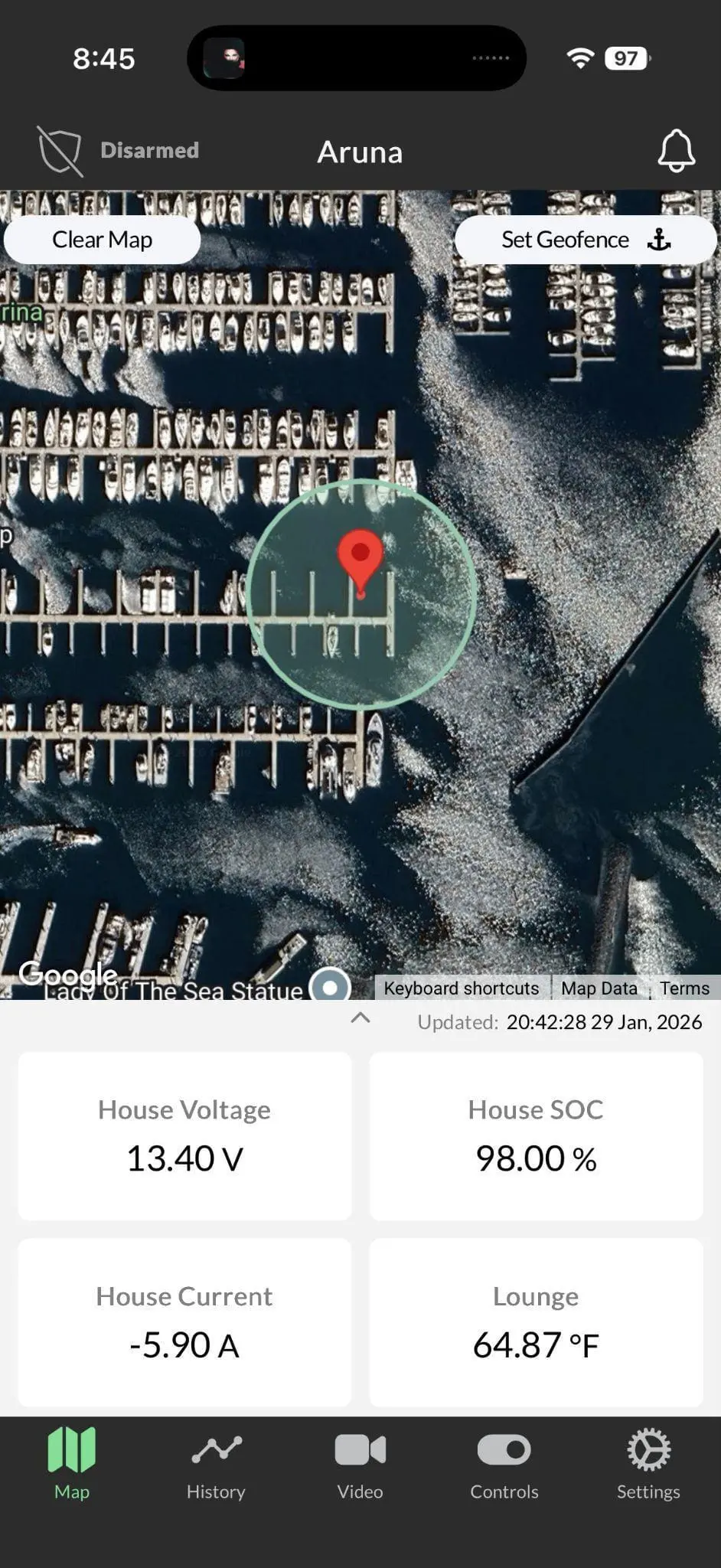
BRNKL monitoring application running on an iPhone and showing electrical and environmental status.
What Should You Actually Monitor?
Regardless of which system you choose, a remote monitor is only as good as the alarms you configure. To avoid notification fatigue, I recommend focusing on the big four:
- Shore Power: This is your early warning system. You want to know the second the AC input drops to zero.
- Battery Health: If the shore power fails, you need to know your battery bank voltage and state of charge to estimate how much time you have before the boat goes dark.
- High Water and Bilge Pump Activations: If your bilge pump is running more than usual, you need to know in case something is wrong.
- Temperature: Even if everything above is working, if your heaters aren’t keeping up with the cold, you’ll want to know before pipes freeze or other damage occurs.
Remote monitoring doesn’t replace the need to physically check on your boat—nothing beats a real-world inspection of your dock lines and fenders. But it does add peace of mind and allow for better control. When you can see that your batteries are at 100% and your cabin is a crisp 50°F, that storm outside sounds a whole lot quieter.