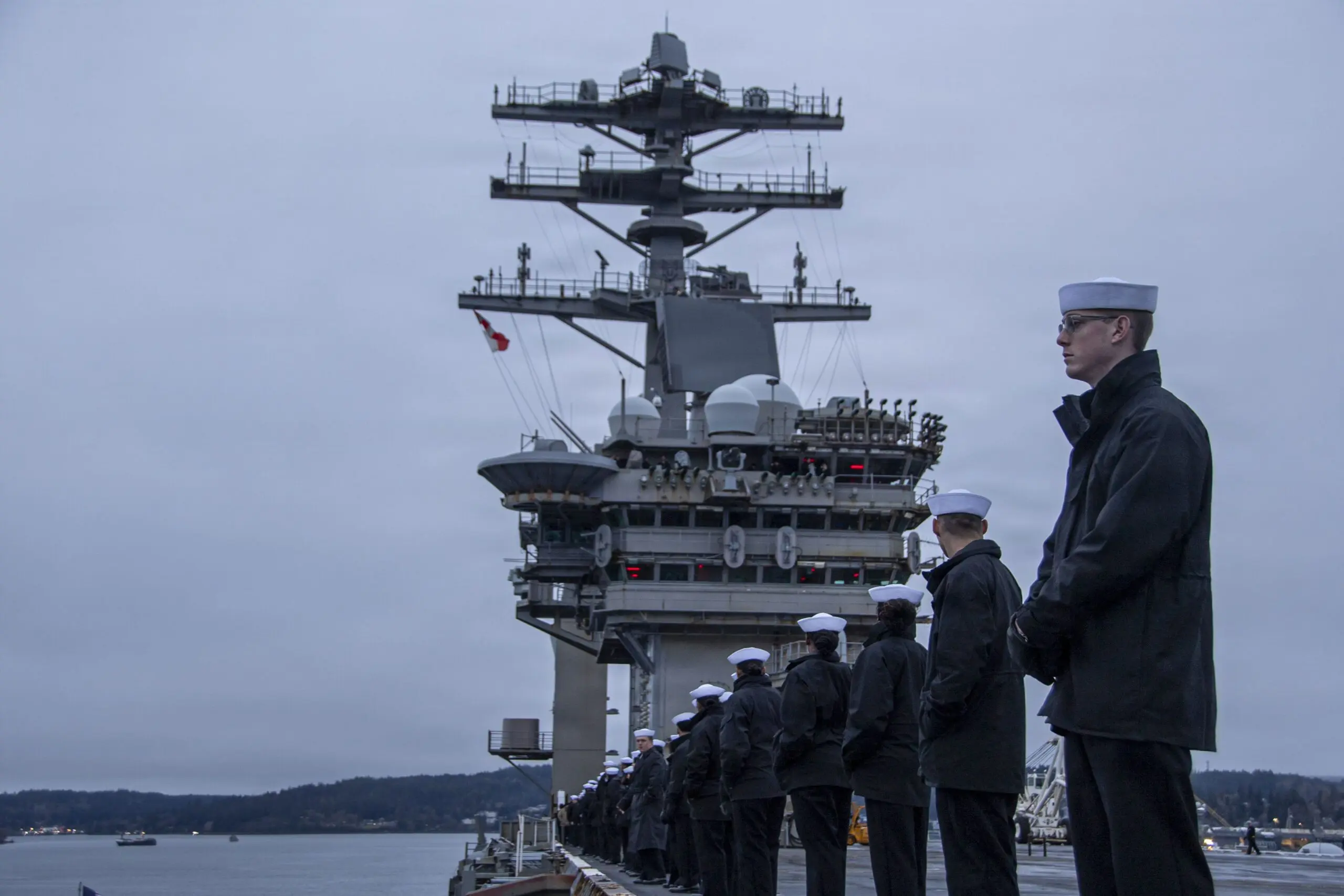
Image: U.S. Sailors man the rails on the flight deck of the USS Nimitz during the carrier’s final departure from Naval Base Kitsap-Bremerton on Mar. 7, 2026. CREDIT: (U.S. Navy photo by Mass Communication Specialist 2nd Class Peter K. McHaddad)
A few days after the USS Nimitz (CVN 68) steamed out of her home port of Bremerton for a planned decommission on March 7, word came from the US Navy about a change of plans for the legendary 51-year-old nuclear-powered aircraft carrier. The expected decommissioning date for the vessel has been pushed 10 months ahead, from May 2026 to March 2027.
As this publication reported in the previous issue, Nimitz is still currently headed to Norfolk, VA, and is expected to serve out the remainder of her service life there, according to a March 14 story from military journal Breaking Defense. Nimitz is not expected to make a return to Bremerton or join Operation Epic Fury in the Persian Gulf before she ends her career.
“Nimitz’s service life has been extended to maximize the aircraft carrier’s service life and allow the ship to continue contributing to Navy readiness,” said Lt. Commander Pete Pagano, public affairs officer for CVN 68. “The Nimitz’s service life extension is unrelated to current operations,” he added.
The Navy also reported that decision to prolong CVN 68’s service life will coincide with the delayed launch of the new Ford-class aircraft carrier, USS John F. Kennedy (CVN 79), which underwent sea trials in February and is currently expected to be commissioned in March 2027. By keeping Nimitz in service until that date, the Navy can maintain is global 11-carrier fleet operational, as required by Congressional mandate for national security.
Once CVN 68 reaches her final home port in Norfolk, shipbuilder Huntington Ingalls, Inc., based in Newport News, VA, will begin its $95 million contract “for advance planning and long-lead-time material procurement to prepare and make ready for the accomplishment of the inactivation and defueling of USS Nimitz,” Pagano said.
The carrier’s final active deployment ended in December 2025, after serving US Central Command and US Indo-Pacific Command for nine months.