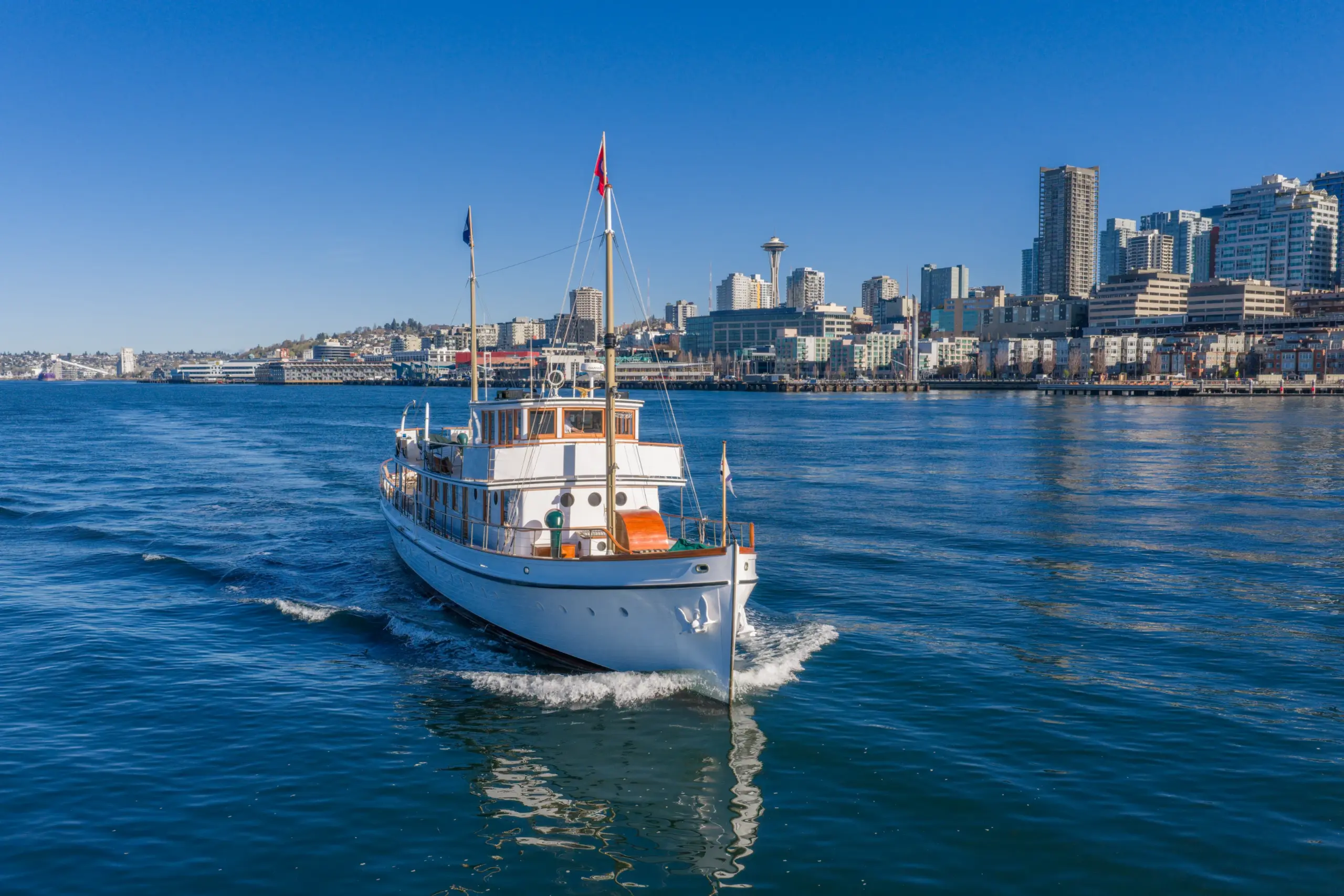
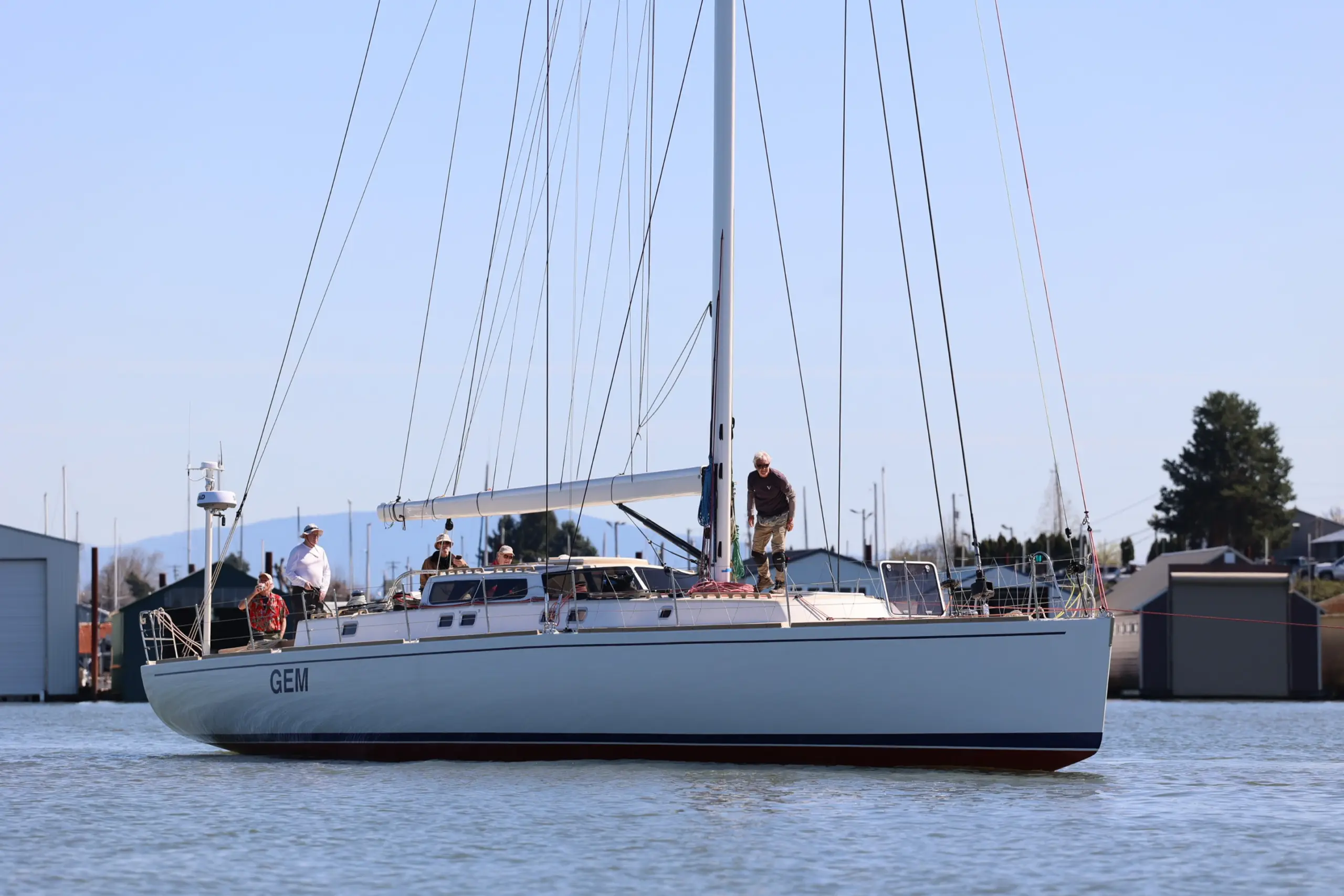
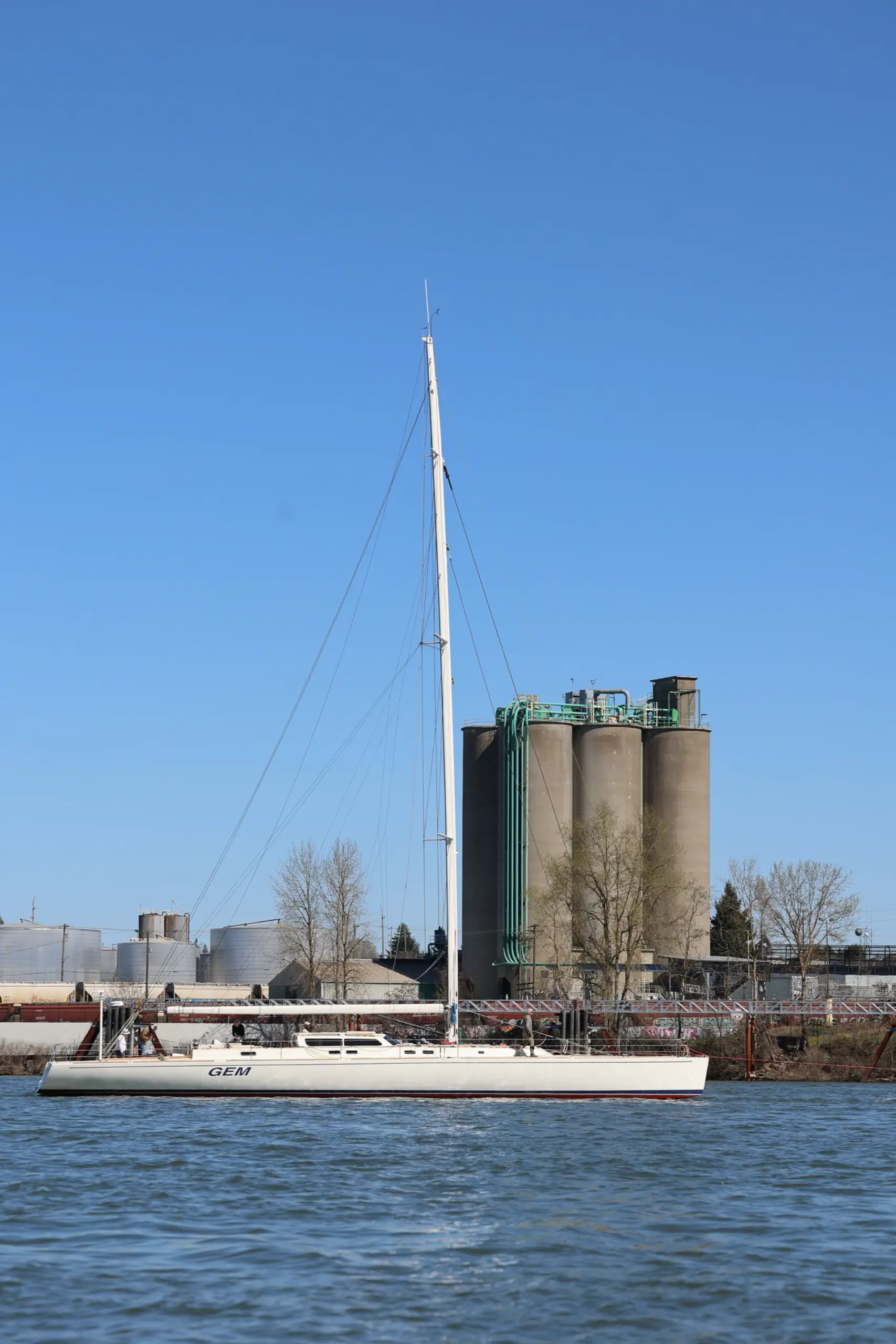
Image: Gem’s sleek profile as she enters the Portland Yacht Club after a maiden voyage across the Columbia River from Schooner Creek Boat Works on Hayden Island.
I journey to Hayden Island in the Columbia River on a surprisingly sunny March day for a sailboat christening and to learn more about the PNW Offshore Race—more specifically, its now 50-year history. To celebrate, a whopping 50 boats have registered for the often-harrowing 193-nautical-mile experience up one of the most hostile, but beautiful, coastlines of the West Coast. Among the bold 50 will be Gem, the newly splashed 80’ Tom Wylie-Steve Rander collaboration to whose christening I made pilgrimage.
I park at Schooner Creek Boat Works, stroll down the docks, and there Gem floats in all of her glory a few hundred yards out on the river. Dinghies and crew are busy at some stage in the commissioning process and making official measurements for racing ratings. I join two figures watching and gawk.
Dock-talk intel
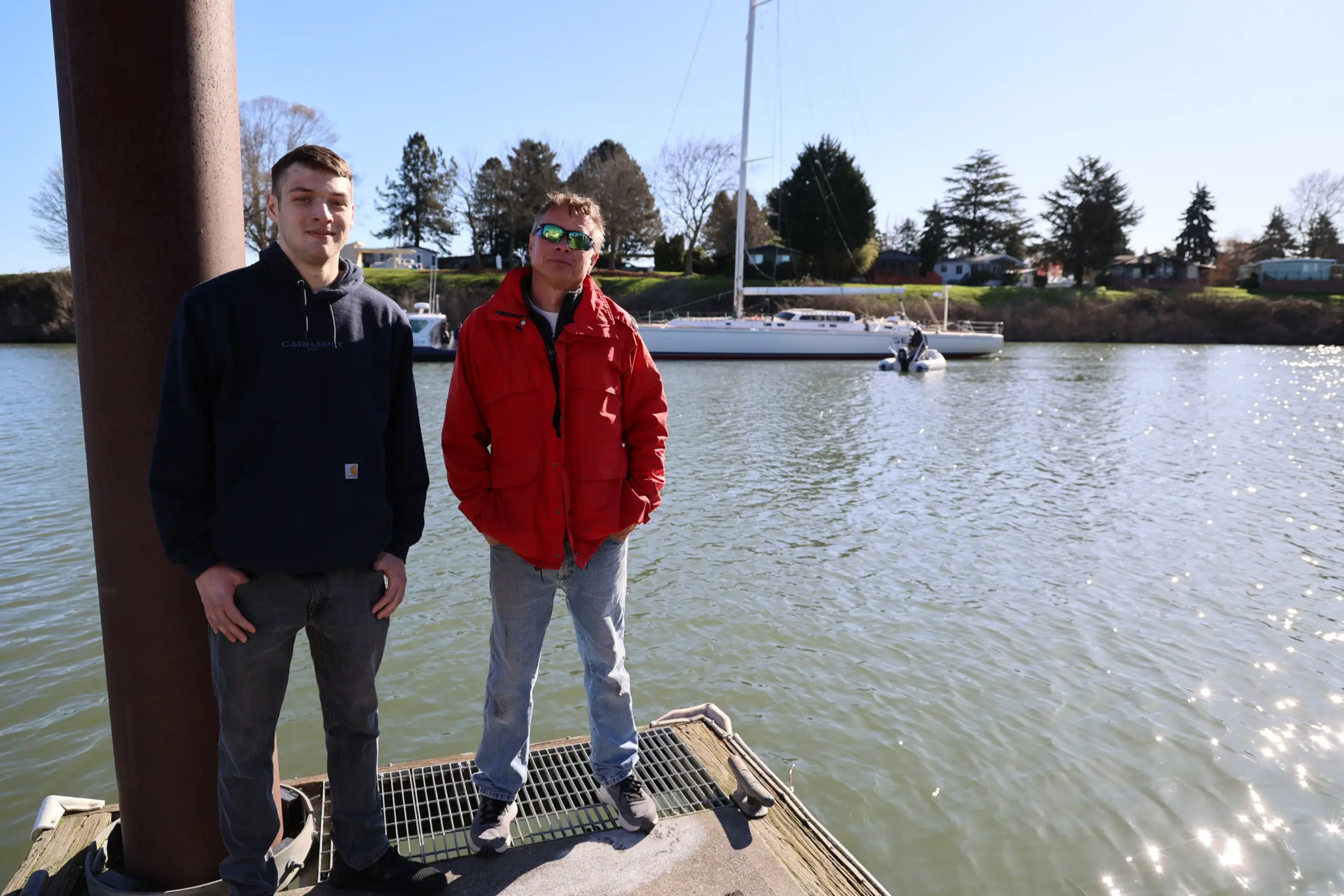
While Gem is measured off the docks of Schooner Creek Boat Works, I chat with Jonathan Erikson and Logan Oliverio who, like me, are reduced to idleness on shore. The two have been part of Gem’s construction for most of the boat’s three-year build that started in the spring of 2023. Steve Rander led the process.
“Steve is a bit of a legend around here; he started Schooner Creek Boat Works,” said Erickson. “He built the predecessor of this boat, Rage. He built that boat and sailed it and set records and won a million races with it. Rage is still going strong after 30-plus years.”
One cannot truly understand Gem without knowing Rage—the 60’ Wylie-Rander racing machine that inspired Gem’s creation. David Raney, owner of Gem, was formerly the longtime owner of Rage.
“He [owner David Raney] wanted basically that boat [Rage] with more amenities,” said Erickson. “There’s a lot more room in the interior and guest stateroom. Really nice owner’s stateroom—there’s a bathtub, for crying out loud.
“It’s a lot more cruising-friendly, but it’s designed to go as fast as hell,” said Erickson. “I think it’s going to have similar performance characteristics. The hull is similar—long and skinny. I think, like Rage, instead of a bowsprit, they just made the bow longer. And it’s going to have a lot more options for sails… fully rigged, might be three different headstays. There are a lot of headsail options.”
While I talk with them, Erickson and Oliverio rarely take their eyes of Gem in the bay. It makes sense, as the two have been daydreaming about this moment for about three years.
“We’re really seeing it for the first time out there on the water. It’s even prettier than I imagined it, to be honest,” said Erickson. “I think it’s a beautiful boat.”
Oliverio is currently 20 years old, and Gem was his first job right out of high school.
“Logan is a fast learner, and he’s already better than a lot of the guys at a lot of the things we do,” said Erickson.
I ask Oliverio if he thinks his path is going to be with the marine trades.
“I think we’ll see what opportunities arise from it,” said Oliverio, with a nod. “A lot of branching paths I can take with it. I’m looking forward to it.”
Rage family and Gem inception
After the measurements are completed, Gem returns to the Schooner Creek docks, where the owner and crew prepare for the transit to the Portland Yacht Club (PYC) and christening party. The hop up and across the Columbia River is not far but is made somewhat more complex with an engine that refuses to start. New boat problems, but no matter—a tow is organized with the boating community that’s organically formed around Gem. I finally have a chance to hop aboard and shake owner David Raney’s hand and hear his story as the crew gather and prepare.
“It all feels very real at this point,” said Raney after we ease onto the foredeck for a chat. “Finally feels like a boat. There’s some details still to do, but we’ll be ready for the race.”
For Raney, sailing has been a lifetime passion that began during his youth in San Francisco Bay. His doctor father was an avid racer and cruiser with his all-physician sailor friends, who called themselves the “Yacht Docs.” Raney got into more serious dinghy racing in his teens and moved up in size.
“And then I did a Transpac in ’75 and Tahiti Race in ’76,” said Raney. “Interestingly, three of us from the Tahiti Race in ’76 are going to be on the Pacific Cup crew together, actually on the Northwest Offshore crew together.” After the 193-nautical-mile PNW Offshore maiden race, Gem is gunning to compete in the Pacific Cup this year from San Francisco to Honolulu. At the time of this writing, the other 80’ entrant into the Pacific Cup is Apsaras, an Advanced 80 by skipper Ken Chui of Seven Star Yacht Club, Hong Kong.
Raney’s professional life drew him eastward to Pittsburgh, PA. All in all, life was good, but the sailing itch needed scratching. Ultimately, a visit back to the Bay Area and sailing with friends convinced him to consider running a West Coast-based sailboat and racing campaign from Pittsburgh.
“My brother convinced me to start looking at lightweight boats,” said Raney, referring to Santa Cruz 50s and 52s. But when he came across an advertisement selling Rage, he was drawn in. “I saw the ad for Rage, which said, ‘Pacific Cup record-holder that can be cruised by a couple.’ I thought, how can that be? But I decided to come out and see her.
“I walked down that dock right there,” Raney said, pointing up toward Schooner Creek Boat Works. “And she had a tiller,” he grins. The ads all showed Rage with a wheel, which it had for a period of time. “The story is the crew on the Tahiti Race in 2008 said they wouldn’t go if he didn’t put the tiller back on because it’s so much more fun.”
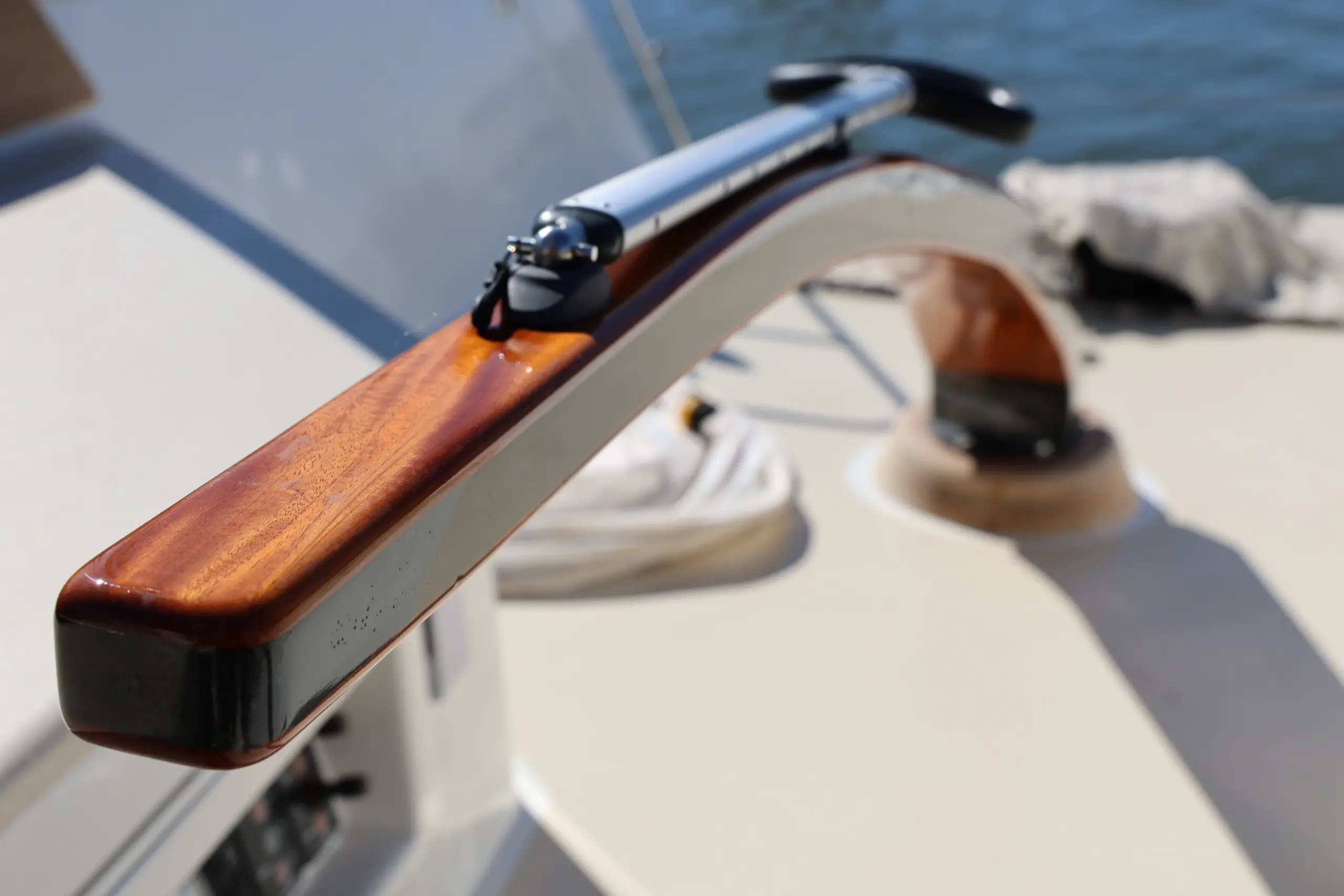
Raney didn’t tell Rander, but, inwardly, he knew that if the boat drove well with a tiller, he was going to buy it. The river test cruise was a dream, and the rest is history. Rander gave Raney a critical heads up—Rage came with a family.
“The people who came out are part of the Rage family, people who are very attached to the boat and sailed on her for many years,” said Raney. For him, the Rage family has been a blessing. “No way I could’ve pulled off 10 years of racing Rage without the Rage family—I’m too far away. Amazingly wonderful people. Knew the boat. Super nice. Good sailors. So we were able to campaign a boat from a distance and it worked out great.” Raney bought Rage in 2015, and the first race was the PNW Offshore Race in 2016.
“The most fun I’ve ever had sailing was on that boat. Iconic,” said Raney, wistfully. “There’s really nothing like driving a boat like that with a tiller and high speed downwind. She’s very light on the helm and just an incredible rush. It’s like driving a big dingy, really. Tremendous amount of fun.” Raney loved Rage so much that he enjoyed the deliveries as much, or more, than the races themselves. “It’s just fun to do ocean miles,” he said. “Some of the crew who did it with delivery told me they were spoiled. We hardly used the autopilot, everyone wanted stick time on the boat.”
For Raney, the path to the new build, Gem, really started during the global pandemic disruption. He, now 72, concluded during a bout of life reflection that he was going to age out of Rage. But he also knew he wanted to do more sailing, not less. Conversations with Rage boat designer, Tom Wylie, and builder, Steve Rander, began.
“I wasn’t going to do a boat that wasn’t a Wylie-Rander boat,” said Raney. “Rage, I thought, was a magical collaboration, and I was looking to get that again. And I think we did.
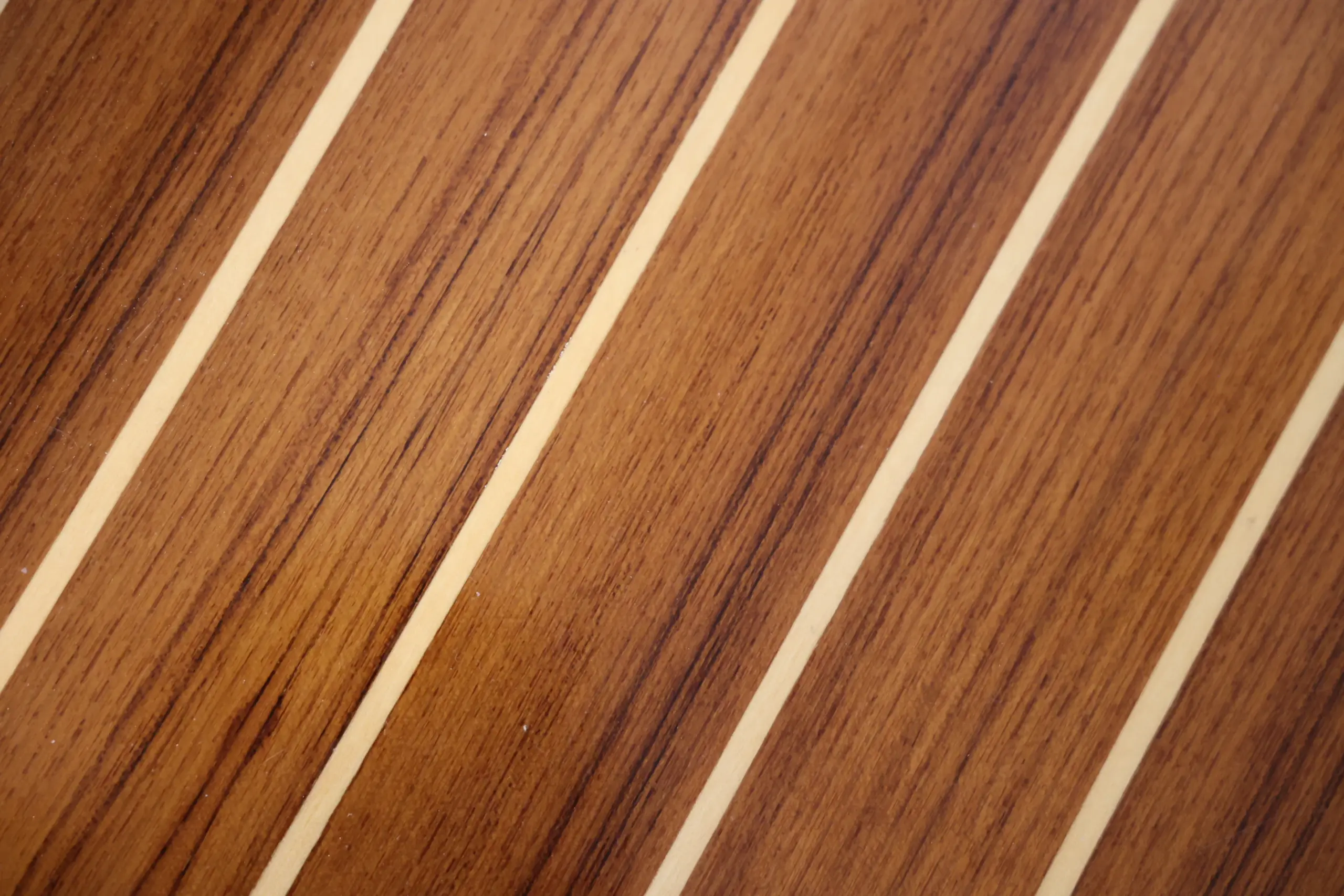
“I told Tom I wanted a 100-year boat,” continues Raney. “There was a famous boatyard in San Francisco, Stone, and people used to say, when I was young, that if a boat was really old it had to be a Stone boat. I said ‘I want that. I want a boat that’s going to last.’”
Finally, Raney wanted his new boat to be ideal for hosting the grandkids.
“I’m excited about that,” said Raney. “The oldest is five. Steve swears to me and Tom that my oldest grandchild will be able to drive the boat in light or modest wind—light touch, just like Rage. I hope so. We haven’t sailed her yet, so we don’t know.”
As with many major developments in life, the whole adventure was sealed with a single conversation. Rander, who is busy prepping Gem for the tow to PYC, pauses to set the scene.
“I said, ‘Dave, it’s either now or never’,” said Rander, sharing a meaningful look with Raney. “And that was it.”
“I said ‘now’,” replied Raney.
“End of story,” said Rander. “That’s how things work.”
“This has been an incredible adventure that I’ve gotten great joy out of, even though we haven’t sailed the boat yet,” said Raney with a chuckle.
Name ideas for the new boat were bandied about, many playing on the Rage theme like “Outrageous.” Ultimately, Raney wanted the new boat to have its own identity and wanted to pay an homage to his supportive wife Denise—who is a gem.
Gem – The boat
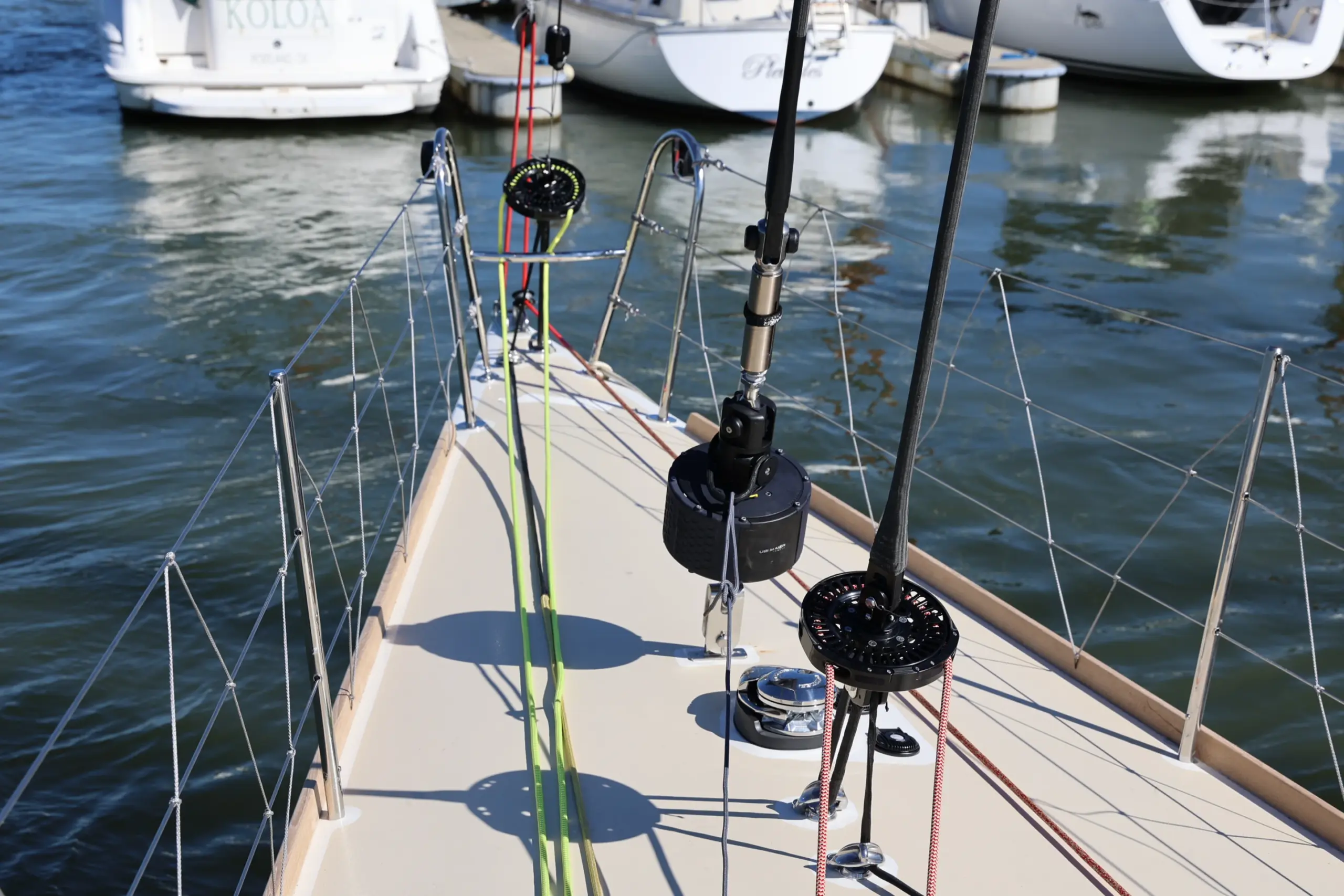
Still dockside, Raney walks me through some of the notable features of Gem. One of the most attention-grabbing is the dual cockpits—an open, racing-minded one near the tiller aft and a more sheltered center cockpit.
“The center cockpit, to put it bluntly, is my attempt that I can be crossing oceans at 85 and not fall out of the boat,” said Raney. “I’m half kidding, but not really.” The comfort-cruising-minded center cockpit is part of Gem’s liveaboard friendly design.
“The boat is exceptionally thin, proportionally thinner than Rage, and that was a thin boat,” said Raney of the extremely skinny 13’9” beam. When looking at Gem straight on from directly aft, one might guess she has half her actual 80’ length. “That was necessary in Tom’s mind to achieve the wider helm with the tiller. I had to have a tiller. There’s not a lot of boats this size that are tiller-driven. It’s just an incredible experience on the rail, hiking over with the tiller in your hand.”
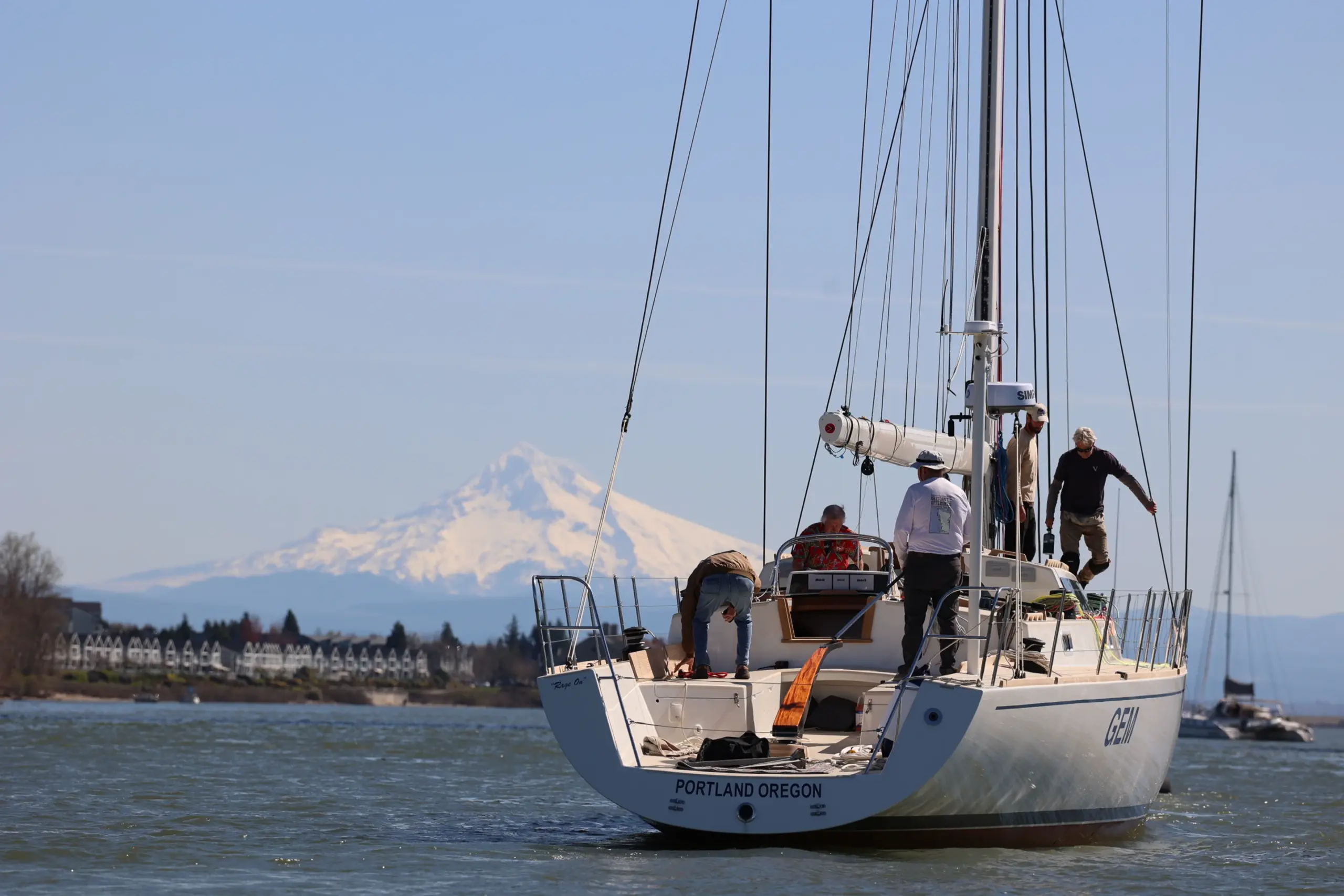
7. SLOT 7. Gem on her maiden trip with a glorious Mt. Hood backdrop. From an aft view like this, the narrow beam hardly makes Gem look 80 feet long.
Raney describes the cold-molded construction technique that also integrates carbon fiber into the hull.
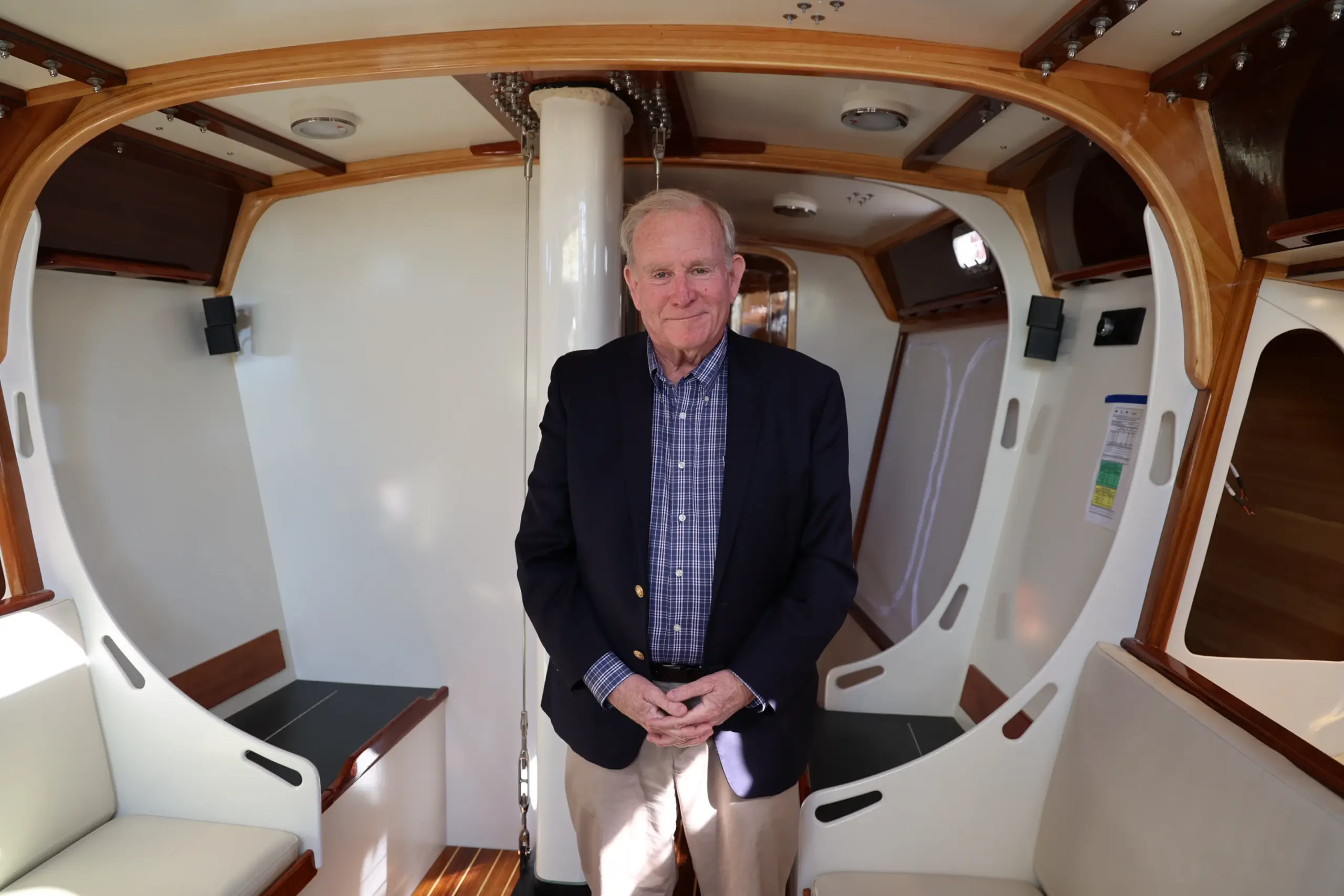
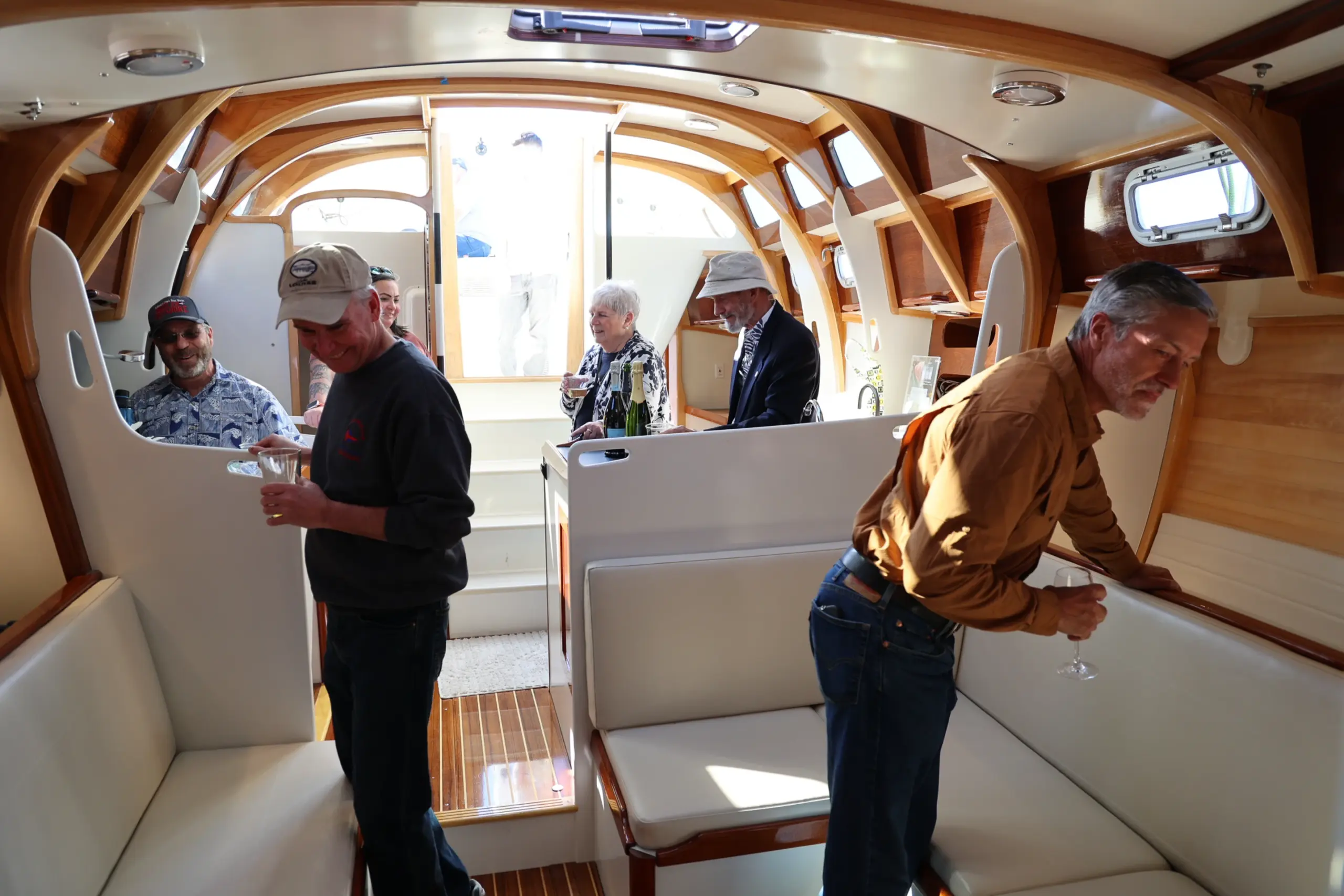
“The main strength of the hull is carbon, but the bulkheads and stringers are all wood,” said Raney. “You’ll be quite amazed how much wood there is, it’s pretty shocking.” I went below and was, indeed, amazed by the warmth of the woodwork and more. The salon is palatial and the berths sumptuous. It’s surreal that such an interior is possible on such a narrow racing boat.
“We had a fantastic consultant that Tom knows—Dave Halse who worked for a lot of iconic programs for the mast,” said Raney. “He helped project-manage the mast. We had some just incredible talent. We’ve had comments that this is the most fun project I’ve ever done.”
“We’re trying to bring together elements that I’m not sure get brought together as often as you’d think,” adds Raney. At long last, Rander gives Randey the thumbs up. The crew of Gem casts off the docklines for the maiden cruise under tow to PYC.
PNW Offshore Race – 50 boats for 50 years
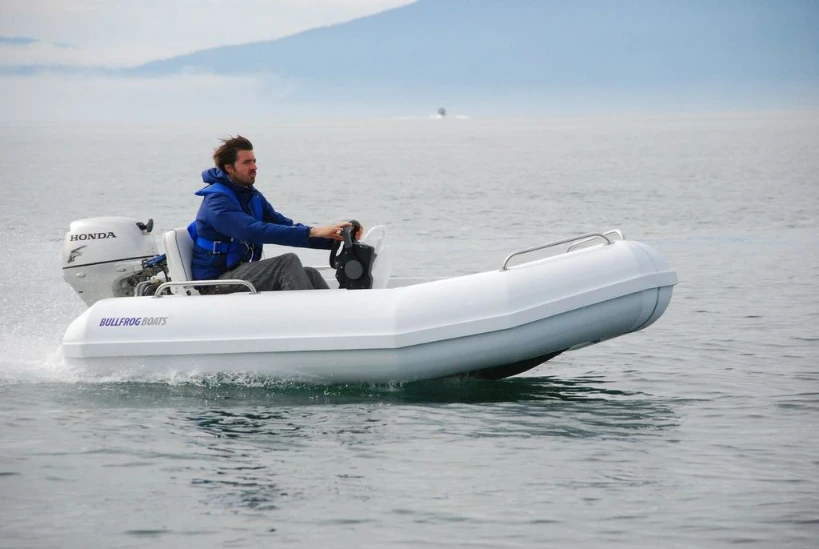
I hitch a ride with Doug Schenk on his RIB to be a part of the Gem tow escort and catch springtime sun on the Columbia River. Even under tow, Gem is an elegant sailboat as she floats past the newly renovated Vancouver, WA, waterfront, under the I-5 bridge, and, for a time, maintains course right toward snowy Mt. Hood that stuns from a distance.
Fortunately for me, Schenk is the perfect person to chat with to get an insider scoop on the Pacific Northwest (PNW) Offshore Race. He filled me in on PNW Offshore between coordinating the tow over the VHF and checking channel depths to ensure Gem’s 12’6” draft can transit. If his name rings a bell, you may have raced against him and his Club Swan 42, Free Bowl of Soup.
“I was on the race board, which was under Corinthian Yacht Club of Portland, but we actually dissolved that and put it under Portland Yacht Club a couple of years ago,” said Schenk. “This is the first full year the PNW Offshore Race will be hosted by the Portland Yacht Club and the 50th year of the race’s existence.”
The PNW Offshore Race, formerly the Oregon Offshore Race, carries a unique legacy as it enters half a century of existence. While some refer to the race as a feeder event for northerly events like the Swiftsure International Yacht Race and/or the Van Isle 360 International Yacht Race, it didn’t start that way.
“As I recall, like most things around sailing, it started in a bar and somebody telling somebody else ‘we should have a race out of Astoria to somewhere’,” said Schenk. “We should go offshore.”
The inaugural Oregon Offshore Race in 1976 started in Astoria and went south to Newport, OR. But the first race kicked off many years of experimentation regarding the course, be it going up or down the coast or out farther offshore and back. Ultimately, the desire emerged from the racing community to “not turn back” but, rather, finish in the Salish Sea—summer cruising grounds for many. The race in 1980 was the first Oregon Offshore to finish in Victoria, BC, and it’s been that way ever since—with a few notable exceptions.
“During COVID-19, there was a couple of years where we couldn’t go to Canada and we went to Port Angeles,” said Schenk. “PA Yacht Club was amazing… It was so fun going there, maybe every so many years we’ll go back there again.”
One change was the transition from being the Oregon Offshore Race to the PNW Offshore Race that reflected the shift from starting in Astoria, OR, to Ilwaco, WA (north of Astoria on the Columbia River), in 2020.
“We were having problems with depth in Astoria and number of slips,” explains Schenk. Organizers explored Ilwaco as an alternative start, and it’s been wildly successful. “Ilwaco is amazing,” he said. “They’ve totally embraced the race. It’s a fun time to go down there the week before the start. So, once we realized it starts in Washington and ends in Canada, it’s not really the Oregon Offshore anymore.”
Schenk is so knowledgeable about the race that he produced a comprehensive presentation that’s available to view on the PYC website (portlandyc.com).
“I kind of explain it as an 11-course meal. Some of the ends and finishes are kind of getting to Ilwaco and other stuff, but there’s, like, four different things you got to think about tactically up the coast of Washington,” he chuckles. “Which can be gnarly. That’s usually when most people including myself say we’re never going to do this again. Normally you turn the corner [around Cape Flattery to enter the Strait of Juan de Fuca]… you’re all tired and wet, and the spinnaker comes up and it, for some reason, always seems to be warmer and sunny.” He laughs. “You immediately start talking about what you’re going to do next time.”
He also describes the tactics of shooting up the Strait. Should a skipper go through Race Rocks or around them? The bay outside of Victoria can also be surprisingly sporty with strong tide rips. Odgen Point, in Victoria, was the traditional finish line; however, a high amount of cruise-ship activity has prompted organizers to move the finish line out to a point a bit off the point, itself.
“Then you’re in Victoria, which is always fun,” said Schenk, all but winking.
What makes the upcoming 50th iteration of the race extra special aren’t tweaks to the race course, but rather the club’s successful “50 Years, 50 Boats” goal. Fifty boats is far more than normal for the demanding race that begins in the relatively far-flung (for Salish Sea sailors) Ilwaco location on the river. The concept started in similar jocular spirit that likely inspired the entire PNW Offshore Race concept in a bar 50 year ago.
“We were talking about what to do for the 50th,” said Schenk. “‘You know what? Wouldn’t it be amazing if we had 50 boats for the 50th race?’ We all laughed. ‘Yeah, right.’ You know what? Let’s make that the slogan and just go with it. Not only that, let’s say we’re limiting it to 50, which is actually kind of true because even fitting 50 boats in Ilwaco will be an adventure.”
The tried-and-true marketing tactic of scarcity worked like a charm and the race promptly filled up. At the time of this writing, nine boats are even coming down from Canada to join in the race, which is not usual. Many Seattle boats are coming down south, as well.
“And then, you know, a bunch in Portland that haven’t done it in a while,” said Schenk. “Or are finally going to do it. If you’re going to do it, why not do this one?” As with Steve Rander’s “now or never” appeal to David Raney to build Gem, for many local sailors being among the proud northward-bound 50 is a “now” life-affirming decision.
Free Bowl of Soup, of course, will be racing. “Our Club Swan 42 was the scratch boat for the last couple of years, fastest boat,” said Schenk. “We’re, like, ninth fastest—tenth or eleventh even—this year. Which is awesome; it’s going to be some great competition.” Both Gem and Rage will be in the pack gunning for gold.
The christening of Gem
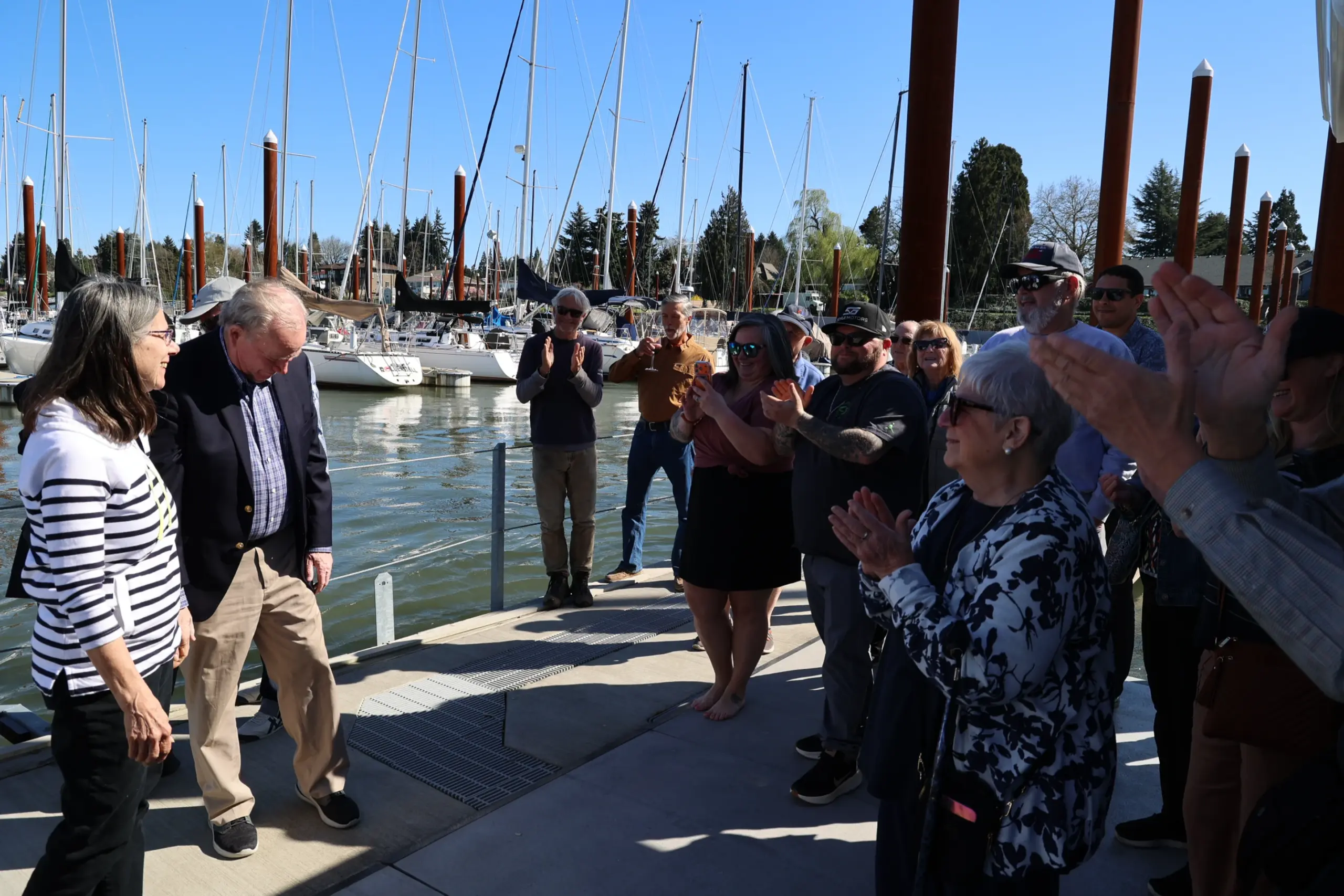
Gem transits to PYC without interruption and I hop off Schenk’s RIB with a “thank you.” A few hours later, the blazers and Hawaiian shirts are on and the christening party is under way. Steve Rander, David Raney, and Denise address the large dockside crowd from the bow of the new sailboat.
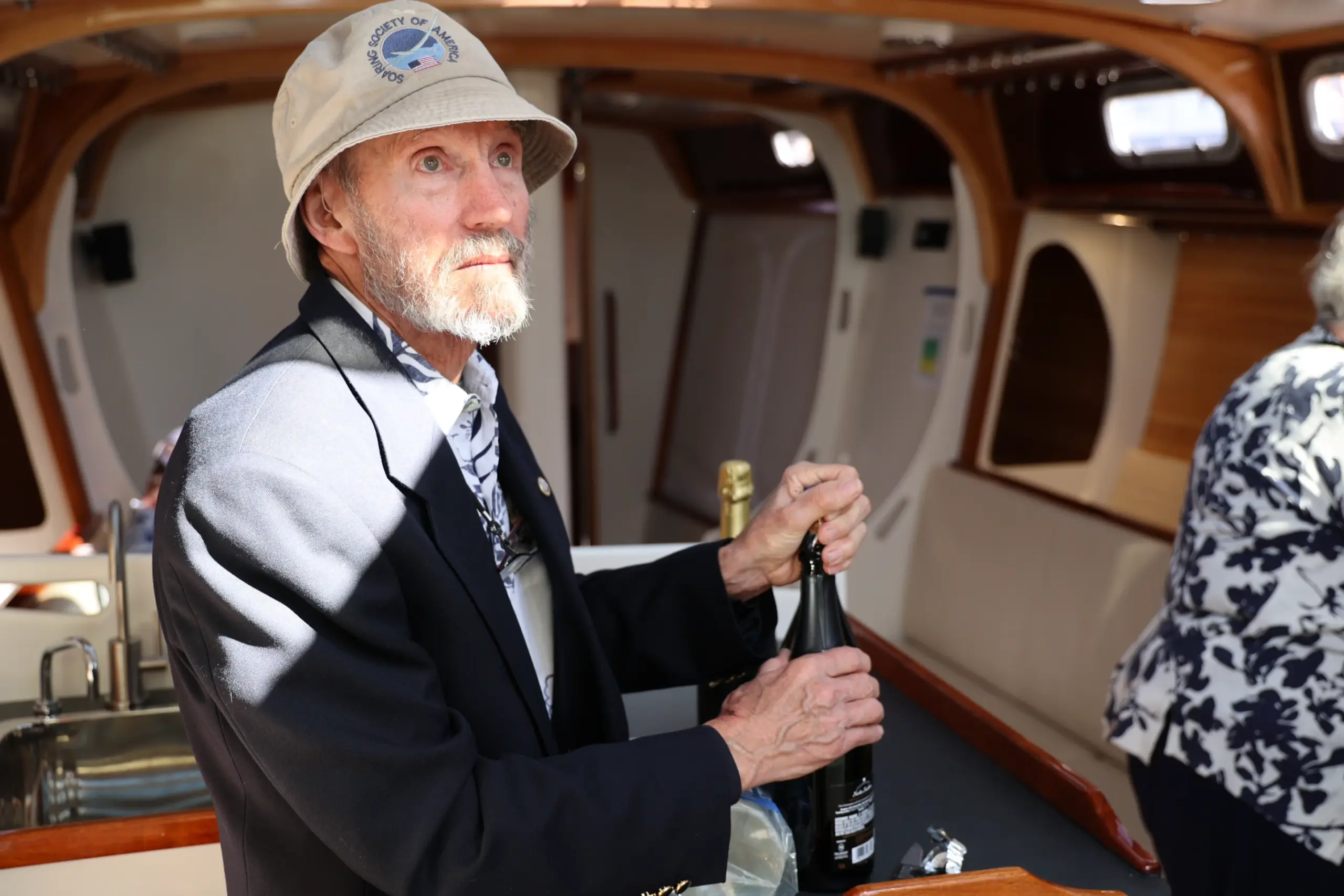
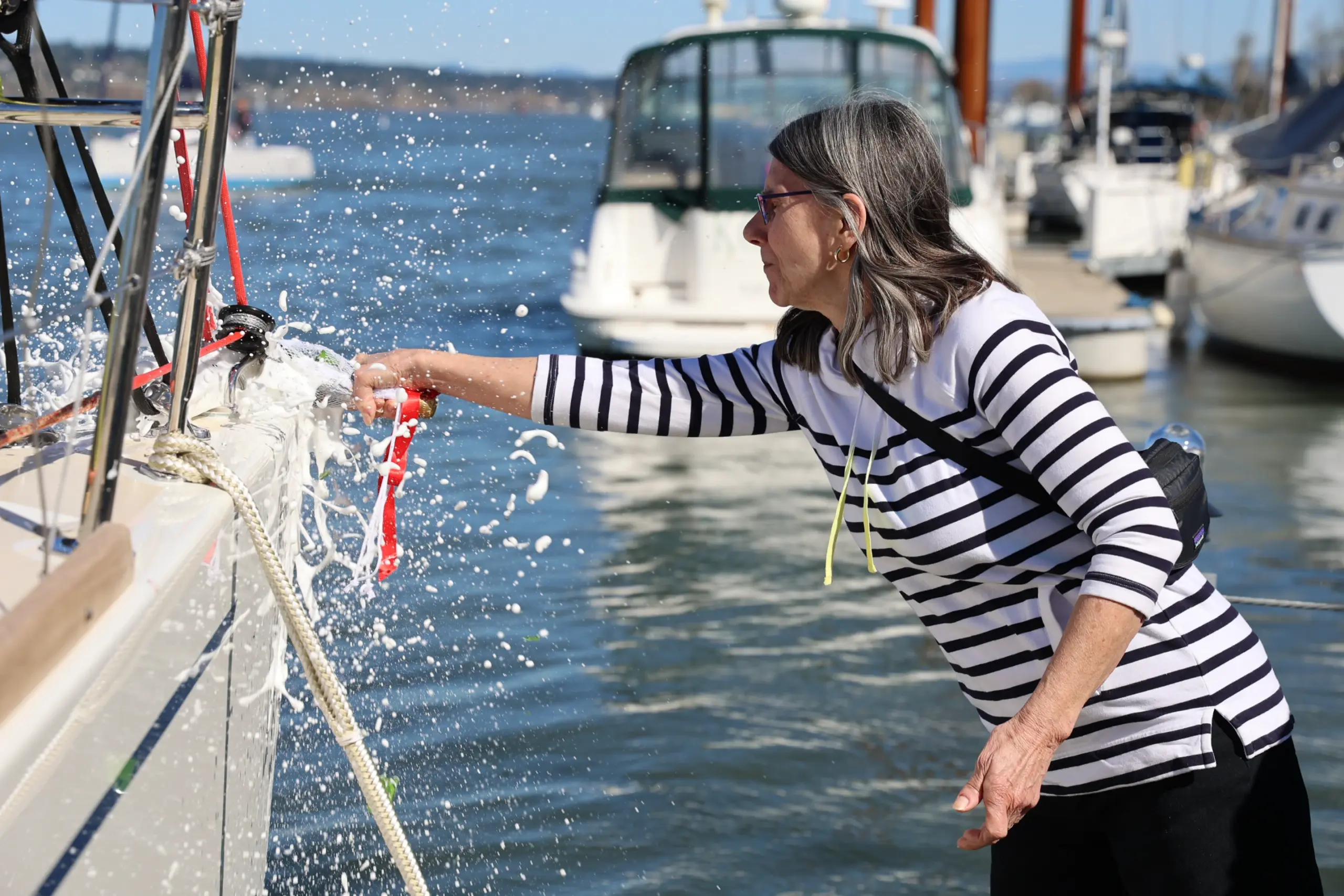
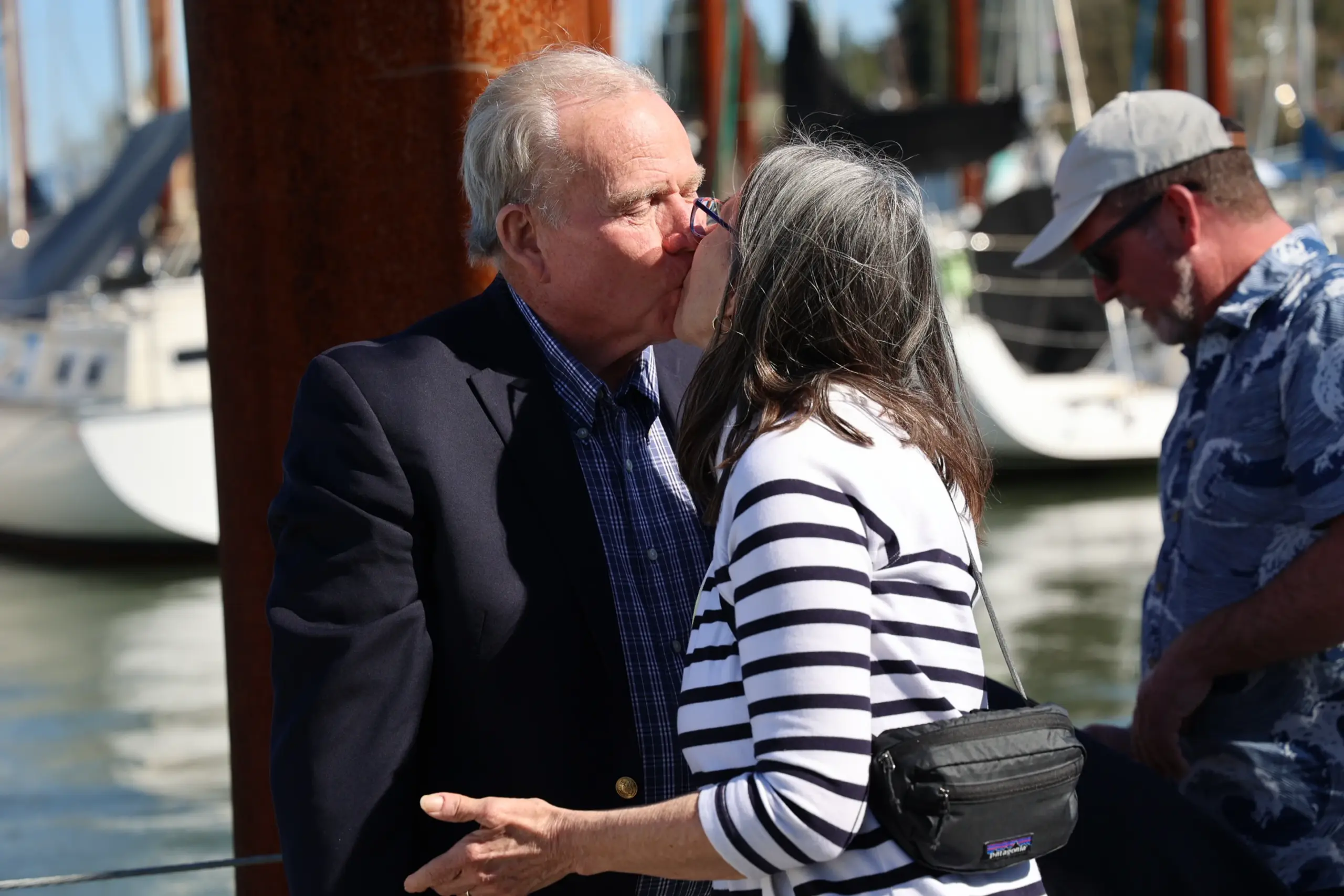
“I christen you, Gem!” Denise proclaims, with a flawless smash of the champagne bottle. Cheers and applause. Kisses. Hugs. Personal heart-to-heart asides. Poured drinks. Gem is soon crawling with swooning admirers. Rander pours endless champagne below in the gorgeous, spacious salon. Let it be known, world, Gem has arrived.
As you read this in the May/June issue of Nautical Northwest, it’s quite possible that Gem is battling her way north as part of the bold 50 of PNW Offshore Race’s 50th. For Gem, the racers, and, perhaps, all of us in our own ways, the same fateful life choice stands: If not now, then never.