In the Pacific Northwest, the start of the sailing season doesn’t ease its way in—it arrives all at once. One weekend, you’re looking at boats on the hard and wondering how long winter will hang on, and the next you’re back on the starting line, cold air in your face, waiting for the gun. The Corinthian Yacht Club (CYC) Center Sound Series has a way of marking that transition better than anything else; three races spread across late February and March that quickly remind you what kind of sailing we have here.
This year’s series unfolded across three race days—Blakely Rock on February 28, Three Tree Point on March 7, and Possession Point on March 21—each one offering a completely different version of Puget Sound.
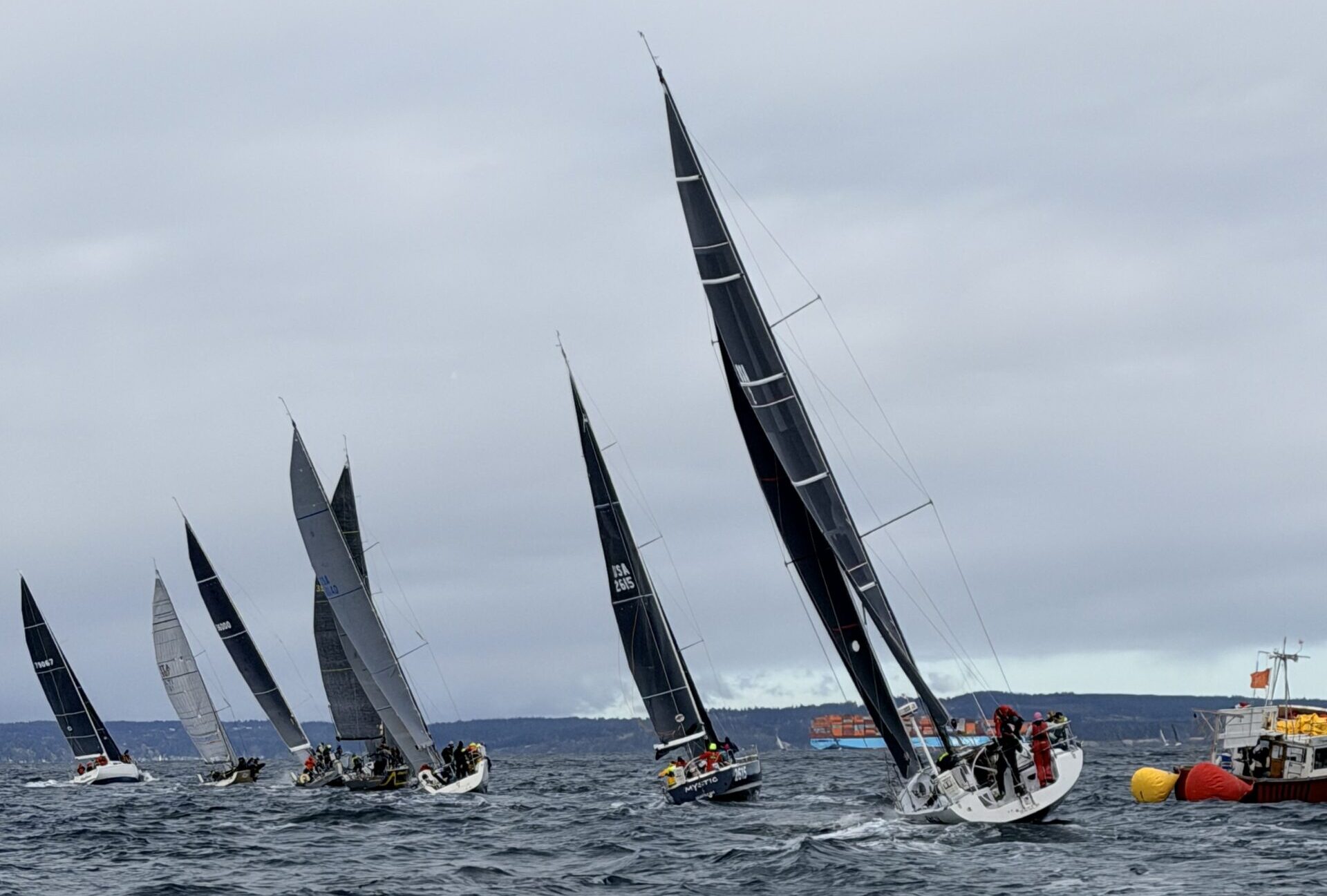
The opener to Blakely Rock wasted no time setting the tone. A northerly breeze filled in across the starting area in the mid-teens and continued to build. With a modified starting sequence sending the faster boats off first, the fleet spread out cleanly from the start. It felt less like easing into the season and more like being dropped straight back into it.
The course itself was simple—upwind to a mark off Edmonds, then a long run south toward Blakely Rock—but the conditions turned it into something more dynamic. On TP52 Smoke, the upwind leg unfolded quickly, with the TP52s converging tightly at the weather mark before setting spinnakers. As the boats turned downwind, the breeze built into the high teens and low twenties, and the race shifted into a fast, pressure-driven run.
Passing West Point, the fleet came alive. Boats stretched out, spray flying, choosing angles toward Bainbridge as the rocks and eventual spinnaker douses came into play. The approach to Blakely Rock compressed things again, particularly through the narrow passage between the rock and Restoration Point, where several boats made big gains by holding kites longer and pushing the limits of a tight rounding. Around the corner, the fleet turned north and back upwind toward the finish off Shilshole. Sunshine, breeze, and boats moving at speed—it was the kind of opening race that resets expectations in a hurry.
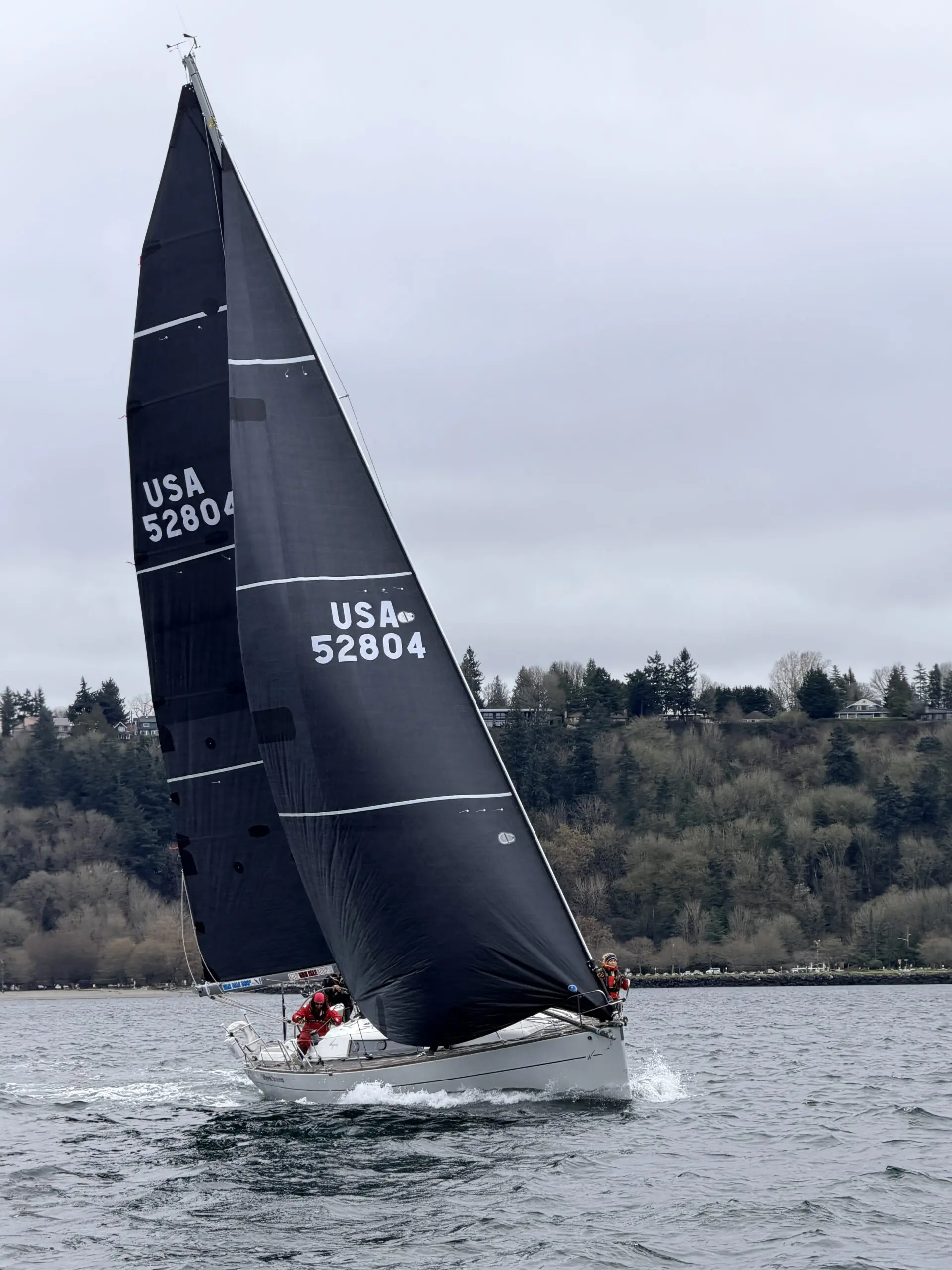
A week later, the shift to Three Tree Point brought a different challenge. The course had been moved up in the series this year, giving it a better chance of delivering stronger conditions. Once again, the breeze showed up, with a steady 15 knots at the start and just enough variability to keep things from settling in.
With the fleet back to a traditional start—slower boats off first—the race had a different feel. The upwind leg was solid—not survival mode like Blakely, but plenty of breeze to keep everyone honest. The current was relatively mild and the water about as flat as you’re going to get in 15 to18 knots, turning it into a sporty-but-fun beat along Alki and West Seattle.
But, as we worked into Three Tree Point, it started to get a little weird. The wind shifted just enough to the west to make you question what you thought was coming. It felt like it wanted to build but never quite committed, despite forecasts hinting at something stronger. The fleet worked its way around the button-hook approach and up went the kites for the run home.
On Smoke, that’s where things opened back up. The breeze filled again—gusting into the low twenties—and the boat finally got to do what it wants to do. Once we were in pressure, it was just about staying in it, working the long, narrow lanes of breeze stretching down the sound. Not as all-out as Blakely, but enough to stretch out and make gains on the way back.
The final race to Possession Point started with more promise. The fleet launched north in solid breeze, with earlier starters taking full advantage. The Olson 29 Sabotage led the way, sailing well and holding a significant lead up the course, nearly to the turning mark before the faster fleets began to close. It had the feel of a proper distance race: boats spread out, lanes established, making steady progress north.
And then, almost without warning, it unraveled.
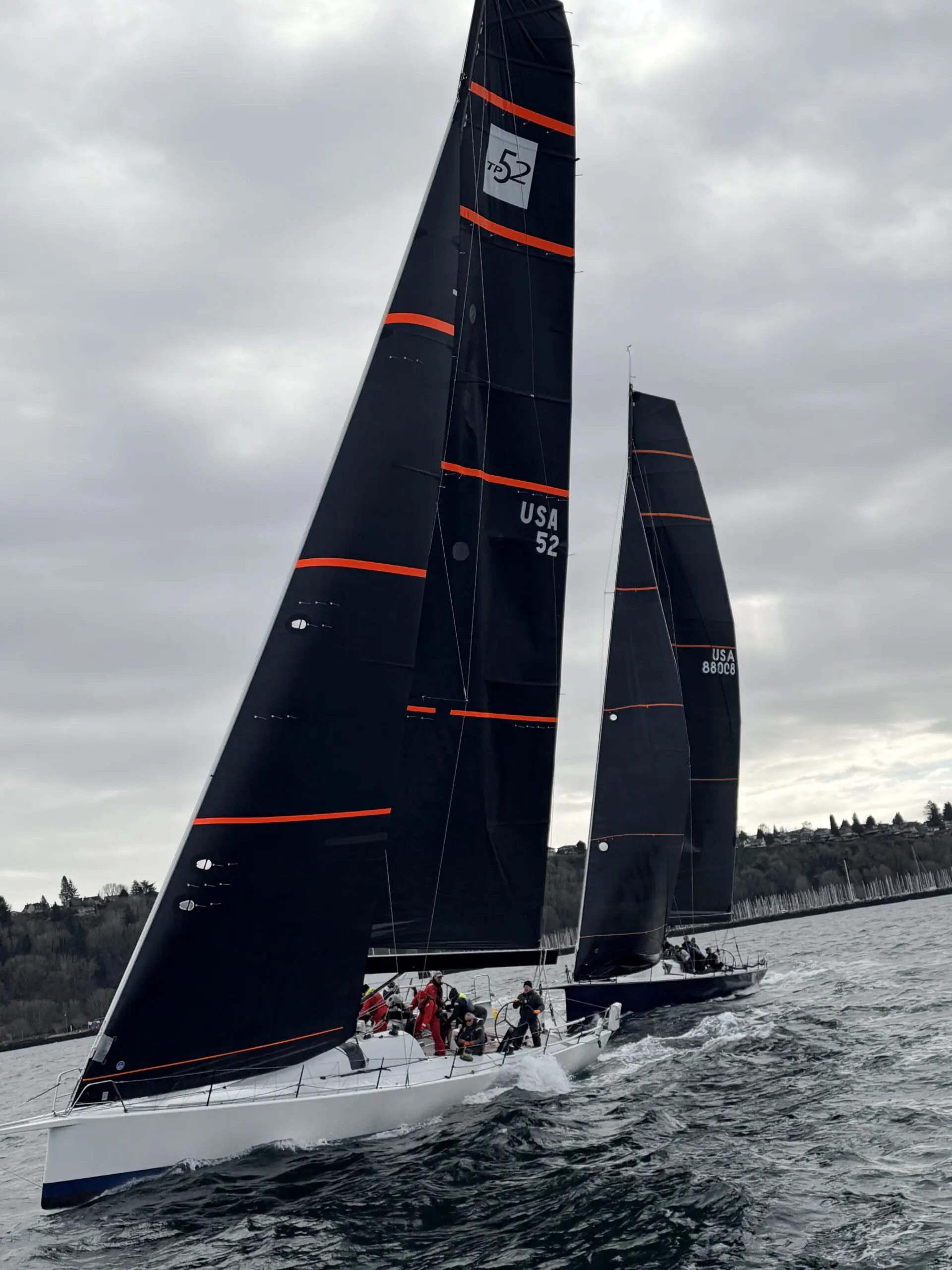
As the fleet approached Possession Point, the wind shut down and the current began to shift. What had been forward progress turned into a slow retreat, with boats stalling and sliding backward as the flood built. For those who had already rounded, it became a push toward the finish. For the rest, it was something closer to survival.
Sails hung limp and the only movement came from the current sliding past the hull. Opportunities disappeared and the race compressed into a frustrating, drawn-out puzzle. It was the kind of moment that defines Puget Sound—not because it’s dramatic, but because it forces patience.
After nearly an hour of drifting, a faint line of pressure began to fill. On Smoke, positioned farther east than much of the fleet, there was just enough opportunity to move first. As the breeze built, the boat edged toward the Edmonds shoreline, finding slightly better pressure and more favorable current. It wasn’t a big move, at first, but it was enough to begin separating—slowly turning a stalled race back into forward motion.
By the time the fleet made its way back to Shilshole, the series had delivered three races that could not have been more different: breeze and speed at Blakely Rock, a more controlled and tactical race at Three Tree Point, and a patient, current-driven grind at Possession Point.
The J/111 Hooligan put together a consistent series to take the overall win, staying in the mix across all three races. We followed on Smoke with a strong showing, including a win at Three Tree Point, offset by a difficult final race in the overall standings, thanks to the light air at Possession. Our rival, TP52 Glory, remained competitive throughout and took home third overall for the series.
That variability is what makes the Center Sound Series what it is. You don’t win it by dominating a single race—you win it by staying in the game when things stop going your way. By the end of the series, the dust is gone, the communication is sharper, and the rhythm of racing has returned.
Because, in the end, sailing isn’t about individual perfect races. It’s about managing imperfect ones just a little better than the boat next to you.