On May 16, 1924, the steam schooner G.C. Lindauer left Reedsport, Oregon, at 1130 hours that Friday morning with a crew of 14, bound for San Francisco. Full below and stacked on deck was 410,000 feet of lumber—what was described as “an unusually large cargo” for her. Pilot AW Reed was at the helm with Captain Hendrickson in command as she cruised the corridor of low hills and evergreens along Umpqua River on her approach to the Pacific Ocean.
It was a clear spring day and, in the distance, Alvarado, a bigger ship with twice as much lumber, had easily steamed over the bar in spite of the strong wind coming out of the northwest. It was between 1300 and 1400 hours and the tide had turned. A big swell was building on the outgoing tide.
From the shore, G.C. Lindauer’s bow appeared to ride a bit deep in the water. When she swerved out of the channel, this, combined with the northwest wind, swung her bow around and drove her into the south spit. Waves rolled over her and dumped four feet of water into her engine room. She began to heel. Captain Hendrickson ordered the deck load of wood cut loose. The cargo tumbled off and she began to right herself.
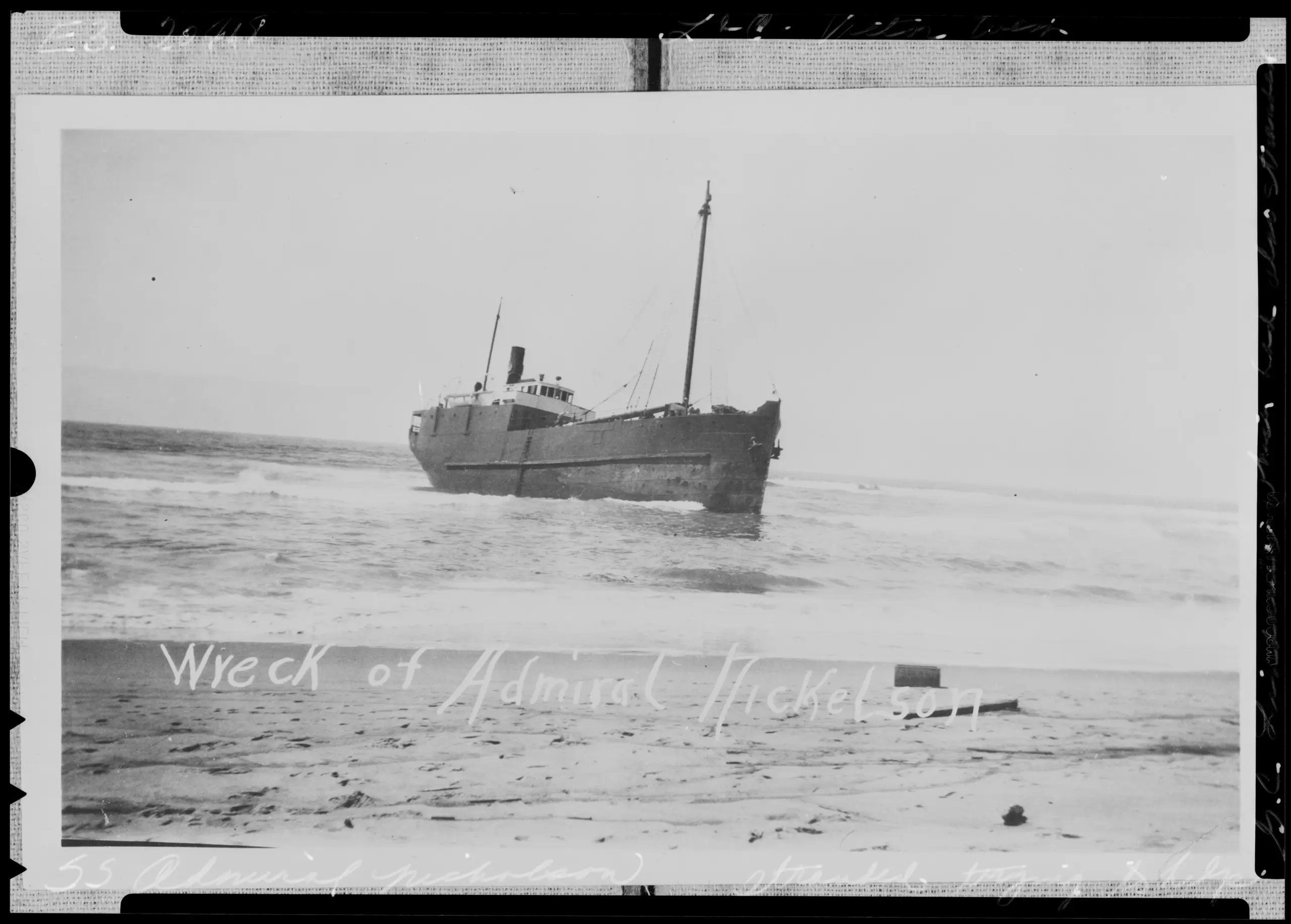
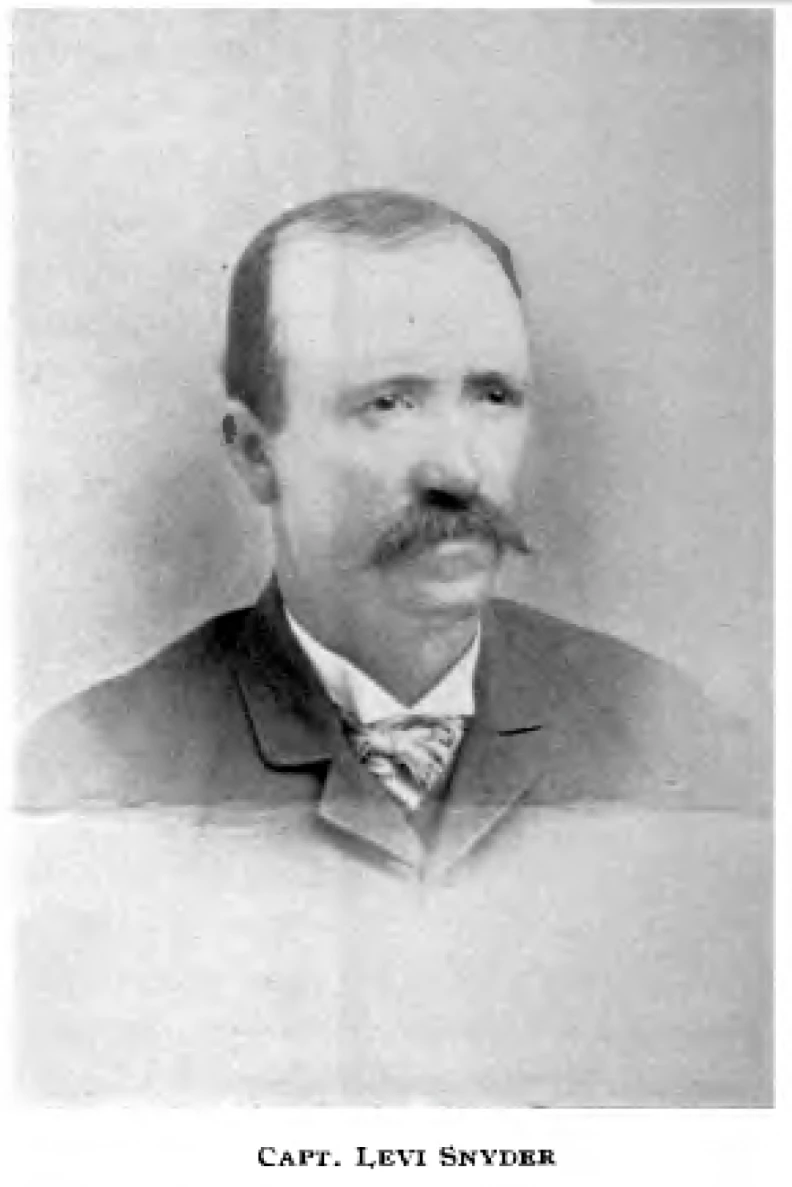
The crew of G.C. Lindauer began their struggle for ship and souls as another craft approached from the south. Admiral Nicholson was a steel ship built in 1909, a bit shorter, but with more volume and crewed with 18. She was lightly loaded with 25 tons of goods for Reedsport with veteran captain Levi Snyder in command. Though born in Pennsylvania in 1859, Levi had been on boats in Oregon since at least the age of 21. He’d plied these waters for 45 years and was a familiar face up and down the Oregon Coast.
He and his crew approached the Umpqua bar at 1430 hours in the afternoon. The tide was driving into the wind-blown breakers pushing steep walls of water at the entrance. As Admiral Nicholson drew close to the bar and the wounded G.C. Lindauer, she slowed and even appeared to reverse. Either she was going to help the stranded vessel or had misjudged the approach. The loss of momentum allowed the 44-knot northwest wind to grab her and carry her south along the flat, sandy beach almost a half mile away.
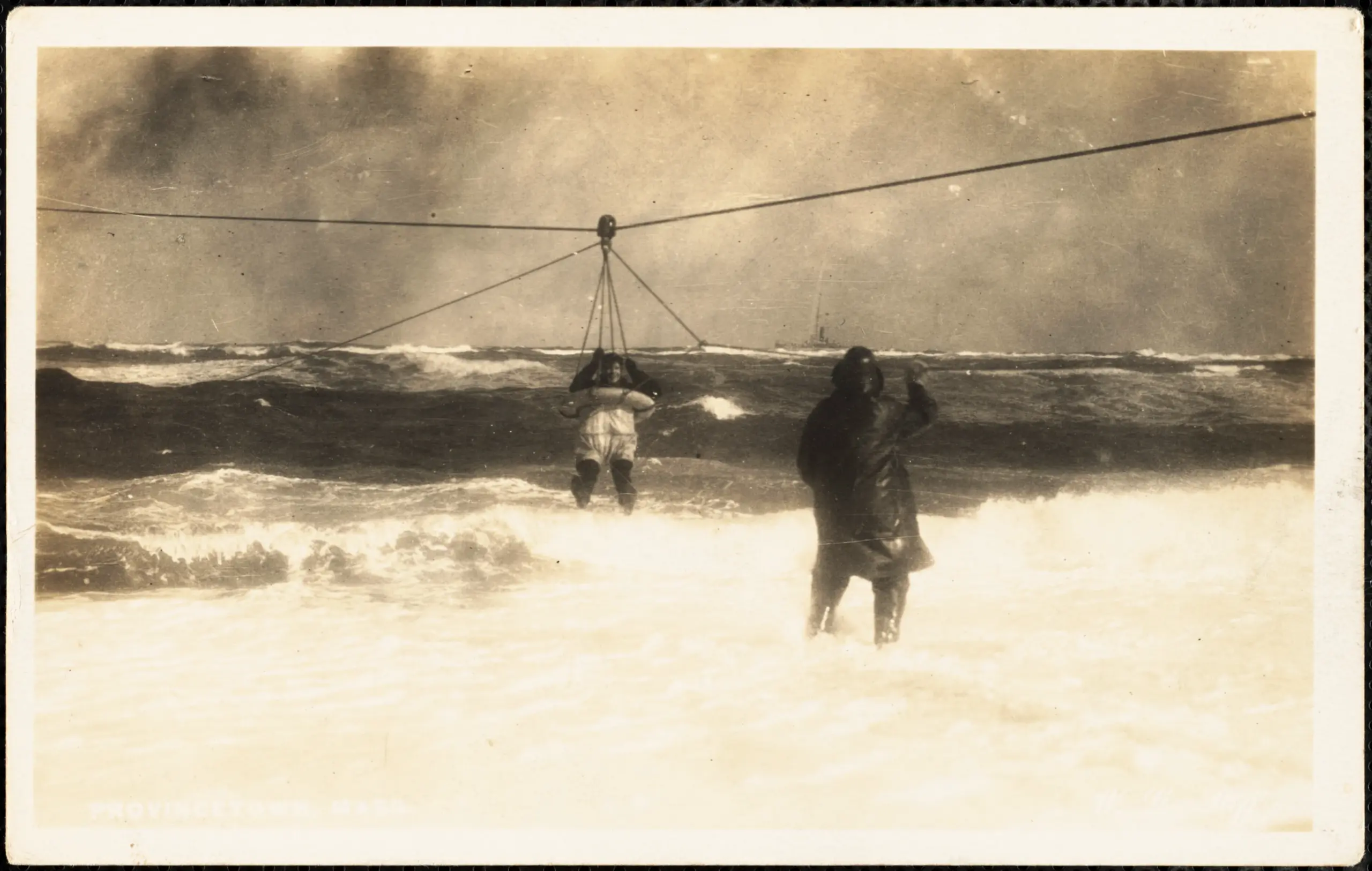
By 1830 hours, the back of G.C. Lindauer had broken. Her deck was below water. Three crew had been taken off by the US Coast Guard (USCG), but the rest had fought all afternoon. Now they made their retreat. The USCG had launched a line to set up the breeches buoy to start the evacuation. The tool was a mixture of a life ring, harness, and zipline, where a line was launched and secured to the ship and back to shore. The crew rode the line to shore one at a time. By 2030 hours, they were done and under a bright, clear moon. The USCG had already repositioned to Admiral Nicholson. Despite a span of 400’, the moonlit rescue of 21 men was over by 2230 hours.
The next day, Saturday, the newspapers called the fight; Admiral Nicholson was lost. Captain Snyder was not so sure. With a skeleton crew, they reboarded the vessel and got her ready for high tide at 2345 hours that night. On Sunday, it was still undecided. The underwriters had arrived from San Francisco and salvage equipment was coming. On Monday, it was decided she leaked too much to be saved. The cargo was discharged at low tide and taken off on horsedrawn wagons.
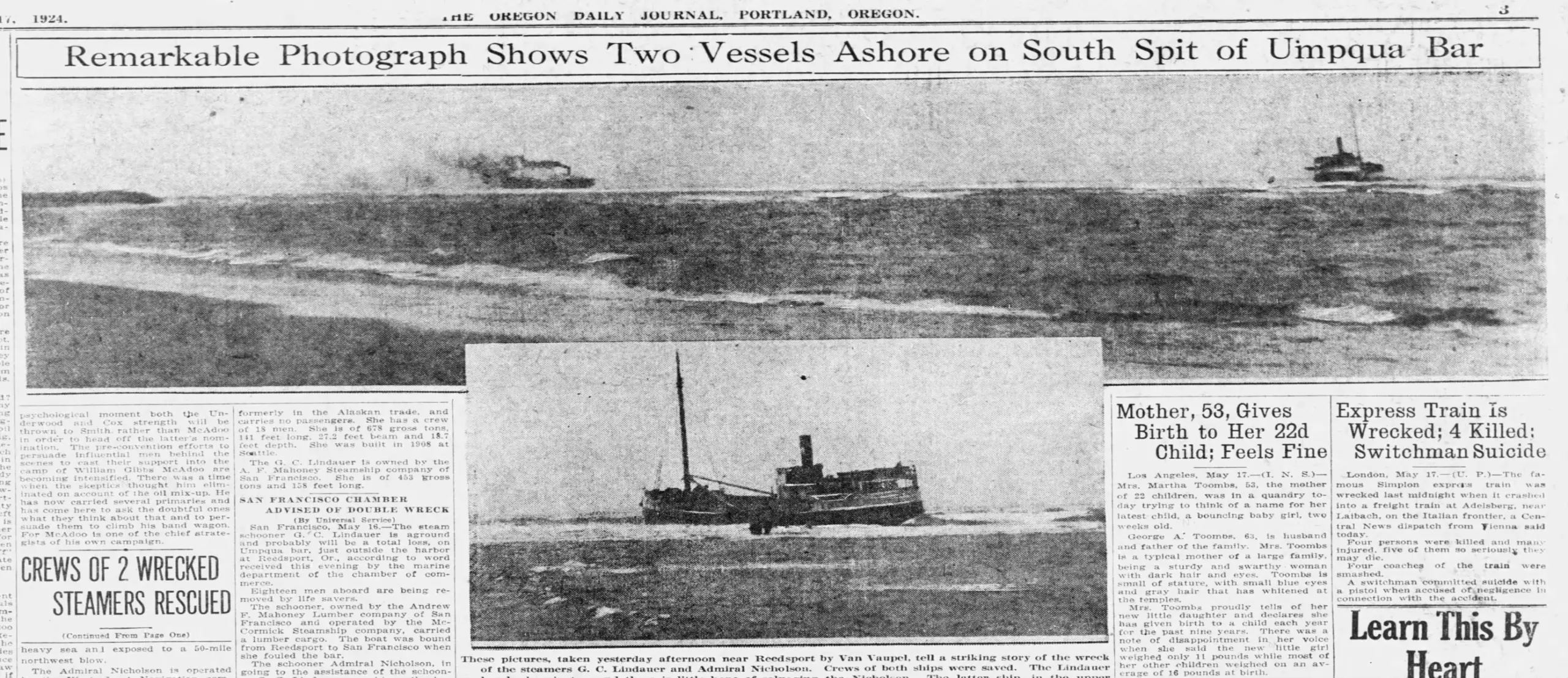
A week later, the insurance was paid out, with a threat that the disaster would double premiums. Two weeks after the incident, the pilot of G.C. Lindauer, AW Reed, was found responsible for negligence. It wasn’t “the fault of the bar” that he missed the channel.
Captain Snyder was also found at fault. His license was suspended for 90 days. His bravery wasn’t questioned, but it was a matter of bureaucracy. He’d failed to report a faulting steering gear that had prompted previous concerns and that “regulations demand(ed) that such matters be reported to the district inspectors.”
By June 18, a month after the disaster, a local man had bought the wreck of the G.C. Lindauer and was building a plank road on the sand to salvage what was left of the ship. The Admiral Nicholson appeared abandoned.
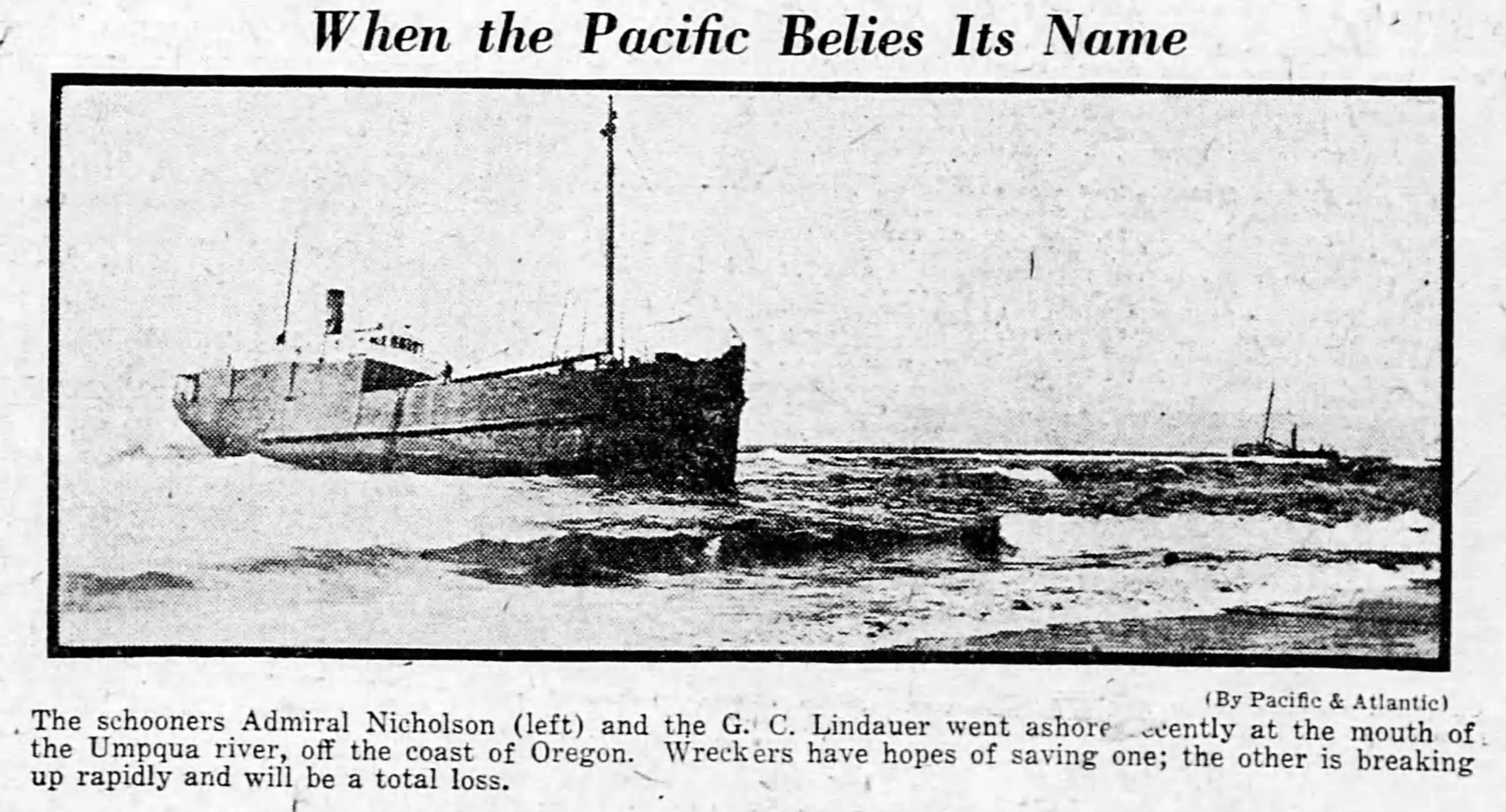
– “When the Pacific Belies its nName” Herald and Review, Decatur, Illinois, June 4, 1924, pg. 16